Address:
Shenzhen Bao'an District Xinqiao Subdistrict Huangpu Community Huangpu East Ring Road No. 504 Shenzhen Yuan Industrial City Building C
Work Hours:
Monday to Friday: 9AM - 21PM
Weekend: 9AM - 21PM

Address:
Shenzhen Bao'an District Xinqiao Subdistrict Huangpu Community Huangpu East Ring Road No. 504 Shenzhen Yuan Industrial City Building C
Work Hours:
Monday to Friday: 9AM - 21PM
Weekend: 9AM - 21PM

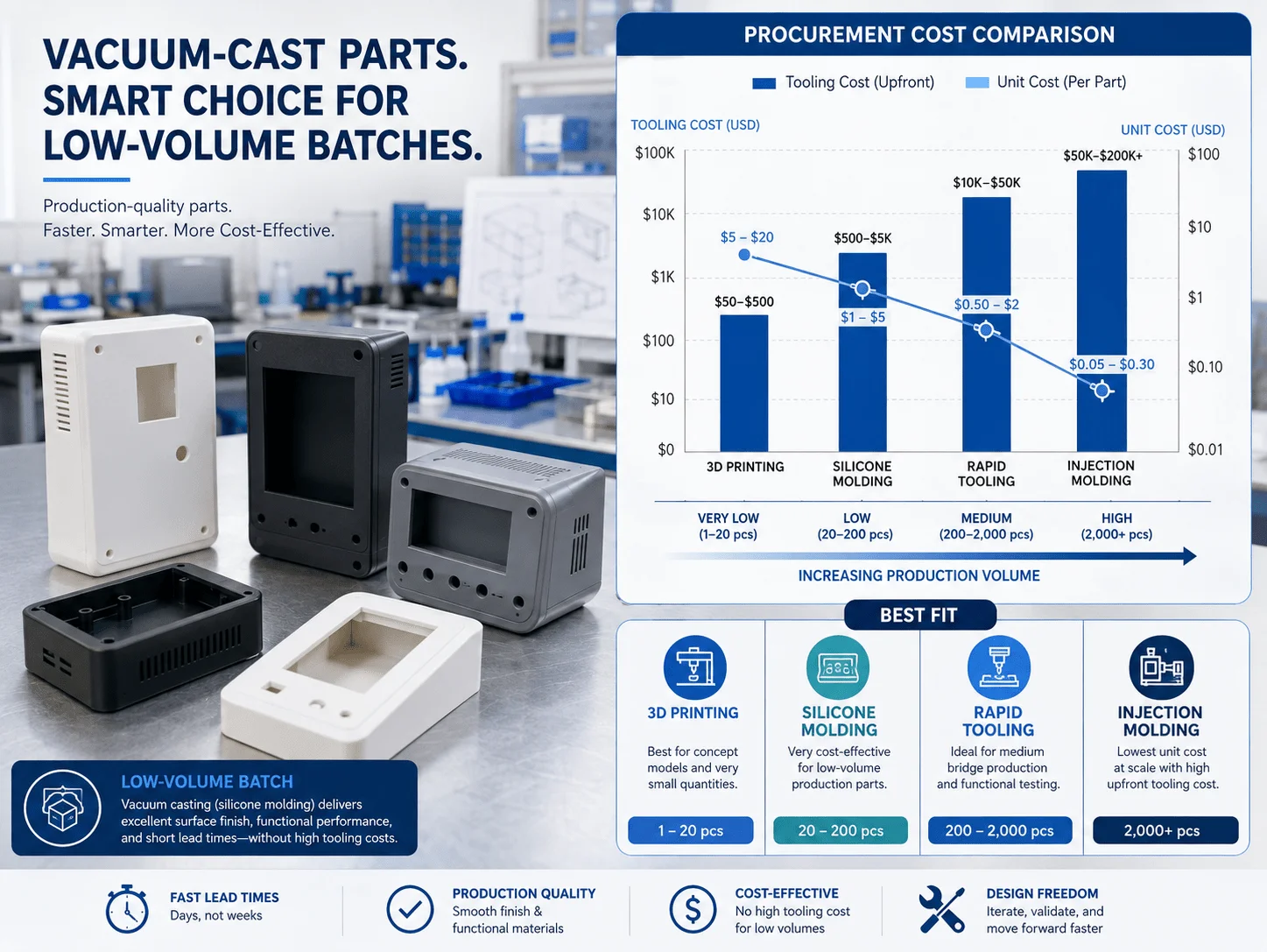
Silicone molding—often called vacuum casting or urethane casting—is one of the most practical bridge-manufacturing methods for teams that need production-like plastic parts before injection molding is financially justified. During new product introduction, 3D printing may not deliver the required surface quality, material behavior, or batch consistency, while hard tooling can be too expensive and inflexible for an evolving design. Silicone molds fill that gap by reproducing a high-quality master pattern in polyurethane resin, usually within days and without the capital commitment of steel tooling.
For Senior Mechanical Engineers, Product Designers, NPI Managers, Founders, and Sourcing Professionals, the value of the process lies in balancing appearance, performance, quantity, lead time, and budget. This guide explains medical material considerations, process selection, surface-quality control, cost drivers, DFM rules, low-volume procurement strategy, and supplier qualification for healthcare, automotive, robotics, consumer electronics, and industrial equipment projects.
How Silicone Molding and Vacuum Casting Work
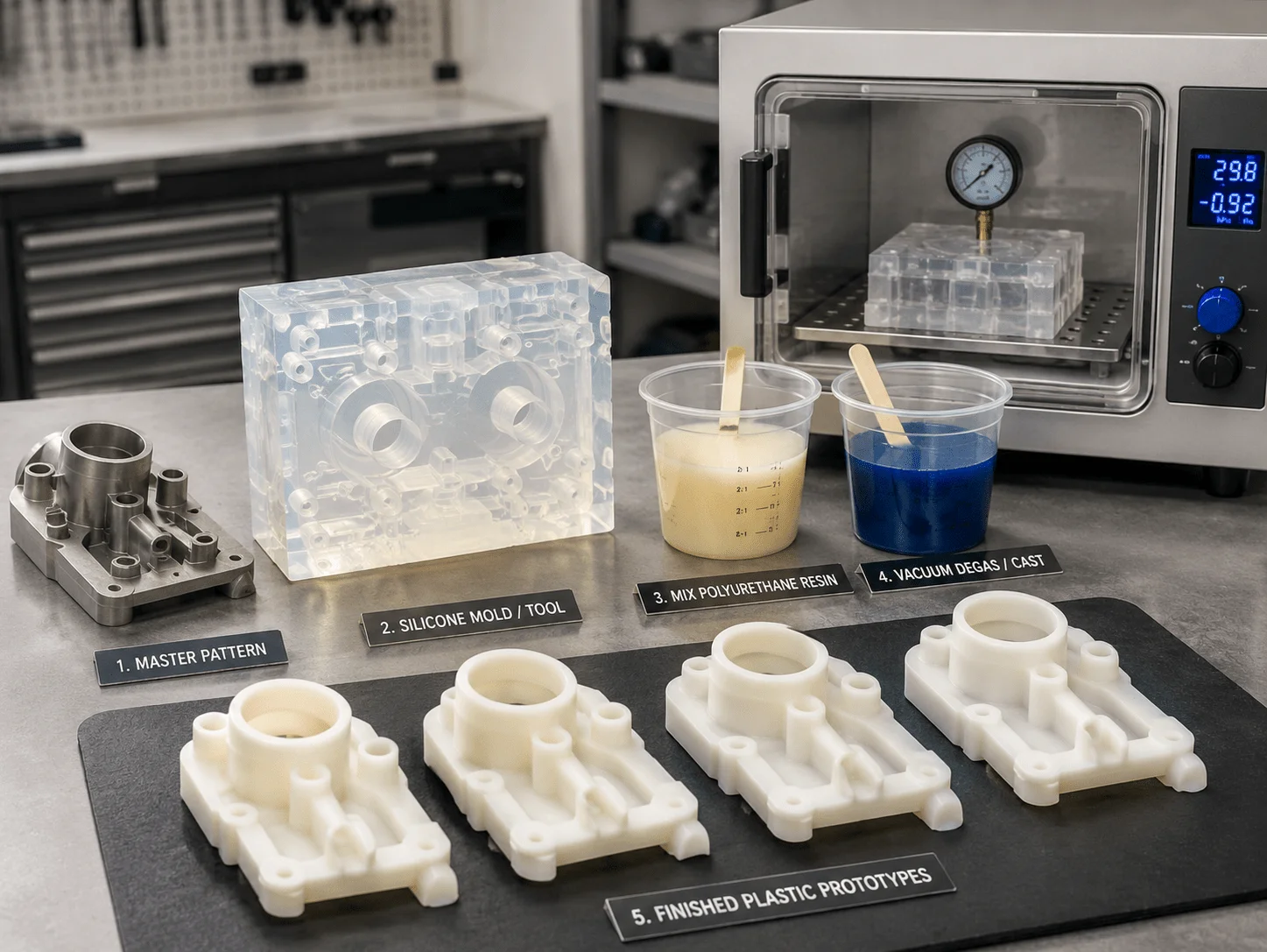
Silicone molding begins with a master pattern that represents the final geometry and surface condition of the required part. The master is commonly produced by SLA 3D printing or CNC machining, then manually finished to the target cosmetic standard.
It is placed inside a mold box, liquid silicone is poured around it, and the silicone is cured. The mold is cut along a planned parting line, the master is removed, and the resulting cavity is used to cast polyurethane resin under vacuum.
The vacuum stage helps remove trapped air and allows resin to fill fine details, narrow ribs, lettering, textures, and cosmetic surfaces. After curing, the part is removed, trimmed, finished, and inspected. A mold can often produce approximately 15–25 castings, although usable mold life varies with part geometry, resin chemistry, wall thickness, texture, and required quality.
A typical workflow includes:
1.CAD and DFM review
2.Master-pattern production
3.Master sanding, polishing, or texturing
4.Silicone mold design and casting
5.Resin selection and color matching
6.Vacuum casting and curing
7.Trimming, secondary finishing, and assembly
8.Dimensional and cosmetic inspection
Silicone molding is especially effective when a team needs several identical or closely related parts with better aesthetics and more production-like material behavior than basic prototype printing can provide.
| Manufacturing Method | Typical Strength | Main Limitation | Best Quantity Range |
| 3D printing | Fastest route to complex one-off parts | Surface and material behavior vary | 1–10 |
| Silicone molding | Production-like appearance without hard tooling | Limited mold life | 10–100 |
| CNC machining | Tight tolerances and real stock materials | Expensive for complex plastic geometry | 1–100 |
| Injection molding | Lowest recurring cost at scale | High tooling investment | 500+ |
Industry Applications & Material Compliance
Medical Innovation: Using biocompatible polyurethane resins for vacuum casting
Using biocompatible polyurethane resins for vacuum casting can help medical-device teams produce functional housings, handles, covers, ergonomic samples, laboratory fixtures, and preclinical evaluation parts without committing to production tooling.
However, “medical grade” must never be treated as a generic marketing label. The exact resin, supplier documentation, test standard, contact type, exposure duration, sterilization method, and manufacturing controls must match the intended use.
For non-patient-contact prototypes, the primary requirements may be stiffness, impact resistance, cleaning resistance, appearance, and assembly performance. For limited skin-contact or evaluation applications, the engineering team may require documented biocompatibility testing under relevant standards.
Sterilization adds another layer of complexity because many casting resins cannot tolerate repeated autoclave cycles, radiation, or aggressive chemicals without discoloration, embrittlement, swelling, or dimensional change.
A medical R&D team should define:
Whether the part contacts skin, tissue, fluids, or no patient at all
Contact duration and frequency
Required biocompatibility documentation
Cleaning and sterilization method
Operating temperature
Chemical exposure
Mechanical load and drop-test requirements
Color, transparency, and cosmetic expectations
Traceability and inspection records
Vacuum casting is valuable for design verification, clinician feedback, user studies, packaging checks, assembly trials, and limited pilot builds. It can provide a closer representation of molded plastics than many basic prototype processes, especially when the supplier uses controlled mixing, degassing, curing, and post-curing.
It is important to distinguish prototype validation from production approval. A resin suitable for short-term evaluation may not automatically be appropriate for a commercial medical device. The final material and production process still require risk assessment, verification, and regulatory review.
Automotive, Robotics, and Industrial Applications
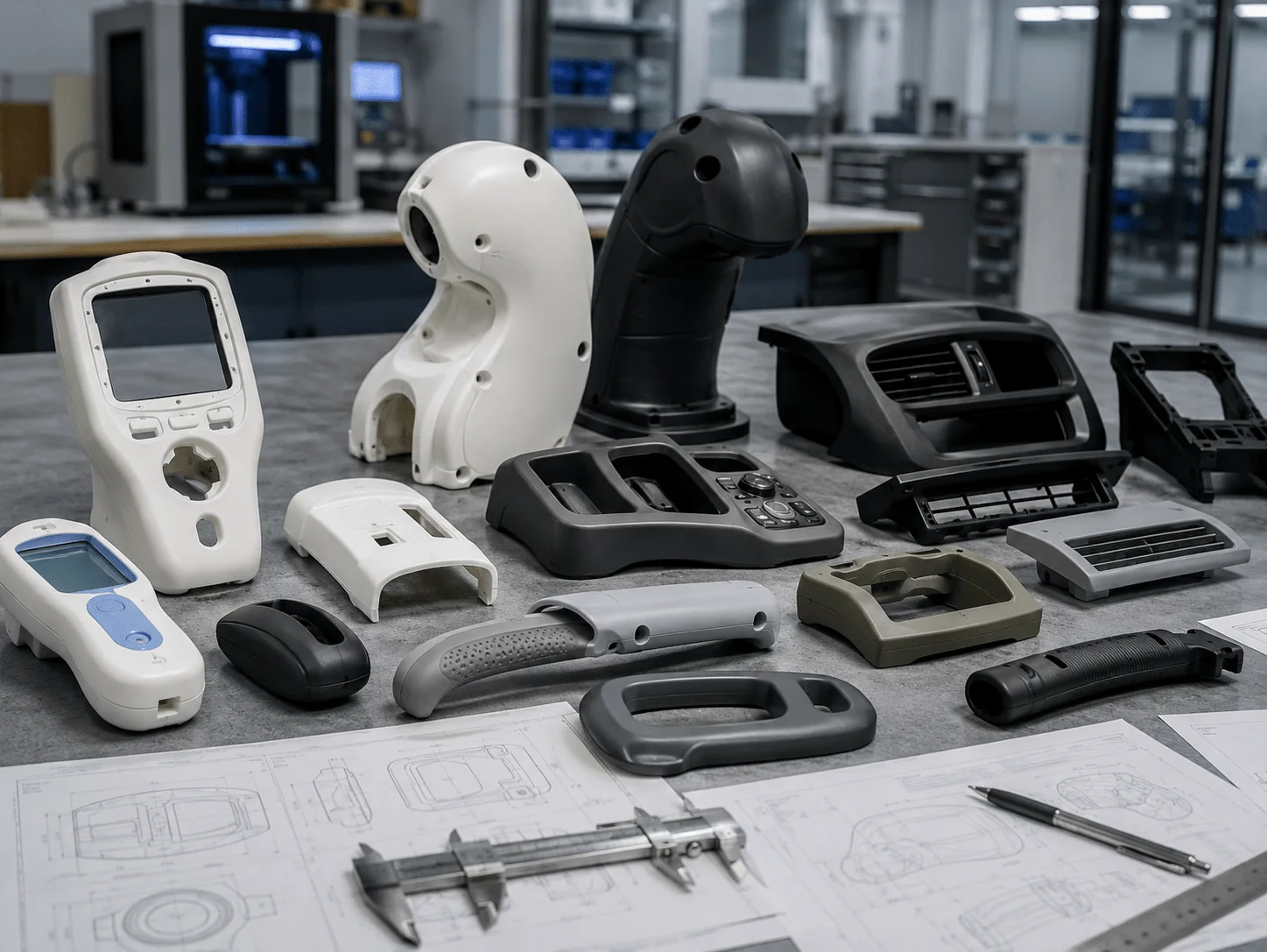
Silicone-molded polyurethane parts are also used for automotive interior samples, sensor housings, robotic covers, control knobs, instrument bezels, protective caps, ducts, handles, and industrial equipment enclosures.
Flexible resins can reproduce seals, boots, grips, and soft-touch components, while rigid resins can simulate ABS-, polycarbonate-, or polypropylene-like behavior.
For robotics and automation, low-volume casting is useful when each machine configuration needs a slightly different protective cover or operator interface. For automotive development, it supports interior appearance reviews, assembly checks, lighting studies, and functional testing before injection tooling is released.
Process Trade-Offs & Surface Quality
Cost Breakdown: silicone molding vs 3d printing cost
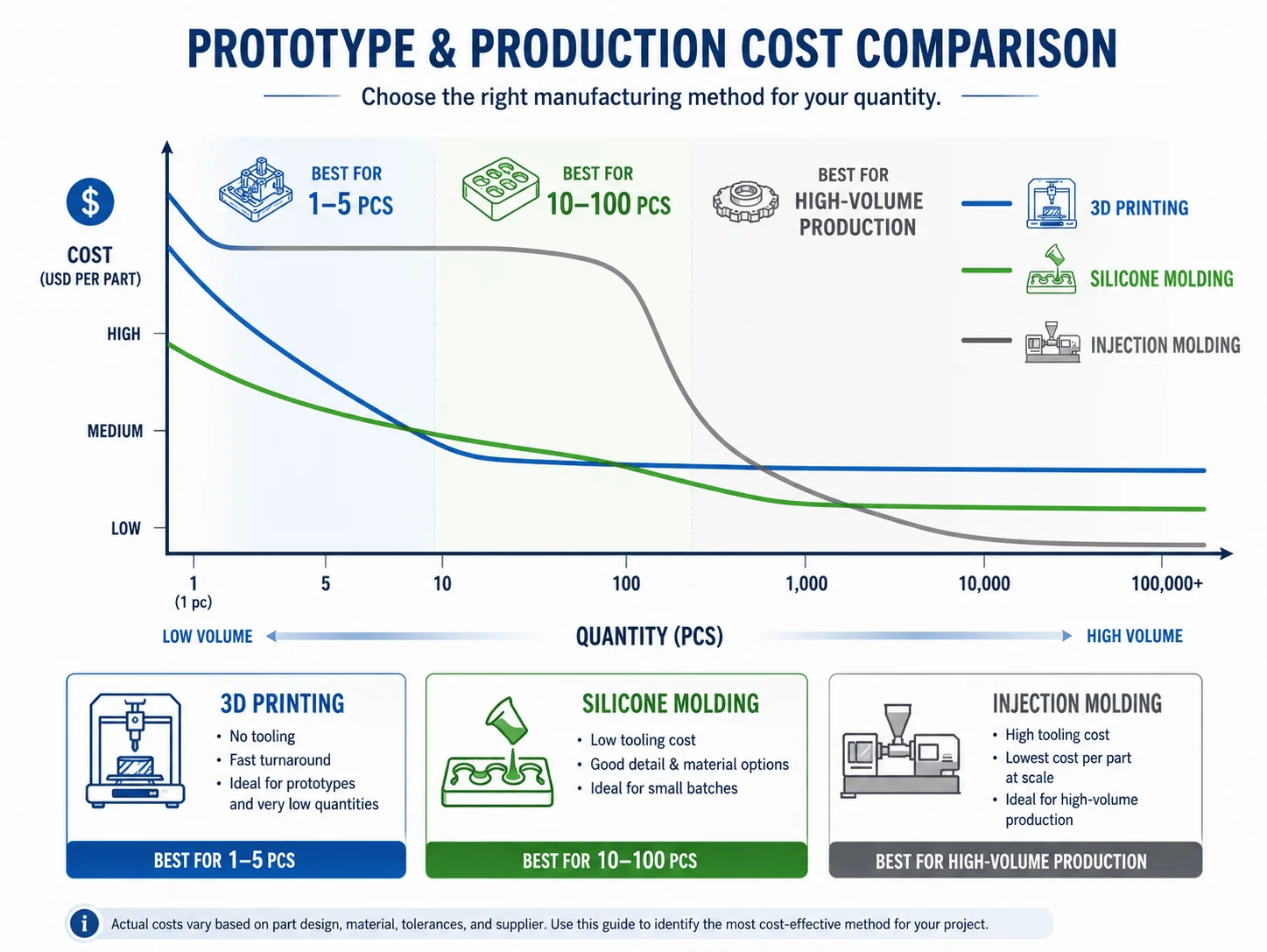
The silicone molding vs 3d printing cost comparison changes as quantity increases. For one to five parts, direct 3D printing is normally the most economical option because no master finishing or mold fabrication is required.
Once the quantity reaches approximately 10–100 pieces, silicone molding often becomes more attractive because the master and mold costs can be distributed across the batch.
The break-even point depends on part size, geometry, finish, material, required inspection, and the selected printing process. A small SLS nylon bracket may remain economical at higher quantities, while a highly cosmetic SLA housing that requires extensive sanding and painting may become expensive after only a few units.
| Cost Factor | 3D Printing | Silicone Molding |
| Initial setup | Low | Moderate master and mold cost |
| Unit cost at 1–5 pieces | Usually lower | Usually higher |
| Unit cost at 10–100 pieces | May remain relatively flat | Often decreases as setup cost is shared |
| Surface consistency | Process-dependent | High when the master is well finished |
| Material simulation | Limited by available print materials | Broad polyurethane property range |
| Color matching | Often requires secondary finishing | Color can be mixed into the resin |
| Design changes | Very easy | A new mold may be required |
| Best value | One-off parts and rapid iteration | Stable low-volume batches |
A realistic cost model should include more than the quoted casting price. The total delivered cost may include master production, master finishing, mold fabrication, resin, casting labor, trimming, painting, insert installation, inspection, packaging, and shipping.
The cost curve usually has three stages:
Concept stage: Direct printing is normally fastest and cheapest.
Validation stage: Silicone molding becomes attractive after geometry stabilizes.
Production stage: Injection molding becomes economical when demand and design stability justify tooling.
Founders and Engineering Managers should avoid moving to silicone molding too early. If the design is still changing daily, paying for a mold can create waste. Conversely, printing 30 cosmetic housings individually may consume more time and budget than producing one polished master and a silicone tool.
Technical Comparison: Silicone Molding, SLA, SLS, and Injection Molding
| Requirement | Silicone Molding | SLA | SLS/MJF | Injection Molding |
| Cosmetic surface | Excellent | Excellent after finishing | Moderate | Excellent |
| Functional material range | Broad polyurethane range | Resin-dependent | Strong nylon options | Broad production plastics |
| Complex internal geometry | Moderate | High | High | Limited by tooling rules |
| Tight repeatability | Good for prototypes | Process-dependent | Good | Excellent |
| Upfront investment | Moderate | Low | Low | High |
| Design flexibility | Medium | High | High | Low after tooling |
| Best use | Low-volume production-like parts | Detailed visual prototypes | Functional nylon parts | High-volume stable production |
Aesthetic Excellence: Achieving Production-Grade vacuum casting surface finish
A production-grade vacuum casting surface finish begins with the master pattern. Silicone reproduces small scratches, layer lines, polishing marks, engraving, texture, and gloss with remarkable fidelity. That makes master preparation one of the most important quality steps in the entire process.
If the master has a mirror-polished surface, the castings can reproduce a high-gloss appearance. If it is bead-blasted or textured, the molded parts can carry a consistent matte finish. Fine leather grains, spark textures, engraved logos, and product graphics can also be transferred when the master and mold are prepared correctly.
Common finish options include:
High-gloss polished surfaces
Fine satin finishes
Matte cosmetic textures
Molded-in color
Transparent or tinted parts
Soft-touch coatings
Painted Class-A surfaces
Printed labels and logos
Metallic or rubber-like appearances
Parting lines, gates, vents, and trim areas must be planned around cosmetic surfaces. A poor parting-line location can create visible witness marks, while an unsuitable gate can affect flow or leave a noticeable trim point.
Industrial Designers should identify Class-A, Class-B, and hidden surfaces on the drawing so the supplier can prioritize appearance where it matters.
Transparent parts require additional discipline. The master must be polished carefully, the mold must be clean, and casting parameters must minimize bubbles, contamination, and flow marks. Even then, optical transparency comparable to production injection molding may require additional polishing or coating.
Color matching should be approved using a physical sample or agreed color reference. Small differences can arise from resin batches, wall thickness, pigment concentration, lighting, and curing conditions.
Design for Manufacturability and Quality Control
Practical DFM Rules for Silicone-Molded Parts
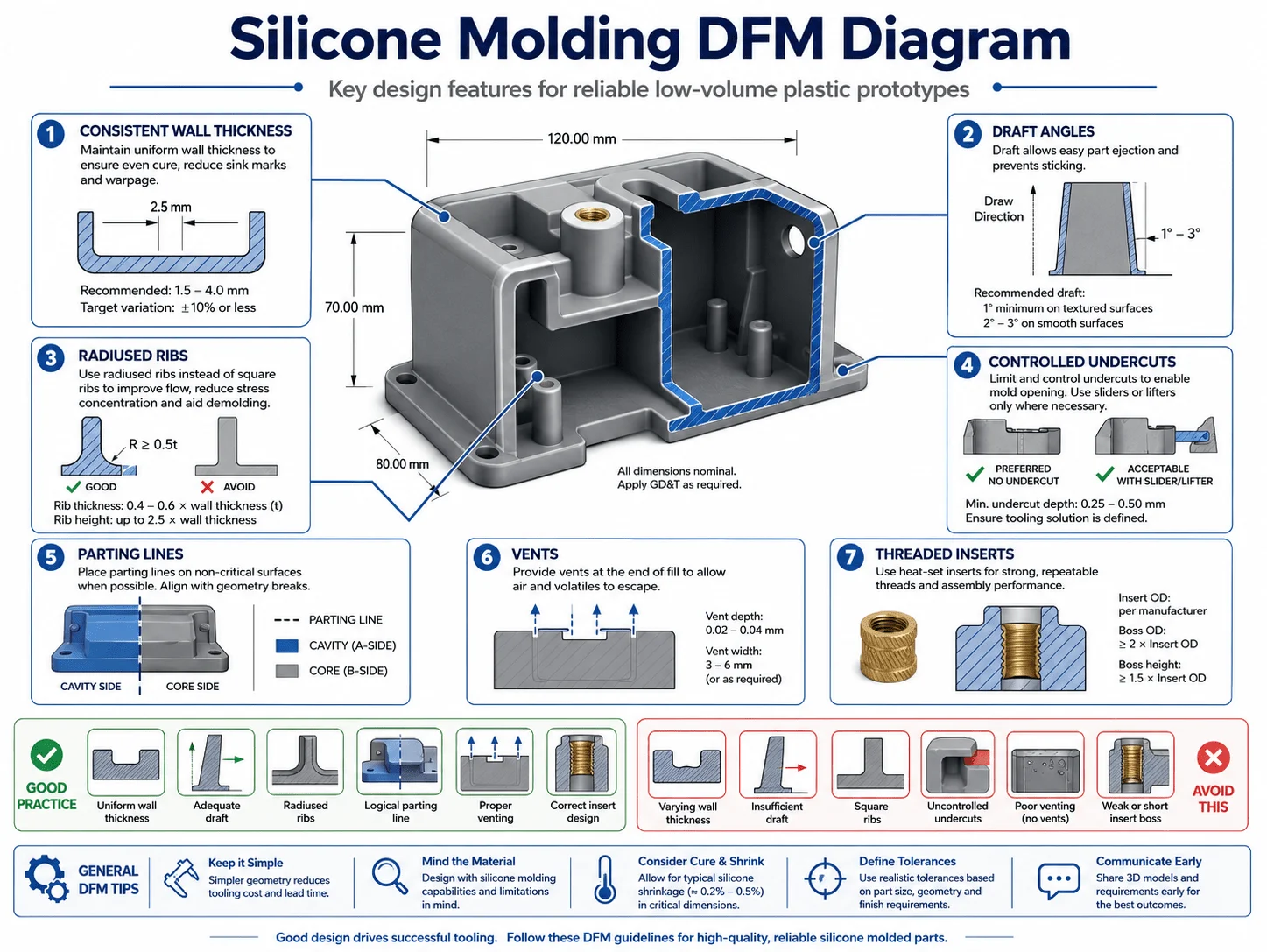
Silicone molds are flexible, but they do not eliminate the need for DFM. Good design reduces air traps, mold tearing, shrinkage, deformation, and manual finishing.
Maintain Practical Wall Thickness
Extremely thin walls may not fill consistently and can deform during demolding. Very thick sections may cure unevenly, increase material consumption, and create shrinkage.
Consistent wall thickness generally improves filling, curing, dimensional stability, and appearance.
Add Draft Where Possible
Silicone can flex around undercuts more than a steel mold, but draft still makes demolding easier and reduces stress on both the casting and the mold.
Deep textured walls benefit especially from additional draft because the microscopic texture increases resistance during part removal.
Control Deep Ribs and Narrow Gaps
Tall, thin ribs can trap air, distort, or tear the silicone mold. Increasing rib thickness, adding radii, reducing rib height, or dividing the design into assembled parts may improve reliability.
Use Realistic Tolerances
Vacuum casting is a prototype and low-volume process, not precision CNC machining. Overall dimensional behavior is influenced by master accuracy, silicone shrinkage, resin shrinkage, curing, geometry, and post-processing.
Critical fits may require drilling, reaming, machining, or insert installation after casting.
Plan Inserts and Hardware
Threaded inserts, metal bushings, magnets, pins, and other components can be cast in or installed afterward. The supplier needs clear drawings, orientation, retention details, and pull-out requirements.
Define Parting Lines and Cosmetic Zones
Parting lines should avoid critical visual surfaces, sealing areas, and precision interfaces where possible. Engineers should identify acceptable witness marks, gate positions, and trim locations before the mold is manufactured.
Quality Risks and Preventive Controls
Common defects include bubbles, incomplete filling, sink, warpage, visible parting lines, color variation, surface contamination, and dimensional drift. These problems can often be reduced through stable process parameters and a clear inspection plan.
| Risk | Likely Cause | Preventive Action |
| Air bubbles | Inadequate degassing or poor venting | Vacuum control and improved vent design |
| Short fill | Narrow flow path or insufficient resin flow | Gate and vent optimization |
| Warpage | Uneven wall thickness or curing | Balanced geometry and controlled curing |
| Surface defects | Poor master or contaminated mold | Master inspection and mold cleaning |
| Color variation | Inconsistent pigment ratio | Controlled mixing and batch records |
| Dimensional variation | Shrinkage and flexible tooling | Practical tolerances and first-article approval |
| Torn mold | Aggressive undercuts or thin silicone sections | Split mold, more draft, or revised geometry |
A first-article sample should be approved before the full batch is cast. The review should cover fit, dimensions, color, gloss, texture, parting-line visibility, insert position, and any critical functional test.
For repeat orders, the buyer should understand whether a new mold will be required. A worn silicone tool may gradually lose edge definition, surface quality, or dimensional consistency. The supplier should track mold cycles and replace the tool before quality falls below the agreed standard.
Procurement Strategy & Scaling
Financial Edge: silicone molding for low volume plastic parts
Using silicone molding for low volume plastic parts allows Procurement Managers and Strategic Buyers to reduce upfront investment during NPI, pilot production, market testing, and bridge manufacturing.
Instead of funding an aluminum or steel injection mold before demand is proven, the team can order a smaller batch and preserve cash for product development, certification, sales, and supply-chain preparation.
The method is especially valuable when:
Quantity is below approximately 100 parts
The design is stable enough for a mold but not final enough for hard tooling
Several color or material variants are required
Cosmetic presentation is important
Functional polyurethane behavior is acceptable
Market demand remains uncertain
Lead time is more important than the lowest possible unit price
A procurement decision should compare total cost at several quantities rather than evaluating a single unit price.
| Quantity | Recommended Strategy | Financial Logic |
| 1–5 | 3D printing or CNC machining | Avoid mold setup |
| 6–10 | Compare direct printing with one silicone mold | Depends on finish and geometry |
| 10–30 | Silicone molding often becomes attractive | Mold cost begins to spread |
| 30–100 | Strong range for vacuum casting | Lower average cost and consistent finish |
| 100–500 | Compare multiple silicone molds with rapid tooling | Demand and design stability matter |
| 500+ | Injection molding often becomes stronger | Tooling can be amortized |
Understanding the Cost Structure
Silicone molding quotations commonly contain the following elements:
DFM and mold planning
Master-pattern manufacturing
Master finishing
Silicone mold production
Polyurethane resin
Casting labor
Mold-cycle allowance
Trimming and cleaning
Painting, polishing, or coating
Inserts and assembly
Inspection
Packaging
The most effective cost-reduction actions are usually design-related:
1.Stabilize the CAD before mold production.
2.Use one master for several related variants where practical.
3.Reduce unnecessary wall thickness and resin volume.
4.Simplify deep undercuts and fragile ribs.
5.Limit premium finishing to visible surfaces.
6.Standardize colors, inserts, and hardware.
7.Combine approved quantities into one batch.
8.Provide complete drawings and acceptance criteria.
For example, a cosmetic electronics enclosure with several painted colors may be less expensive when the base resin is cast in a neutral color and only visible panels are painted. A hidden internal bracket may not require the same finishing standard as the exterior housing.
When to Move from Silicone Molding to Rapid Tooling
Silicone molding is not always the lowest-cost option indefinitely. When demand increases, recurring labor and limited mold life can make rapid injection tooling more economical.
The transition point depends on:
Annual quantity
Part size and complexity
Resin requirements
Tolerance and repeatability
Surface-quality expectations
Assembly needs
Expected design life
Tooling budget
Lead-time requirements
A stable product with recurring demand of several hundred or several thousand parts should be evaluated for aluminum or steel tooling. A product with uncertain demand, frequent revisions, or multiple customized variants may remain better suited to silicone molding for longer.
Application Scenarios
Medical Diagnostic Housing
A medical startup needs 25 housings for assembly trials and clinician feedback. The parts require molded-in color, threaded inserts, smooth cleanable surfaces, and resistance to common cleaning agents.
Vacuum casting supplies a consistent pilot batch while final injection-mold details remain under review.
Consumer Electronics Pilot Batch
A hardware company needs 50 premium enclosures for investor demonstrations and controlled field testing. A polished SLA master defines the gloss and texture, while separate molds produce the main housing, buttons, and transparent light pipe.
Robotic Protective Cover
A robotics manufacturer requires several cover variants for different sensor packages. Silicone tools avoid dedicated production molds for each configuration and allow brass inserts to be incorporated for reliable assembly.
Automotive Interior Evaluation
An automotive design team uses vacuum-cast bezels, knobs, and trim parts to assess color, texture, ergonomics, fit, and lighting before releasing production tooling.
Industrial Soft-Touch Handle
An equipment manufacturer needs 80 handles with a rigid core and flexible grip. A two-stage casting strategy provides realistic functional samples for pilot machines and user testing.
Aerospace and Laboratory Components
Aerospace and laboratory teams may use vacuum casting for ducts, protective covers, instrument housings, and non-flight evaluation parts. Requirements should clearly distinguish test hardware from production-certified components.
Selecting a Silicone Molding Supplier
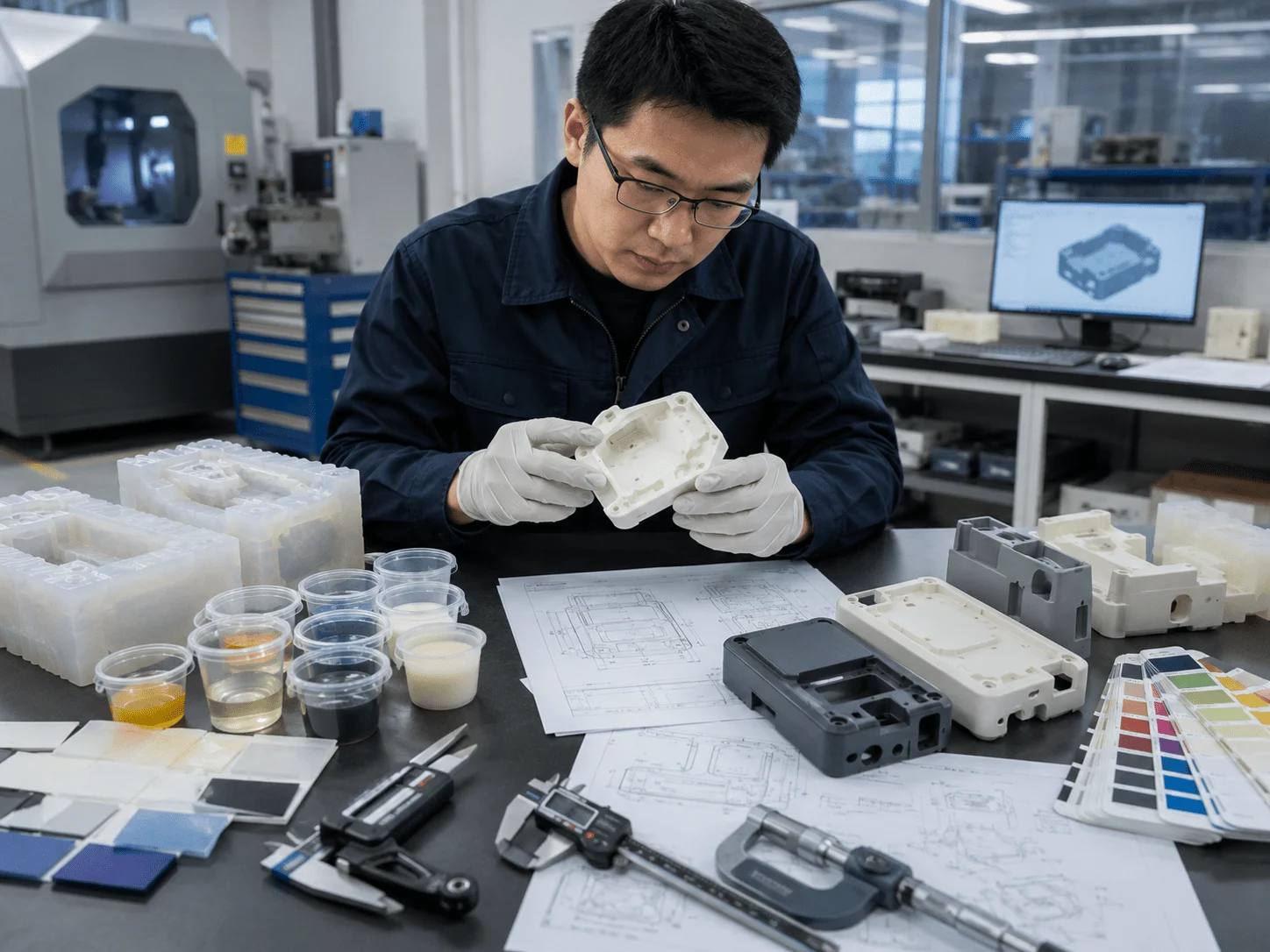
A capable supplier should manage master preparation, mold design, resin selection, color matching, inserts, finishing, inspection, and revision control.
The RFQ should include STEP files, dimensioned drawings, quantity, intended use, target material behavior, color, gloss, texture, critical dimensions, insert requirements, cosmetic zones, and delivery targets.
Evaluate whether the supplier offers:
SLA and CNC master patterns
Rigid and flexible polyurethane systems
Transparent casting
Color matching
Insert molding
Painting, polishing, and printing
First-article approval
Mold-cycle tracking
Dimensional inspection
Repeat low-volume production
Secure revision management
The supplier should identify expected tolerances, parting lines, gate positions, mold life, finishing assumptions, and material limitations before manufacturing begins.
Frequently Asked Questions
What is silicone molding?
Silicone molding is a low-volume manufacturing process in which a flexible silicone tool is created from a master pattern and used to cast polyurethane parts under vacuum.
How many parts can one silicone mold produce?
Approximately 15–25 castings are common, although geometry, undercuts, resin chemistry, texture, and quality requirements affect actual mold life.
Is silicone molding the same as vacuum casting?
The terms are often used together. Silicone molding refers to the flexible tool, while vacuum casting refers to casting resin under vacuum to reduce trapped air and reproduce fine details.
When is silicone molding cheaper than 3D printing?
It often becomes financially attractive at roughly 10–100 stable parts, especially when consistent cosmetics and production-like material behavior are required.
Can silicone molding produce transparent parts?
Yes, but clarity depends on master polishing, mold cleanliness, resin quality, degassing, process control, and post-processing.
Can threaded inserts be included?
Yes. Inserts, bushings, magnets, pins, and other hardware can be cast in or installed afterward when the retention method is properly defined.
What tolerances are realistic?
Accuracy depends on master quality, silicone and resin shrinkage, geometry, curing conditions, and part size. Precision fits may require secondary drilling, reaming, or CNC machining.
Are vacuum-cast resins suitable for medical use?
Some polyurethane systems provide documented biocompatibility for defined applications. The exact resin, contact condition, sterilization method, and compliance evidence must be reviewed.
How long does a silicone molding project take?
Lead time varies with master production, finishing, mold complexity, quantity, and secondary processes. Many projects can be completed in several working days to a few weeks.
When should the project move to injection molding?
Injection molding should be evaluated when the design is stable, demand is recurring, and tooling can be amortized across a larger production quantity.
Silicone molding bridges one-off prototypes and production tooling by providing repeatable, high-quality plastic parts with lower upfront investment. Its strongest business case appears when geometry is stable, quantities remain limited, and appearance or polyurethane material behavior matters more than achieving the absolute lowest mass-production unit price.
Good results depend on realistic tolerances, carefully prepared masters, practical wall thickness, controlled undercuts, planned parting lines, approved materials, and a supplier capable of maintaining cosmetic and dimensional consistency throughout the batch.
Scaling from a single functional design to a pre-production run should not deplete your R&D budget. Whether you are a Senior Mechanical Engineer developing healthcare enclosures or a Sourcing Manager seeking low-volume plastic alternatives, GC Prototype provides master-pattern production, silicone tooling, vacuum casting, color matching, surface finishing, insert installation, and dimensional inspection.