Address:
Shenzhen Bao'an District Xinqiao Subdistrict Huangpu Community Huangpu East Ring Road No. 504 Shenzhen Yuan Industrial City Building C
Work Hours:
Monday to Friday: 9AM - 21PM
Weekend: 9AM - 21PM

Address:
Shenzhen Bao'an District Xinqiao Subdistrict Huangpu Community Huangpu East Ring Road No. 504 Shenzhen Yuan Industrial City Building C
Work Hours:
Monday to Friday: 9AM - 21PM
Weekend: 9AM - 21PM

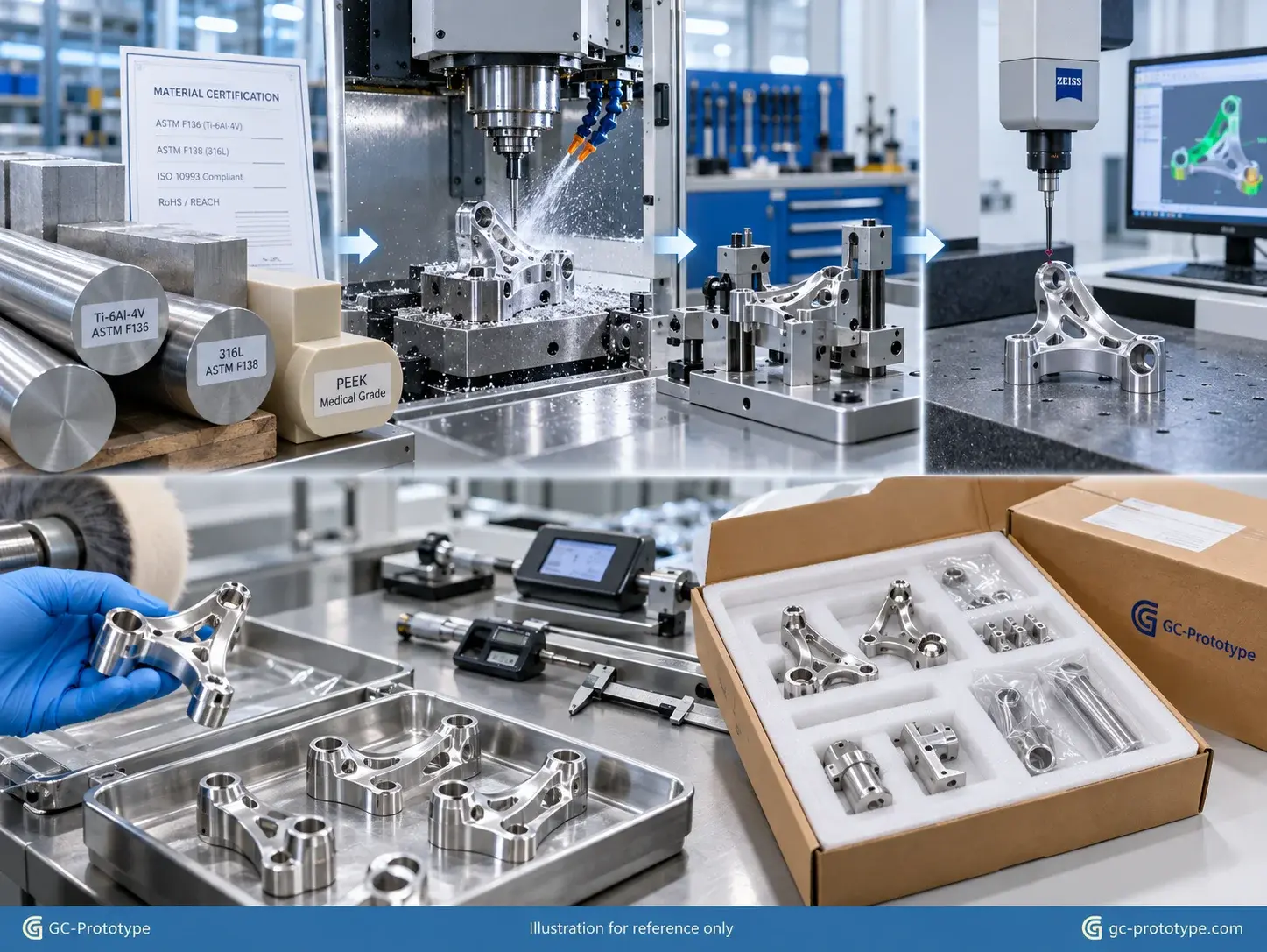
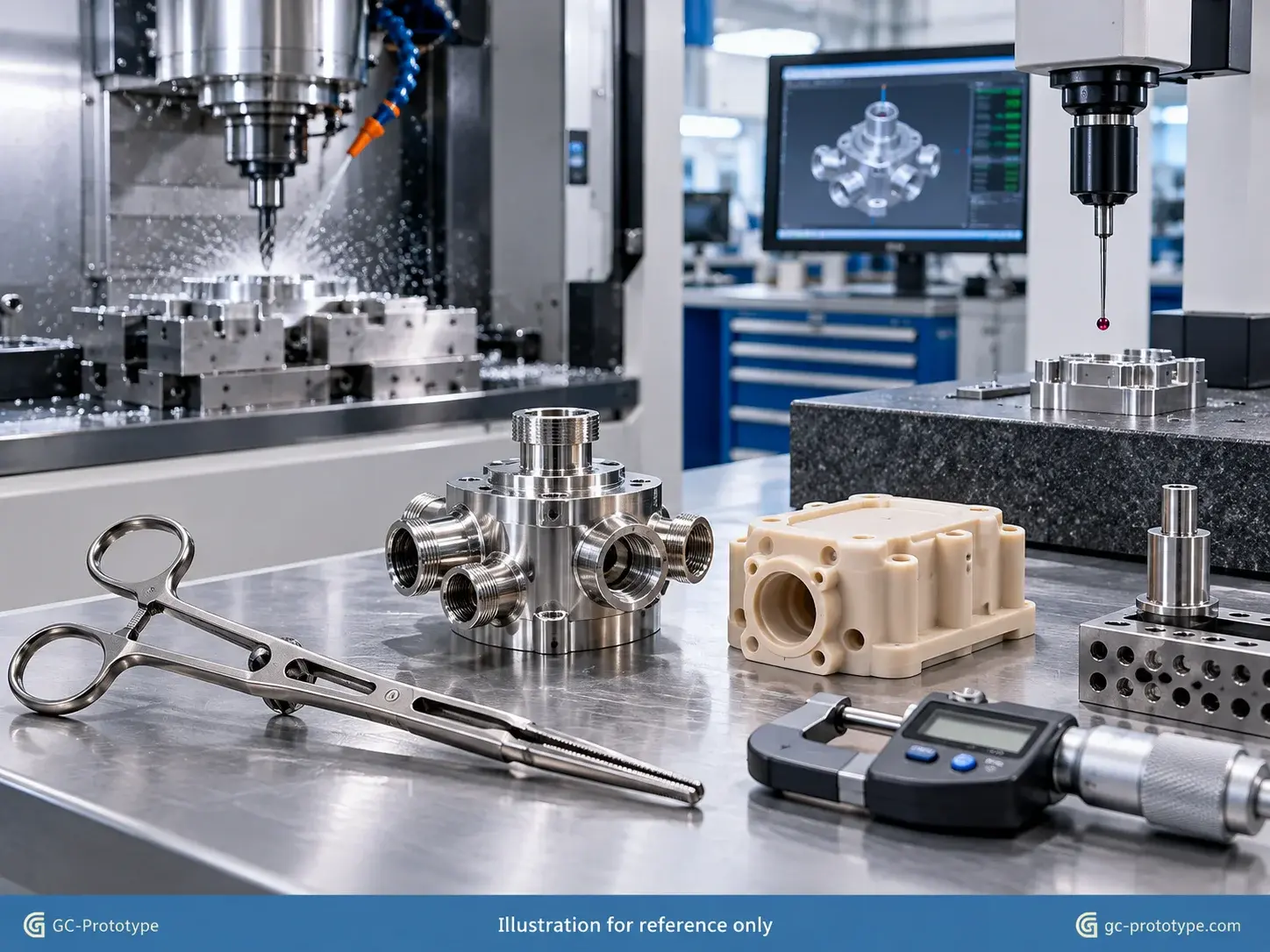
Medical device prototyping materials selection is one of the earliest decisions that determines whether a functional prototype can survive sterilization, repeated mechanical loading, fluid sealing, and dimensional validation. At the same time, engineering teams comparing rapid cnc prototyping vs 3d printing for medical devices must decide whether the prototype only needs to demonstrate form and fit—or whether it must reproduce production-intent material properties, tight tolerances, threads, sealing surfaces, and mechanical reliability.
During medical-device NPI and preclinical development, prototypes are often expected to perform under conditions that cosmetic mockups cannot reproduce. Surgical instruments may require repeated articulation without binding. Fluidic components may need leak-tight interfaces. Housings may need to tolerate aggressive cleaning agents or steam sterilization. Small tolerance errors can change assembly preload, valve motion, optical alignment, or seal compression.
For Medical R&D Engineers, Biomedical Engineers, Senior Mechanical Engineers, NPI teams, Quality Managers, and Procurement Managers, precision CNC machining provides a flexible route from early design to functional hardware without the lead time and sunk cost associated with production tooling.
This guide covers compliant material selection, quality and traceability, CNC versus additive manufacturing, tight-tolerance design, DFM cost control, lead-time optimization, and the complete development path from CAD → prototype samples → functional validation → low-volume pilot production → production support.
Medical product development rarely moves directly from CAD to production tooling.
A typical program may include:
Concept verification
Engineering prototypes
Functional prototypes
Preclinical test units
Design verification builds
Low-volume pilot production
Production-transfer activities
Each stage answers different questions.
Early models may only need to verify overall geometry, ergonomics, or packaging. Later prototypes may need to behave much more like production hardware.
Those later-stage requirements can include:
Mechanical strength
Tight sliding fits
Sterilization resistance
Fluid sealing
Thread durability
Dimensional stability
Surface finish
Material traceability
This is where CNC machining becomes especially valuable.
Because parts are produced directly from engineering metals and plastics, teams can test material properties and mechanical interfaces that are much closer to the intended final design.
Unlike injection molding or other tooling-dependent processes, CNC machining also allows design changes without committing to expensive permanent molds.
If testing identifies:
A weak wall
An incorrect seal groove
A misaligned shaft
A poorly positioned connector
Excessive friction
the CAD model can be revised and another prototype can be manufactured without replacing production tooling.
For medical startups and established OEMs alike, this ability to iterate quickly can reduce downstream risk.
Medical device prototyping materials selection should begin with the functional and regulatory environment the part must survive, not simply with what material is easiest to machine.
Medical prototypes may be exposed to:
Steam sterilization
Chemical disinfectants
Saline solutions
Repeated mechanical stress
Elevated temperatures
Electrical requirements
Direct or indirect patient contact
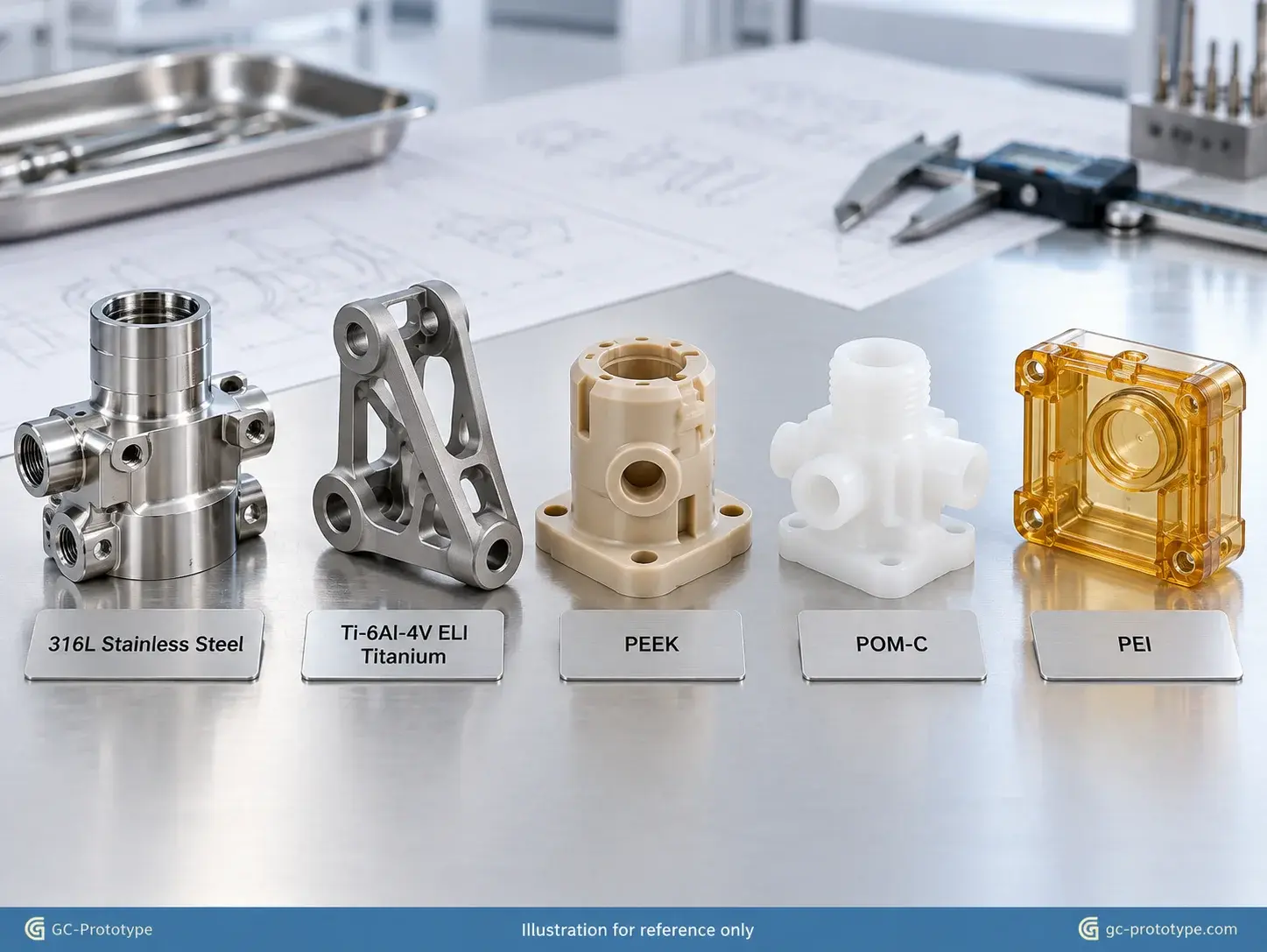
Common CNC-machined materials for medical development include:
316L stainless steel
Ti-6Al-4V and Ti-6Al-4V ELI
PEEK
POM-C / acetal
PEI / Ultem
Each material offers a different balance of mechanical performance, temperature resistance, machinability, chemical resistance, cost, and regulatory familiarity.
316L stainless steel is widely used for:
Surgical instruments
Fluid-handling components
Fixtures
Medical equipment structures
Advantages include:
Good corrosion resistance
High strength
Excellent finishing capability
Familiar machining behavior
Its main disadvantage is weight compared with titanium and engineering plastics.
For handheld surgical instruments, robotic end effectors, or lightweight assemblies, additional mass may influence ergonomics or dynamic performance.
Titanium alloys are attractive for demanding applications because they combine:
High strength-to-weight ratio
Excellent corrosion resistance
Low density
Established medical use
Ti-6Al-4V ELI, also known as Grade 23, is often considered for applications where controlled material chemistry and high performance are required.
Potential prototype applications include:
Orthopedic components
Implant-related hardware
Robotic surgical interfaces
Lightweight precision instruments
Titanium is more expensive and more difficult to machine than aluminum or many stainless steels. Low thermal conductivity concentrates cutting heat near the tool, increasing the need for appropriate tooling and process control.
PEEK is a high-performance thermoplastic used where designers need:
Electrical insulation
Chemical resistance
Low weight
High-temperature capability
Good mechanical performance
Typical prototype applications include:
Medical housings
Insulators
Sliding elements
Instrument components
For sterilization-sensitive development, engineers should confirm the exact material grade and intended sterilization process rather than assuming that every PEEK grade behaves identically.
POM-C is easier and generally less expensive to machine than PEEK.
It performs well in many:
Gears
Guides
Bushings
Low-friction mechanisms
However, it does not provide the same high-temperature performance as PEEK.
It may therefore be appropriate for general mechanisms but unsuitable for certain repeated high-temperature sterilization environments.
PEI can offer:
High-temperature resistance
Good dimensional stability
Electrical insulation
Transparency in some grades
It is often evaluated for diagnostic equipment, medical housings, fixtures, and functional prototypes.
| Material | Main Strength | Temperature Capability | Machining Cost | Typical Prototype Use |
|---|---|---|---|---|
| 316L Stainless Steel | Corrosion resistance, strength | High | Medium | Instruments, fluid parts |
| Ti-6Al-4V ELI | Strength-to-weight, corrosion resistance | High | High | Orthopedic and premium components |
| PEEK | Chemical resistance, insulation | High | High | Functional polymer parts |
| POM-C | Machinability, low friction | Moderate | Low/Medium | Gears, guides, housings |
| PEI / Ultem | Heat resistance, insulation | High | Medium/High | Diagnostic and electrical components |
Material choice should also consider required certifications, material certificates, cleaning, sterilization, and final device use.
ISO 13485 compliant cnc prototype machining is a commonly searched phrase among medical-device buyers, but engineers should understand what ISO 13485 actually covers.
ISO 13485 is a quality-management-system standard for organizations involved in medical-device manufacturing. It does not define a universal CNC tolerance table.
Instead, an ISO 13485-oriented quality system emphasizes areas such as:
Document control
Supplier management
Traceability
Risk management
Nonconformance control
Corrective actions
Manufacturing records
Dimensional requirements still come from:
Engineering drawings
GD&T
Functional requirements
Product-specific standards
For medical prototypes, disciplined quality practices can be valuable even before production quantities begin.
Medical prototype programs may require material test reports or certificates linking raw stock to:
Material grade
Heat number
Supplier
Purchase batch
Production lot
This becomes especially important for titanium, stainless steel, PEEK, and other materials where the exact grade influences performance or compliance.
Material traceability supports engineering documentation, but it does not by itself make the final device FDA-approved or CE-compliant.
Regulatory approval applies to the complete device and its applicable conformity pathway.
Prototype machining should also consider how process residues are controlled.
Potential contamination sources include:
Cutting fluids
Oils
Abrasive media
Shop debris
For medical prototypes intended for cleaning, sterilization, or sensitive functional testing, the machining supplier should understand downstream cleanliness requirements.
The appropriate strategy may include:
Controlled machining fluids
Cleaning procedures
Dedicated handling requirements
Protected packaging
depending on the project.
Coordinate Measuring Machines can verify complex medical components more comprehensively than manual inspection alone.
CMM inspection may measure:
Hole location
Datum relationships
Flatness
Perpendicularity
Profile
Complex 3D geometry
For a surgical assembly, a full-dimensional report can reveal whether a functional problem originates from the design or from manufacturing variation.
This early feedback is valuable because design defects discovered during prototyping are generally less expensive to correct than problems found after tooling or regulatory verification has begun.
Rapid cnc prototyping vs 3d printing for medical devices should be evaluated according to what the prototype must prove.
Neither technology is universally superior.
3D printing is extremely valuable for:
Form and fit
Ergonomic studies
Anatomical models
Internal channels
Rapid concept iteration
CNC machining is often more representative when engineers need:
Production-intent metals
Dense engineering plastics
Tight tolerances
Strong machined threads
Precision sealing surfaces
Smooth bearing interfaces
| Requirement | CNC Machining | 3D Printing |
|---|---|---|
| Early Design Iteration | Fast | Very fast |
| Tight Mechanical Fits | Excellent | Process-dependent |
| Material Density | Solid stock | Process-dependent |
| Surface Finish | Excellent | Often requires finishing |
| Threads | Strong | Process-dependent |
| Internal Complex Geometry | Tool-access limited | Excellent |
| Functional Load Testing | Excellent | Material/process dependent |
| Low Quantity | Excellent | Excellent |
For quantities such as 1–20 functional prototypes, both technologies can be economical depending on geometry and testing goals.
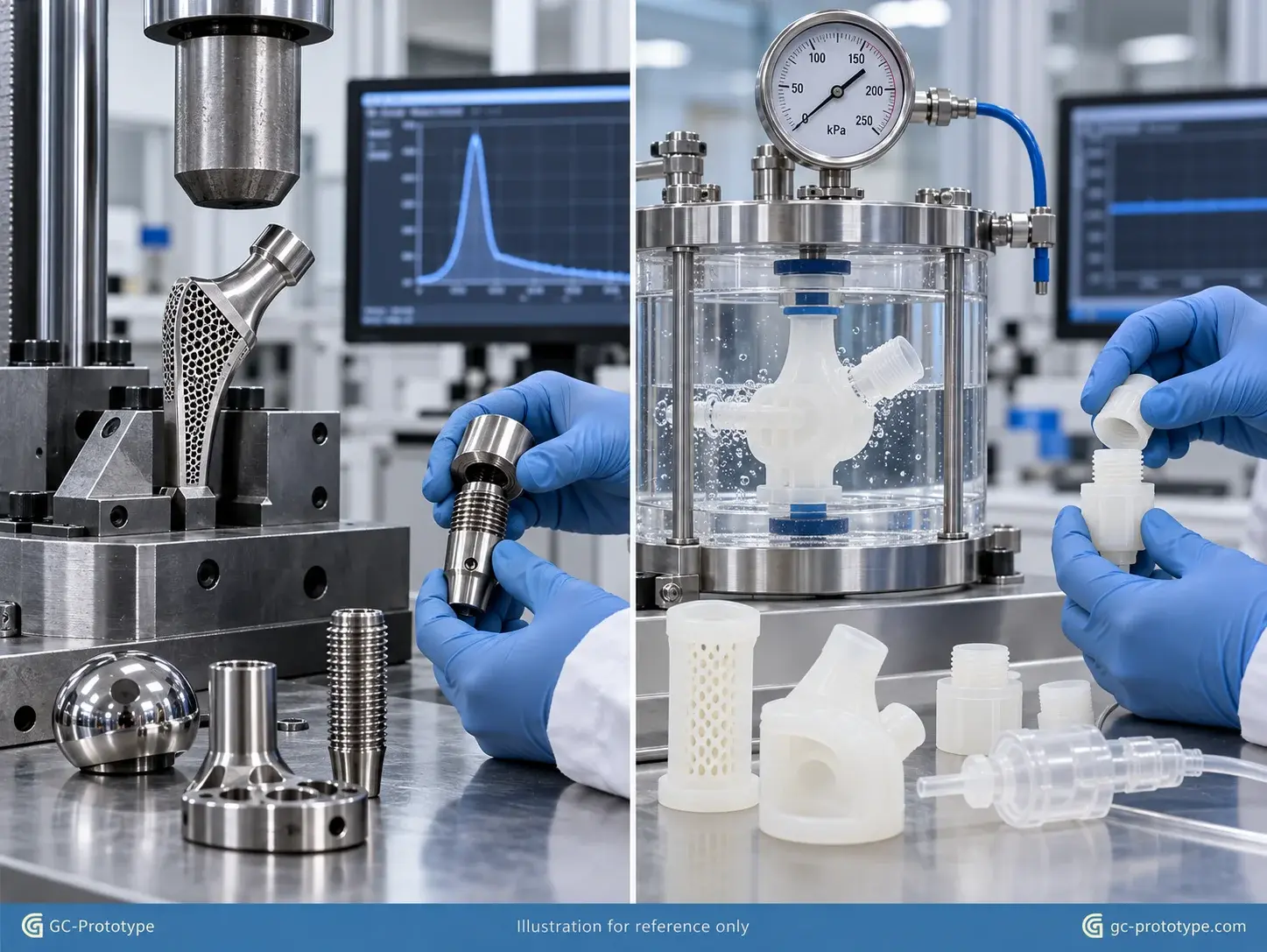
A medical prototype may undergo:
Drop testing
Repeated actuation
Impact testing
Pull-out testing
For these tests, material behavior matters.
A CNC-machined metal component made from the intended alloy can provide more representative mechanical data than a polymer print used only for geometric validation.
However, metal additive manufacturing can also produce highly functional prototypes. Its suitability depends on:
Process
Alloy
Build orientation
Heat treatment
Post-machining
The correct comparison should therefore be CNC machining versus the specific additive process—not CNC machining versus all 3D printing.
Medical devices may contain:
Valves
Pumps
Fluid manifolds
Pneumatic pathways
Sealing performance depends on:
Surface finish
Hole position
Groove geometry
Flatness
Thread quality
CNC machining is well suited to these features because sealing surfaces can be machined directly from dense stock.
Medical components are often assembled and disassembled repeatedly during development.
Machined metal threads generally provide a useful benchmark for:
Clamp load
Screw retention
Repeated assembly
This is especially important when the production-intent component will also be machined from metal.
Medical devices frequently contain moving or sealing features that require accurate dimensional relationships.
Examples include:
Minimally invasive trocar components
Endoscope articulation mechanisms
Valve bodies
Surgical robotic joints
Precision guide sleeves
The outline references ISO 2768-f and approximately ±0.005 mm for certain demanding features.
These should be treated as separate concepts.
ISO 2768 provides general tolerances for dimensions without individually specified tolerances. A ±0.005 mm critical requirement should normally be stated explicitly on the drawing.
Examples include:
Valve Spool Interface
A small clearance may determine:
Leakage
Friction
Pressure response
Sliding Surgical Mechanism
Excessive clearance may create:
Mechanical play
Poor control
Too little clearance may cause:
Binding
Jamming
Precision Bearing Seat
Incorrect fit may influence:
Preload
Runout
Service life
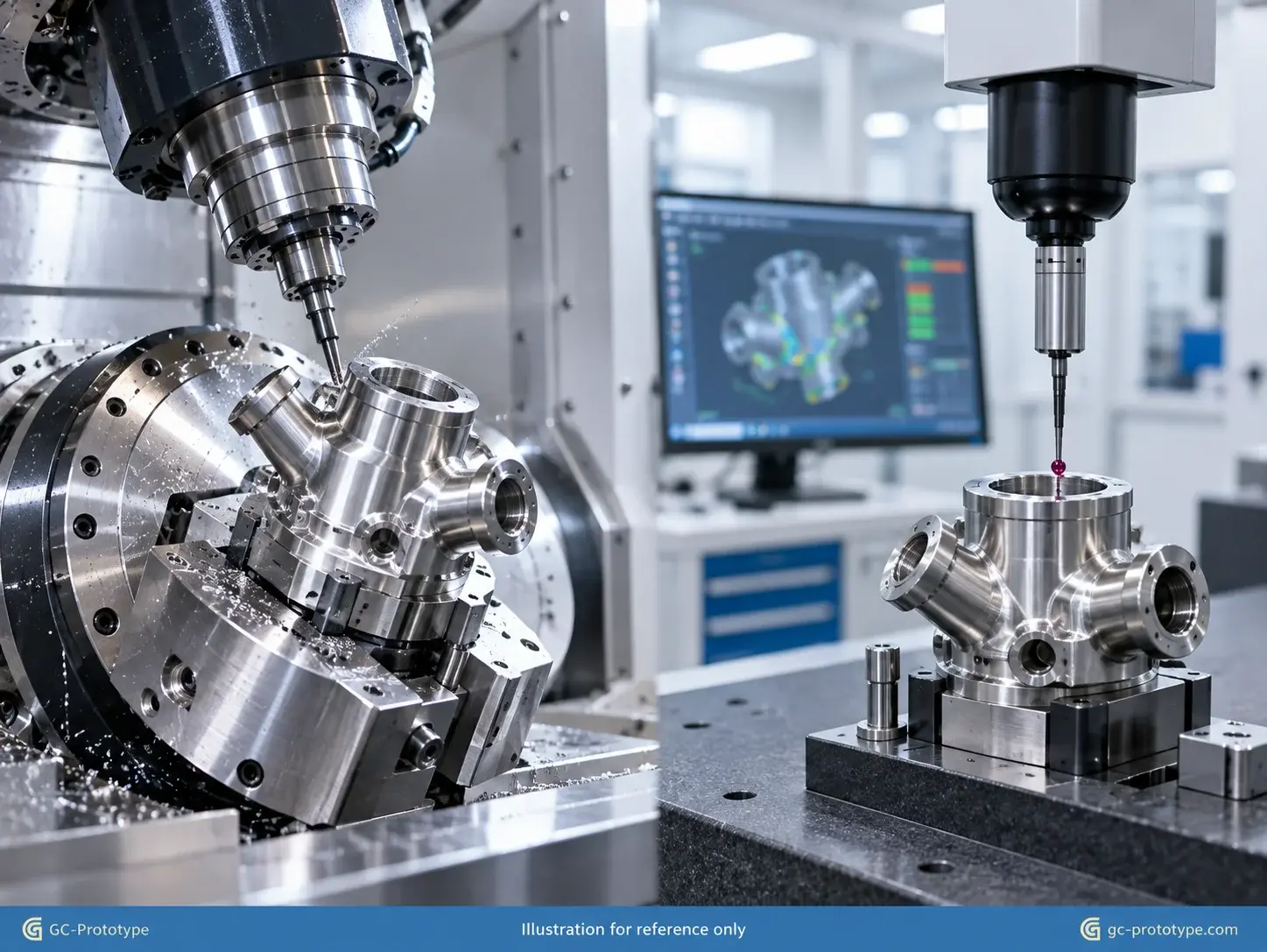
A medical component may contain critical features on multiple faces.
Traditional machining might require:
Machine one face
Remove the component
Reposition it
Establish a new datum
Machine another face
Each setup creates an opportunity for datum-transfer error.
Five-axis machining can reduce the number of setups and maintain relationships between:
Angled holes
Mating faces
Bearing interfaces
Fluid ports
This does not automatically make every five-axis part more accurate than every three-axis part. Accuracy still depends on the complete machining system.
The main advantage is the ability to machine complex relationships with fewer re-clamping operations.
A common medical DFM problem is placing extremely tight tolerances on every dimension.
For example:
±0.005 mm on a sealing bore may be functionally justified.
±0.005 mm on a nonfunctional exterior wall may not be.
Tighter tolerances can increase:
Machine time
Inspection cost
Scrap risk
Lead time
The engineering goal is not “maximum precision everywhere.”
It is the correct precision where function requires it.
DFM should begin before the purchase order is released.
A well-designed CNC component can reduce machining time without changing its clinical or mechanical function.
Important areas include:
Internal corner radius
Pocket depth
Wall thickness
Hole geometry
Tolerance specification
Surface finish
Small internal radii require small end mills.
Small tools:
Remove material slowly
Deflect more easily
Increase machining time
If function permits, larger radii allow larger cutters and more efficient material removal.
Deep pockets require:
Long-reach tools
Reduced cutting parameters
Additional finishing
Medical enclosure designs can sometimes be split into multiple components if doing so reduces machining complexity without compromising cleaning, sealing, or assembly requirements.
Not every medical surface needs an extremely low Ra value.
Critical areas may include:
Seal interfaces
Bearing surfaces
Sliding components
Fluid contact surfaces
Other nonfunctional surfaces may tolerate a standard machined finish.
Applying premium finish requirements everywhere increases cost without necessarily improving function.
| Tolerance Level | Relative Cost Impact | Typical Use |
|---|---|---|
| ±0.10 mm | Low | Noncritical geometry |
| ±0.05 mm | Moderate | General assembly |
| ±0.01 mm | High | Precision interfaces |
| ±0.005 mm | Very High | Selected critical features |
These values are illustrative rather than universal.
Actual cost depends on:
Part size
Geometry
Material
Inspection method
Machine capability
Managing custom medical prototype machining lead times requires Sourcing Managers and NPI Project Managers to understand what actually determines delivery.
Prototype lead time is not only machining time.
It can include:
Raw-material sourcing
Programming
Fixture preparation
CNC machining
Inspection
Surface treatment
Cleaning
Packaging
The outline identifies rapid programs in the 3–7 day range as a target for suitable prototype projects.
That should be understood as project-dependent rather than guaranteed for every medical component.
Special materials can become the longest part of the schedule.
Examples include:
Certified titanium
Specialty PEEK grades
Medical stainless grades
PEI
If an unusual diameter or thickness must be purchased specifically for the job, procurement time may exceed actual machine time.
Designing around commonly available stock can improve both cost and lead time.
Simple parts may use standard workholding.
Complex parts may require:
Soft jaws
Custom fixtures
Multi-stage holding
Reducing setup complexity can shorten both:
Manufacturing time
Engineering preparation
Secondary processes may include:
Bead blasting
Anodizing
Passivation
Electropolishing
Specialized cleaning
A CNC part may be machined quickly but wait longer for an external finishing process.
NPI teams should therefore identify surface-treatment requirements at the RFQ stage.
A standard inspection may be fast.
A full CMM report or complete dimensional inspection requires additional time.
Procurement teams should specify documentation requirements clearly:
Inspection report
Material certificates
FAI
CMM report
Lot traceability
This prevents late-stage delays.
The lowest prototype quote is not always the lowest development cost.
A functional prototype should answer engineering questions.
If a cheap prototype cannot provide reliable information about:
Strength
Sterilization
Sealing
Threads
Dimensional fit
another prototype may be required.
Total project cost can then increase.
| Cost Driver | Why It Matters | Cost Reduction Opportunity |
|---|---|---|
| Material | Titanium/PEEK can be expensive | Select standard stock |
| Machine Time | Complex geometry increases cycle time | Simplify pockets/radii |
| Tolerances | Tight dimensions require control | Tighten critical areas only |
| Setups | Re-clamping adds labor | Consolidate setups |
| Inspection | Full CMM requires time | Define critical inspection |
| Finishing | Adds outside processes | Specify only when needed |
For early quantities, CNC machining avoids dedicated mold investment.
For example, during:
1–20 prototypes
Small engineering builds
Validation units
CNC machining may offer excellent flexibility.
As volume increases, other processes may become more economical.
Potential later-stage processes include:
Injection molding
Die casting
Metal forming
Specialized production machining
Prototype strategy should therefore consider both:
current testing requirements and future manufacturing volume.
A surgical instrument prototype may require:
Thin metal features
Precision pivots
Sliding fits
Repeated actuation
CNC machining allows engineers to evaluate representative metal behavior before production tooling.
An endoscope mechanism may include:
Miniature joints
Shafts
Pins
Tight clearances
Five-axis milling and precision turning allow the engineering team to evaluate motion without relying only on visual models.
A diagnostic device may contain:
Microfluidic passages
Valve seats
Seal grooves
Threaded ports
CNC prototypes support:
Pressure testing
Leak testing
Assembly validation
A surgical robot may combine:
Titanium
Stainless steel
PEEK
Precision bearings
Machined prototypes can validate:
Weight
Stiffness
Sterilization compatibility
Joint movement
A handheld diagnostic device may require:
Aluminum housing
PEEK internal components
Precision connector openings
Sealing surfaces
CNC machining provides production-intent mechanical behavior without waiting for injection molds.
Medical product development is most efficient when manufacturing decisions evolve together with the design.
The engineering team defines:
Material
Geometry
Tolerances
GD&T
Surface finish
Sterilization environment
Inspection needs
A DFM review identifies:
Difficult tool access
Excessively tight tolerances
Thin walls
Expensive materials
Unnecessary machining complexity
before production begins.
Early physical parts help validate:
Fit
Ergonomics
Assembly
Mechanical interfaces
Design revisions are usually still relatively inexpensive at this stage.
More representative hardware may then undergo:
Mechanical cycling
Sterilization
Fluid pressure testing
Leakage testing
Drop testing
Assembly validation
These tests help identify whether the design is ready for more formal verification.
After the design stabilizes, pilot quantities can evaluate:
Manufacturing repeatability
Inspection plans
Assembly workflow
Supply-chain consistency
This stage is particularly important when transitioning from individual engineering prototypes to controlled production.
The final manufacturing route should reflect:
Volume
Geometry
Material
Regulatory requirements
Unit-cost targets
Some components may remain CNC machined throughout production.
Others may transition to:
Injection molding
Die casting
Other scalable processes
The objective is to preserve design intent while improving production economics.
CNC machining creates functional parts from real engineering materials without dedicated tooling. It is particularly useful for tight mechanical fits, sealing surfaces, metal structures, strong threads, and functional testing.
Common options include 316L stainless steel, Ti-6Al-4V titanium alloys, PEEK, POM-C, and PEI. The correct material depends on mechanical, sterilization, chemical, and regulatory requirements.
Not universally. 3D printing is excellent for fast geometry iteration and complex internal structures. CNC machining is often preferred when the prototype must reproduce production-intent material, mechanical interfaces, surface finish, or tight tolerances.
No. ISO 13485 is a quality-management-system standard. Individual dimensional tolerances are specified through engineering drawings, GD&T, device requirements, and relevant product standards.
Selected critical features may potentially achieve this level under appropriate manufacturing and inspection conditions. It should not be applied universally across the entire part unless function truly requires it.
Use standard stock sizes, avoid unnecessarily deep pockets, increase practical internal radii, apply tight tolerances only to critical features, and define inspection and finishing requirements early.
They can be useful when manufactured from the intended material, but testing protocols should match the actual device requirements and regulatory development plan.
Simple projects may sometimes be completed within several days, while complex components requiring specialty materials, extensive inspection, or secondary finishing can take longer. Lead time should be evaluated part by part.
Provide:
3D CAD/STEP model
2D drawing
Exact material specification
Quantity
Critical tolerances and GD&T
Surface finish requirements
Inspection requirements
Sterilization or cleaning requirements
Required material documentation
Yes. CNC machining is often well suited to pilot quantities because designs can be adjusted without permanent production tooling.
Medical device prototyping requires much more than producing a part that looks correct.
A useful functional prototype must provide engineering evidence.
Depending on the device, that evidence may include:
Mechanical strength
Dimensional fit
Sterilization resistance
Sealing reliability
Thread durability
Surface performance
Material traceability
Effective medical device prototyping materials selection helps ensure that the test part represents the actual operating environment. A carefully planned comparison of rapid cnc prototyping vs 3d printing for medical devices ensures that each process is used where it provides the greatest engineering value.
For regulated development programs, iso 13485 compliant cnc prototype machining should be understood as part of a controlled quality approach involving documentation, traceability, inspection, and process discipline—not simply a machining tolerance claim.
Procurement teams should also evaluate custom medical prototype machining lead times at the complete supply-chain level. Material availability, fixtures, inspection, secondary processing, and documentation can be just as important as actual CNC cycle time.
The strongest development strategy connects design, manufacturing, quality, and sourcing from the beginning.
GC Prototype supports the full product-development journey from CAD → prototype samples → functional validation → low-volume pilot production → production support, helping medical-device teams reduce tooling risk, validate critical performance, and move more efficiently toward manufacturing readiness.
Validating life-critical healthcare innovations demands reliable material integrity and micrometer-level precision without unnecessary NPI delay or cost. Whether you are a Senior Mechanical Engineer developing tight-tolerance surgical instruments or a Sourcing Manager evaluating rapid CNC prototyping vs 3D printing for medical devices, GC Prototype provides precision manufacturing support for demanding medical-development programs.