Address:
Shenzhen Bao'an District Xinqiao Subdistrict Huangpu Community Huangpu East Ring Road No. 504 Shenzhen Yuan Industrial City Building C
Work Hours:
Monday to Friday: 9AM - 21PM
Weekend: 9AM - 21PM

Address:
Shenzhen Bao'an District Xinqiao Subdistrict Huangpu Community Huangpu East Ring Road No. 504 Shenzhen Yuan Industrial City Building C
Work Hours:
Monday to Friday: 9AM - 21PM
Weekend: 9AM - 21PM

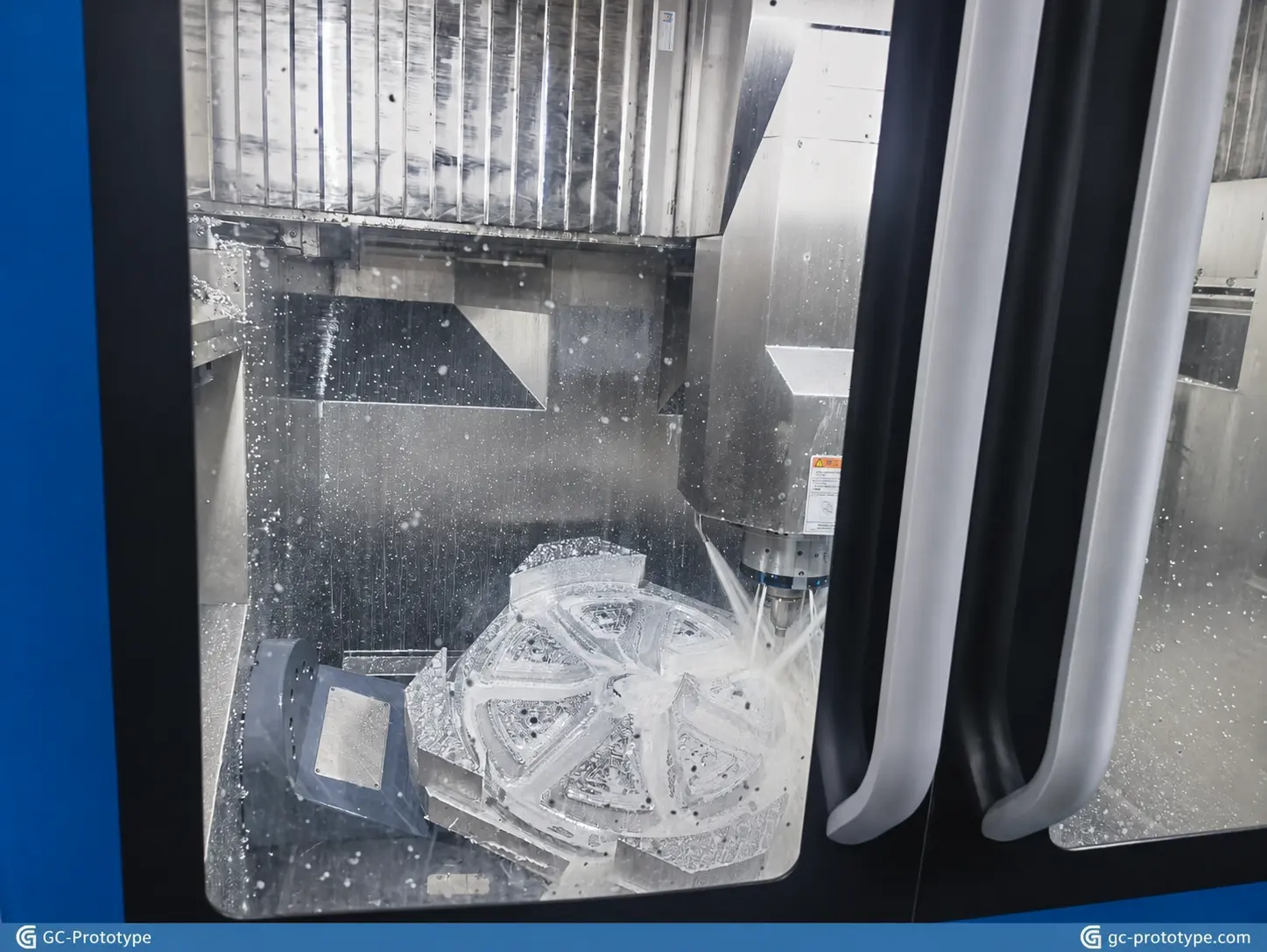
Choosing the right cnc parts manufacturer is essential for companies developing precision components, managing OEM projects, and sourcing reliable custom-machined parts. A qualified manufacturing partner should offer more than CNC equipment. Engineering support, material availability, dimensional inspection, production flexibility, and communication all influence the success of a manufacturing project.
For overseas B2B buyers, finding a dependable machining part supplier can be challenging, especially when comparing manufacturers across different countries. Whether you need aluminum housings, stainless steel components, precision brackets, or complex 5-axis machined parts, the supplier must understand your engineering requirements and production objectives.
At GC-Prototype, we support custom CNC machining projects from CAD review and prototype samples to functional validation, low-volume pilot production, and mass production support. This guide explains how to evaluate CNC manufacturers, verify their capabilities, compare suppliers, and choose the right partner for your next project.
A CNC parts manufacturer produces custom mechanical components according to customer-provided CAD models, engineering drawings, and technical specifications.
Depending on its capabilities, a manufacturer may provide CNC milling, CNC turning, multi-axis machining, drilling, tapping, and secondary finishing operations.
For OEM customers, the service should also include engineering communication, manufacturing feasibility reviews, and dimensional inspection.
Most custom machining projects begin with a 3D CAD model and a 2D engineering drawing.
The CAD model communicates the component’s geometry, while the engineering drawing defines critical dimensions, tolerances, surface requirements, and manufacturing notes.
A capable supplier should be able to review both files and identify potential manufacturing issues before production.
Not every project requires thousands of components.
Product developers often need a small quantity of precision parts for assembly testing, functional validation, engineering evaluation, or pilot production.
A flexible manufacturing partner should be able to support prototype quantities and suitable low-volume production without requiring customers to commit to unnecessarily large orders.
Professional manufacturing support goes beyond producing parts according to a drawing.
It should include communication about material selection, machining feasibility, critical dimensions, inspection requirements, and design revisions.
This engineering collaboration helps reduce misunderstandings and improves the transition from initial prototypes to repeat manufacturing orders.
One of the first things to evaluate when choosing a CNC parts manufacturer is whether its actual machining capabilities match your component geometry.
Different parts require different machine configurations and manufacturing strategies.
CNC milling is suitable for components with flat surfaces, pockets, slots, holes, mounting features, and complex contours.
Common examples include:
Aluminum equipment housings.
Industrial mounting brackets.
Electronic enclosures.
Mechanical fixtures.
Robotics components.
Precision structural parts.
When evaluating a supplier, check whether its equipment can accommodate your component dimensions and machining requirements.
CNC turning is commonly used to manufacture shafts, pins, bushings, sleeves, and other rotational components.
For these parts, important manufacturing considerations include diameter accuracy, concentricity, runout, thread specifications, and surface finish.
If your project involves complex cylindrical components, ask whether the supplier can combine turning with additional milling or drilling operations.
Multi-axis machining is useful for components requiring machining on multiple surfaces or containing complex angled features.
A 5-axis CNC machine can access different orientations with fewer setups for suitable geometries.
This can help reduce repeated positioning and improve the relationship between machined features.
However, more advanced equipment does not automatically mean better results. The machining strategy should be selected according to the actual part design.
Some CNC components require additional operations after machining.
Depending on the material and application, these may include:
Anodizing.
Sandblasting.
Polishing.
Plating.
Heat treatment.
Deburring.
Threading and tapping.
Other specified surface treatments.
Before placing an order, confirm which operations are performed in-house and which are handled through qualified external partners.
| Part Type | Suitable Manufacturing Capability | What Buyers Should Verify |
| Aluminum Housings | CNC Milling | Pocket geometry, mounting holes |
| Precision Brackets | 3-Axis / 4-Axis Milling | Hole positions, flatness |
| Complex Structural Parts | 5-Axis Machining | Multi-face accuracy |
| Shafts and Sleeves | CNC Turning | Diameter, runout |
| Mechanical Connectors | Turning + Milling | Threads, mating features |
| Precision Fixtures | CNC Milling | Dimensional consistency |
A reliable manufacturer should have experience producing different types of components for industrial and engineering applications.
When reviewing a supplier’s portfolio, focus on whether its previous work demonstrates experience with geometries and technical requirements similar to your project.
Aluminum components are widely used in automotive systems, robotics, electronics, and industrial equipment.
Typical products include:
Precision aluminum housings.
Sensor enclosures.
Mounting brackets.
Structural connectors.
Heat-dissipation components.
Custom mechanical fixtures.
Aluminum is frequently selected for its relatively low weight, machinability, and useful mechanical properties.
Stainless steel is suitable for components requiring corrosion resistance, durability, or specific mechanical properties.
Common examples include precision connectors, valve components, shafts, fittings, and mechanical housings.
Material selection should consider the operating environment and required material grade.
Custom housings and brackets are used to support, protect, and position mechanical or electronic assemblies.
Their manufacturing requirements may include precise mounting-hole locations, controlled wall thickness, flatness, and dimensional relationships between multiple surfaces.
Robotics and automotive projects often require custom-machined components that integrate with motors, sensors, actuators, and mechanical transmission systems.
Examples include actuator housings, robotic joint components, mounting plates, sensor brackets, and precision mechanical interfaces.
CNC machining is also suitable for manufacturing plastic components from engineering-grade stock materials.
Common materials include POM, ABS, Nylon, PC, and PEEK.
These materials may be used for bushings, insulating components, mechanical supports, protective covers, and lightweight housings.
The appropriate material depends on the component’s functional and environmental requirements.
Important selection criteria
Quality control is one of the most important factors when choosing a manufacturing partner.
A component may look correct but still fail during assembly if critical dimensions, geometric relationships, or material specifications are not properly controlled.
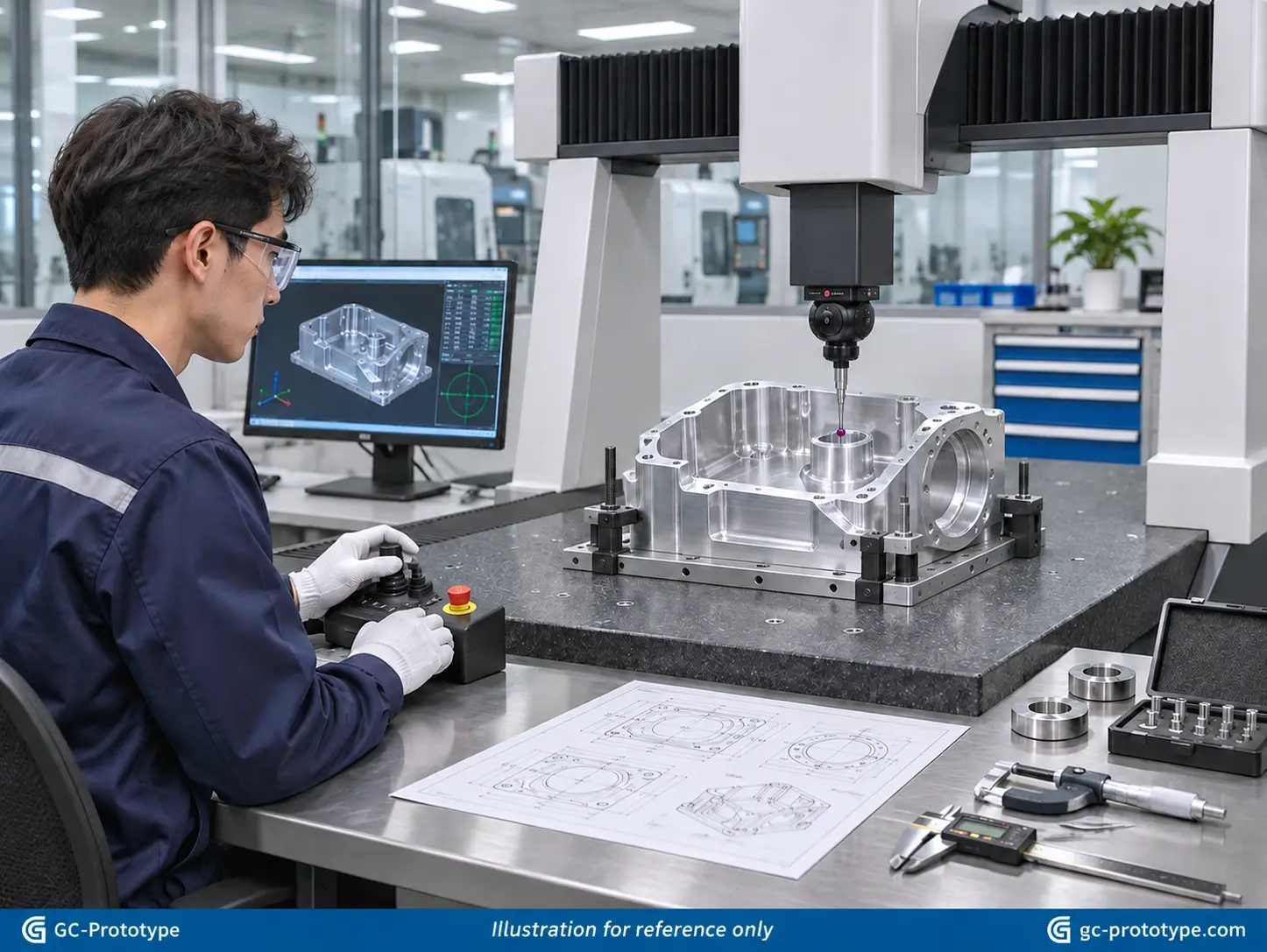
Coordinate Measuring Machines (CMM) are commonly used to inspect complex dimensions and geometric relationships.
Depending on the component, inspection may include:
Hole positions.
Bore diameters.
Flatness.
Perpendicularity.
Parallelism.
Profile requirements.
Critical mounting dimensions.
For components with complex geometries, CMM inspection can provide more detailed dimensional verification than basic measuring instruments alone.
GC-Prototype uses Hexagon CMM equipment to support dimensional inspection requirements.
When evaluating a supplier, ask which inspection equipment is available and whether dimensional reports can be provided for your project.
Material verification is particularly important for components with specified mechanical, chemical, or corrosion-resistance requirements.
Depending on the project, buyers may request:
Material certificates.
Material grade confirmation.
Batch identification.
Chemical composition verification.
Inspection documentation.
GC-Prototype also uses Olympus XRF equipment for material analysis.
XRF can support alloy identification for suitable materials, but it does not replace all material certificates or mechanical property testing.
For critical applications, confirm the required verification method before production.
First Article Inspection (FAI) helps verify that an initial manufactured component conforms to the approved engineering drawing.
It is particularly useful when a part has multiple critical dimensions or when a customer needs documented approval before proceeding with additional quantities.
Final inspection can verify agreed dimensional, visual, and other quality requirements before shipment.
Not every project requires the same inspection documentation, so buyers should define their requirements during the RFQ stage.
Engineering drawings may change during product development.
A reliable supplier should maintain clear revision control to ensure that the correct CAD model and drawing are used for manufacturing.
Before approving production, confirm:
The drawing revision.
The approved 3D CAD file.
Critical dimensions.
Material specifications.
Surface treatment requirements.
Inspection criteria.
This is particularly important for repeat orders and projects involving multiple design iterations.
A manufacturer’s material sourcing capability can directly affect project costs, production schedules, and component quality.
Before selecting a supplier, confirm whether it can source the material grades specified in your engineering drawings.
Aluminum grades such as 6061 and 7075 are widely used in precision machining.
Stainless steel grades such as 303, 304, and 316 are commonly selected for components requiring different levels of machinability, strength, and corrosion resistance.
The supplier should understand the differences between material grades and confirm the actual specification before manufacturing.
Carbon steel and alloy steel may be suitable for structural components, mechanical fixtures, shafts, and other parts requiring specific strength or hardness characteristics.
Depending on the application, additional heat treatment or surface protection may be necessary.
Brass and copper are frequently used for connectors, electrical components, and specialized mechanical parts.
Engineering plastics such as POM, Nylon, and PEEK provide alternatives when low weight, electrical insulation, low friction, or specific environmental properties are required.
When comparing machining parts manufacturers, ask whether they can confirm material grades and provide the documentation required by your project.
For demanding applications, material traceability and consistent sourcing may be as important as the machining process itself.
A qualified manufacturing partner should understand the engineering requirements behind each component.
This is especially important when a customer is developing a new product or modifying an existing design.
Design for Manufacturing (DFM) reviews help identify potential manufacturing difficulties before production begins.
A supplier may review:
Complex internal geometries.
Deep pockets and narrow slots.
Thin walls.
Tool accessibility.
Critical mounting features.
Material suitability.
Unnecessarily tight tolerances.
The objective is to identify possible improvements without compromising the component’s intended function.
Clear communication helps prevent misunderstandings about dimensions, materials, and manufacturing requirements.
A professional supplier should be able to discuss technical questions with your engineering team and clarify any incomplete or conflicting information.
Product development often involves several prototype iterations.
When customers update CAD models or engineering drawings, the supplier should review the changes and confirm their impact on manufacturing.
This helps ensure that revised components are produced according to the latest approved specifications.
For OEM customers, selecting a manufacturer that can support multiple development stages can simplify supplier management.
Instead of coordinating separate companies for every stage, customers can work with a manufacturing partner that understands the product from initial design through production planning.
GC-Prototype supports projects through five stages.
Customers submit 3D CAD files and 2D engineering drawings.
The engineering team reviews the component geometry, material requirements, critical dimensions, and manufacturing feasibility.
Initial samples are manufactured using suitable CNC machining processes.
The objective is to produce physical components that can be evaluated for dimensions, assembly fit, and functional requirements.
Customers evaluate the prototype according to their product requirements.
Testing may include assembly checks, dimensional verification, and functional evaluations.
If changes are required, updated designs can be reviewed before the next manufacturing iteration.
After design validation, low-volume production helps customers evaluate manufacturing consistency and prepare for repeat orders.
For suitable projects, this stage can support quantities such as 10–200 pieces, depending on component geometry, process selection, and production requirements.
Once the product design is established, the manufacturing strategy can be reviewed for production efficiency, repeatability, and cost optimization.
Depending on order volume and component geometry, CNC machining or other suitable manufacturing processes may be considered.
This integrated approach is particularly useful for customers developing new industrial, automotive, robotics, and electronic products.
Choosing between different cnc machined part manufacturers requires more than comparing quoted prices.
A lower quotation does not necessarily represent better overall value if the supplier cannot meet your dimensional, quality, or delivery requirements.
Compare the actual manufacturing processes, equipment, material availability, and inspection capabilities offered by each supplier.
A supplier should be able to explain how your specific component will be manufactured rather than providing a quotation based only on the uploaded model.
Check whether the manufacturer can provide the inspection reports and material documents required by your project.
Also discuss production lead times, communication procedures, packaging, and shipping arrangements.
For repeat orders, communication and revision management become increasingly important.
A reliable supplier should understand your product requirements and maintain consistent manufacturing information across different production batches.
| Evaluation Criteria | Supplier A | Supplier B | What Buyers Should Check |
| CNC Equipment | To be verified | To be verified | Machine types and actual capabilities |
| Material Options | To be verified | To be verified | Material grades and sourcing |
| Inspection | To be verified | To be verified | CMM and inspection reports |
| Engineering Support | To be verified | To be verified | DFM and drawing review |
| Order Flexibility | To be verified | To be verified | Prototype and low-volume orders |
| Communication | To be verified | To be verified | Technical response and revision control |
Use this checklist to compare suppliers based on your actual project requirements rather than relying on marketing claims.
A complete Request for Quotation (RFQ) helps manufacturers understand your requirements and prepare an accurate quotation.
When contacting a machining part supplier, provide as much relevant technical information as possible.
Recommended file formats include:
STEP / STP.
IGES.
2D PDF engineering drawings.
The 3D model communicates the component geometry, while the 2D drawing defines dimensions, tolerances, and manufacturing notes.
Specify the required material grade, initial order quantity, and estimated future demand if available.
This information helps the supplier evaluate material sourcing and suitable manufacturing arrangements.
Identify critical dimensions, surface finish requirements, thread specifications, and any additional inspection documentation.
Avoid assigning unnecessarily tight tolerances to every feature because this can increase manufacturing and inspection costs.
Provide your target delivery date, destination country, and any special packaging requirements.
If the components require individual protection, labeling, or specific documentation, communicate these details before quotation approval.
| RFQ Information | Recommended Details |
| 3D CAD | STEP, STP, IGES |
| 2D Drawing | PDF with dimensions and tolerances |
| Material | Exact grade and specification |
| Quantity | Prototype and batch quantities |
| Annual Demand | Estimated repeat order volume |
| Surface Finish | Anodizing, polishing, plating, etc. |
| Quality | Critical dimensions and inspection reports |
| Delivery | Required delivery date and destination |
Look for a supplier with suitable CNC equipment, material sourcing capabilities, dimensional inspection, engineering support, and experience producing components similar to yours. Communication and production flexibility are also important.
Compare their actual manufacturing capabilities, quality documentation, engineering support, lead times, and quotations. Evaluate how well each supplier can meet your specific drawing requirements.
Yes. STEP files are commonly used to communicate 3D component geometry. However, a 2D engineering drawing is also recommended to define critical dimensions, tolerances, and technical requirements.
Depending on the project, documents may include material certificates, dimensional inspection reports, first article inspection reports, and other agreed quality records.
Many CNC manufacturers support both prototype samples and low-volume production. The suitable manufacturing arrangement depends on part complexity, material, quantity, and required delivery schedule.
Provide a complete 3D CAD model, 2D engineering drawing, material specification, required quantity, critical tolerances, surface finish, and delivery requirements. This allows the supplier to evaluate the project more accurately.
Finding a reliable cnc parts manufacturer is an important step toward achieving consistent quality, efficient product development, and dependable manufacturing support.
GC-Prototype provides custom CNC milling, CNC turning, 3-axis and 5-axis machining, and precision inspection services for international B2B customers.
Our published manufacturing capabilities include HAAS CNC equipment, Hexagon CMM dimensional inspection, and Olympus XRF material analysis equipment.
Whether you need precision aluminum housings, stainless steel components, robotic mechanical parts, industrial brackets, or complex custom-machined components, our team can review your engineering requirements and discuss suitable manufacturing solutions.
Looking for a reliable CNC manufacturing partner for your next project?
Send us your 3D CAD/STEP files and 2D engineering drawings. Our team can review your component geometry, material specifications, critical dimensions, and production requirements.
From CAD review and prototype samples to functional validation, low-volume pilot production, and mass production support, GC-Prototype helps engineering and procurement teams move projects forward.