Address:
Shenzhen Bao'an District Xinqiao Subdistrict Huangpu Community Huangpu East Ring Road No. 504 Shenzhen Yuan Industrial City Building C
Work Hours:
Monday to Friday: 9AM - 21PM
Weekend: 9AM - 21PM

Address:
Shenzhen Bao'an District Xinqiao Subdistrict Huangpu Community Huangpu East Ring Road No. 504 Shenzhen Yuan Industrial City Building C
Work Hours:
Monday to Friday: 9AM - 21PM
Weekend: 9AM - 21PM

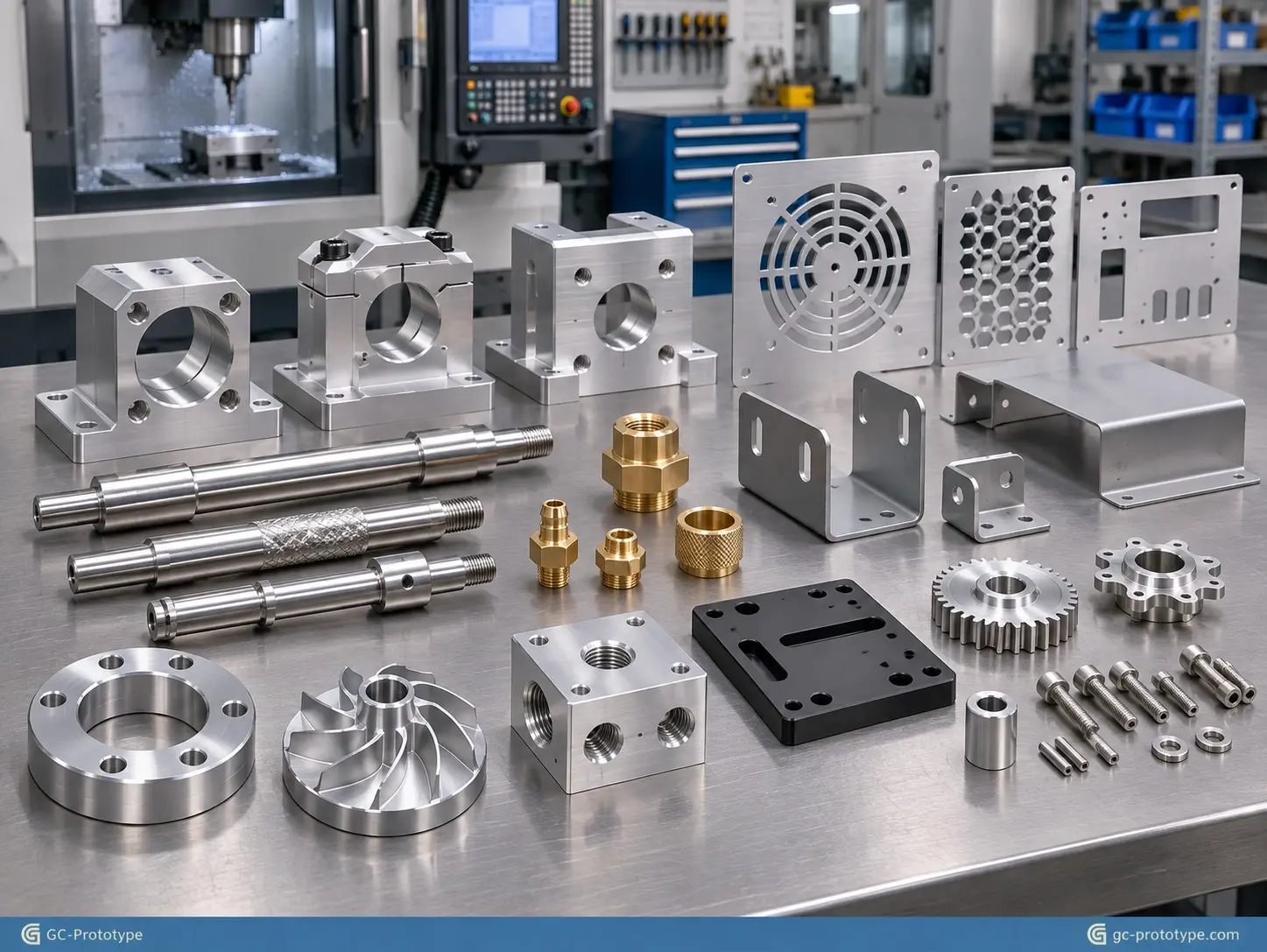
Choosing the right custom fabrication company is essential for OEM manufacturers developing industrial equipment, automation systems, and custom mechanical assemblies. Many projects require more than a single manufacturing process. Precision CNC hardware parts, custom laser cut aluminum panels, formed metal brackets, and mechanical mounting components often need to work together within the same assembly.
Coordinating CNC machining, laser cutting, bending, surface finishing, and assembly requirements can help engineering teams reduce sourcing complexity, improve component compatibility, and control manufacturing costs.
At GC-Prototype, we support custom manufacturing projects through engineering review, CNC machining, sheet metal fabrication, prototype development, and low-volume production.
This guide explains how to coordinate different manufacturing processes, optimize assembly interfaces, manage multi-component projects, and prepare an effective RFQ for custom industrial components.
A custom fabrication company produces components according to customer-specific designs, material specifications, and functional requirements.
For industrial OEM projects, fabrication may involve multiple manufacturing processes rather than a single production method.
Build-to-print manufacturing involves producing customized components according to approved CAD models and engineering drawings.
The manufacturer reviews material grades, dimensions, tolerances, surface requirements, and production quantities before selecting suitable manufacturing methods.
A single industrial product may require CNC milling, turning, laser cutting, bending, welding, and mechanical fastening.
Coordinating these processes helps ensure that individual components meet their intended assembly requirements.
Manufacturing an individual component primarily involves meeting its drawing specifications.
A multi-component project also requires consideration of mounting interfaces, dimensional relationships, assembly sequences, and compatibility between parts.
These requirements should be reviewed before production begins.
Custom mechanical hardware provides essential positioning, mounting, connecting, and supporting functions within industrial assemblies.
Unlike standard fasteners, CNC hardware parts are manufactured according to specific engineering drawings and functional requirements.
CNC-machined mounting blocks provide accurate interfaces for motors, sensors, bearings, electronic modules, and mechanical assemblies.
Their mounting surfaces and hole positions must correspond with the surrounding fabricated structures.
Precision shafts, locating pins, and bushings support movement, positioning, and mechanical alignment.
Their dimensions should be evaluated together with the corresponding holes, bearings, and mounting interfaces.
Customized threaded components connect different mechanical elements within an assembly.
Critical requirements may include thread engagement, bore dimensions, shoulder positions, and compatibility with mating components.
| CNC Hardware Part | Typical Application | Critical Requirement |
| Mounting Block | Industrial equipment | Mounting-hole accuracy |
| Precision Shaft | Mechanical assemblies | Diameter and runout |
| Custom Bushing | Motion systems | Internal and external fit |
| Locating Pin | Assembly positioning | Diameter and alignment |
| Threaded Adapter | Mechanical connections | Thread conformity |
| CNC Machined Bracket | Robotics and automation | Strength and interface accuracy |
GC-Prototype provides custom CNC machining services for precision mechanical components, functional prototypes, and suitable low-volume manufacturing projects.
Aluminum panels are widely used in industrial equipment because of their relatively low weight, corrosion resistance, and suitability for different fabrication and finishing processes.
Customized panels often provide both protective and functional interfaces within an assembly.
Front panels may contain openings for displays, switches, connectors, control buttons, and mounting hardware.
The position of these features must correspond with the internal equipment layout.
For example, an electronic control panel requires accurate alignment between external connector openings and internally mounted electronic components.
Aluminum covers can protect mechanical assemblies, electronic modules, and internal equipment components.
Design considerations include panel thickness, mounting methods, ventilation, structural rigidity, and maintenance access.
Laser cutting can produce customized profiles, ventilation patterns, mounting holes, cable openings, and slots.
However, minimum feature sizes and achievable edge quality depend on the material thickness, equipment, and cutting conditions.
Precision bores or threaded features may require secondary machining.
| Aluminum Grade | Main Characteristics | Potential Applications |
| 5052 | Good formability and corrosion resistance | Bent panels and enclosures |
| 6061 | Good machinability and structural properties | Flat mounting plates and machined panels |
| 3003 | Good formability | Lightweight covers and formed panels |
Material temper is also important. For example, 6061-T6 generally requires greater attention to bend radius and cracking risk than more formable sheet alloys.
Depending on the application, aluminum panels may require anodizing, powder coating, brushing, bead blasting, laser marking, or screen printing.
Buyers should identify visible surfaces, acceptable cosmetic conditions, and any areas requiring masking or special treatment.
Finishing availability and dimensional effects should be confirmed during quotation.
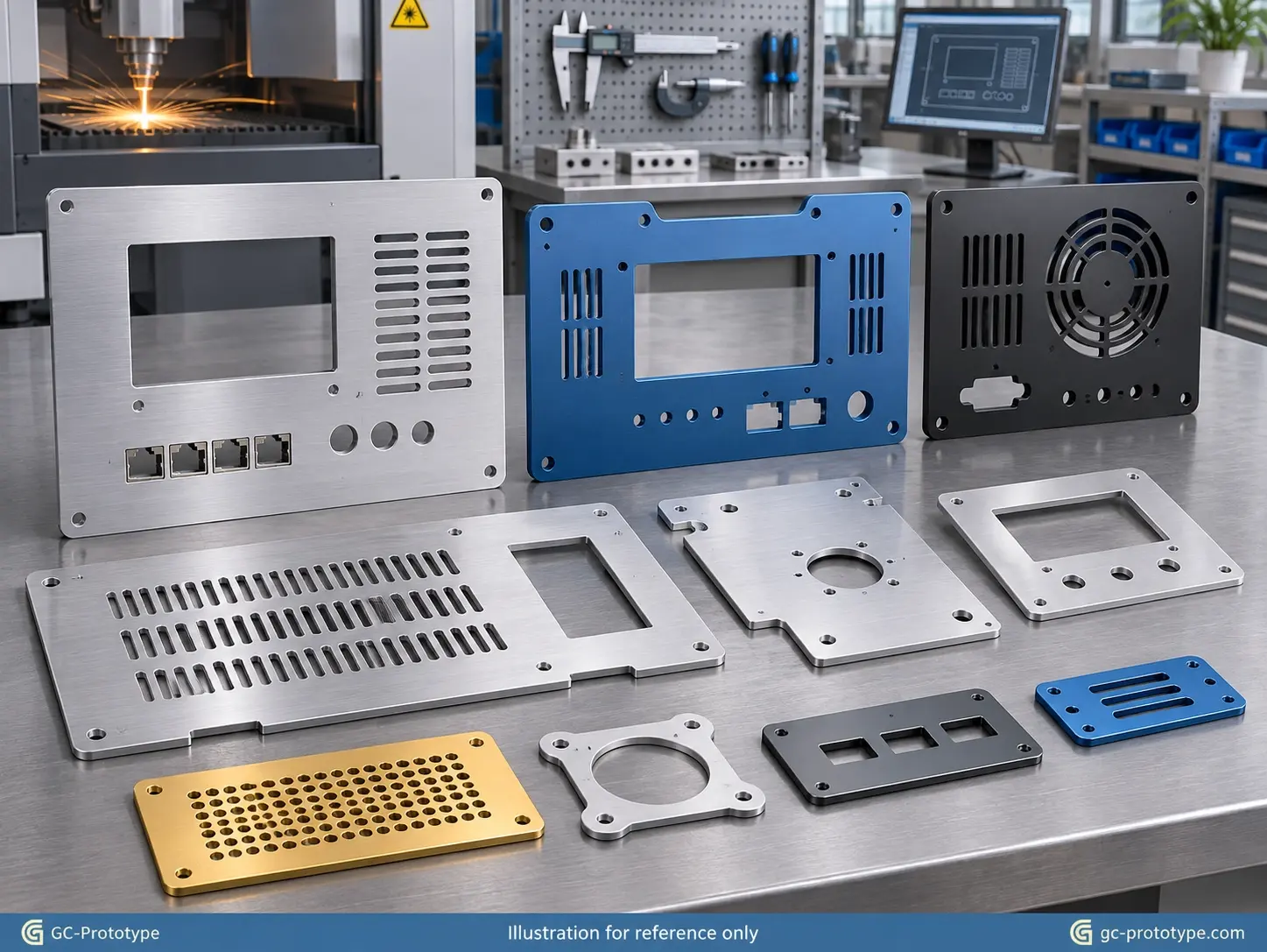
Selecting the correct manufacturing process for each component can improve the efficiency of an entire mechanical assembly.
It is not always economical to manufacture every part using CNC machining alone.
CNC machining is particularly useful for components requiring precision bores, locating surfaces, threaded features, bearing seats, or complex three-dimensional geometry.
Typical examples include mounting blocks, shafts, bushings, and mechanical adapters.
Laser cutting and bending are suitable for many flat or formed sheet metal components, including equipment panels, covers, brackets, and lightweight structural parts.
These processes can reduce unnecessary material removal compared with machining equivalent geometries from solid stock.
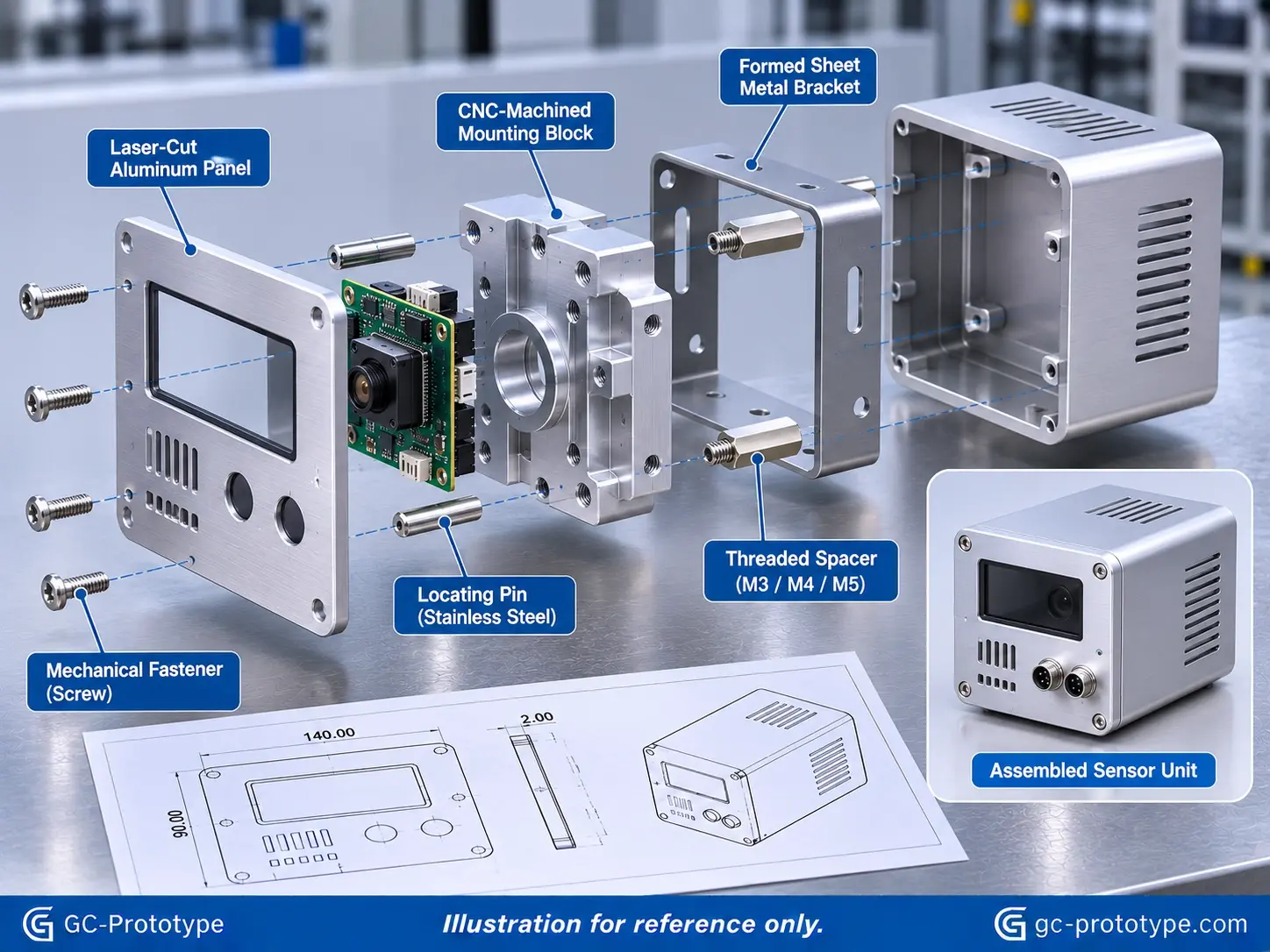
Consider an illustrative industrial sensor module containing an aluminum front panel, CNC-machined sensor mounts, locating pins, and formed support brackets.
Each component can be manufactured using a process suited to its function, while common reference features help maintain assembly compatibility.
| Component | Recommended Process | Main Reason |
| Aluminum Front Panel | Laser Cutting | Efficient flat profile production |
| Precision Mounting Block | CNC Milling | Accurate mechanical interfaces |
| Locating Pin | CNC Turning | Controlled cylindrical dimensions |
| Support Bracket | Laser Cutting + Bending | Efficient formed geometry |
| Threaded Bushing | CNC Turning | Internal and external feature control |
| Equipment Frame | Fabrication and Joining | Structural assembly |
Our custom sheet metal fabrication services complement CNC machining for projects requiring both precision mechanical parts and fabricated metal structures.
Design for Manufacturability (DFM) becomes particularly important when components produced through different manufacturing processes must fit together.
Individual parts may satisfy their drawings but still create assembly difficulties if their dimensional relationships have not been reviewed.
A CNC-machined mounting block and a laser-cut aluminum panel should use compatible mounting-hole patterns and functional reference points.
Engineers should establish common assembly datums rather than dimensioning mating features from unrelated edges.
Tolerance stack-up occurs when dimensional variations accumulate across several components.
For example, a formed bracket, an aluminum panel, and a CNC mounting block may each contribute positioning variation to a sensor assembly.
Engineers should evaluate the combined dimensional variation against the required assembly clearance and alignment.
Thin sheet metal may not provide sufficient thread engagement for directly tapped holes.
Self-clinching fasteners, threaded inserts, rivet nuts, or alternative fastening arrangements may be suitable.
Selection depends on sheet thickness, material hardness, applied loads, and installation requirements.
Welding provides permanent joints but may introduce thermal distortion.
Mechanical fastening allows disassembly and maintenance but requires appropriate mounting geometry and fastener access.
The joining method should reflect structural requirements, assembly accuracy, and serviceability.
Powder coating, anodizing, and other surface treatments may affect mating dimensions, thread clearances, or electrical contact areas.
Critical interfaces should be reviewed before finishing requirements are finalized.
| Design Issue | Potential Risk | Recommended Review |
| Misaligned Mounting Holes | Assembly interference | Common reference datums |
| Tolerance Stack-Up | Poor component fit | Assembly-level tolerance analysis |
| Thin Panel Threads | Insufficient engagement | Suitable inserts or fasteners |
| Weld Distortion | Poor alignment | Joining sequence and fixtures |
| Coating Thickness | Reduced clearance | Finishing allowance |
| Limited Fastener Access | Assembly difficulty | Installation tool access |
A custom fabrication company can support industrial projects requiring both precision mechanical components and fabricated metal structures.
Typical components include sensor mounting panels, robotic actuator brackets, precision locating hardware, and automation equipment covers.
Applications include control panels, electronic enclosures, internal mounting plates, and custom mechanical supports.
Non-implantable equipment components may include diagnostic instrument housings, precision brackets, internal mechanical structures, and laboratory equipment panels.
Application-specific material, quality, and regulatory requirements must be evaluated separately.
Custom fabrication can support automotive test fixtures, prototype mounting components, electrical equipment covers, and development-stage mechanical assemblies.
Industrial machinery frequently requires customized support brackets, mounting blocks, protective panels, positioning components, and inspection fixtures.
Quality control should evaluate both individual component conformity and the compatibility of components within the intended assembly.
CNC-machined parts, laser-cut panels, and formed components should be inspected according to their respective drawing requirements.
Measurement methods should match the geometry and specified tolerances.
Where trial assembly is included in the project, inspection may cover mounting-hole alignment, component clearance, locating features, and overall assembly dimensions.
Material grades, sheet thickness, coating requirements, and cosmetic surfaces should be verified against approved specifications.
Initial components or pilot assemblies can help customers identify dimensional and assembly issues before repeat production.
The inspection scope and approval requirements should be agreed upon in advance.
| Inspection Item | Inspection Focus |
| CNC Hardware Parts | Critical dimensions and functional interfaces |
| Laser-Cut Panels | Profiles, openings and edge condition |
| Bent Components | Bend angles and formed dimensions |
| Hardware Installation | Position, fit and retention |
| Joined Components | Joint condition and alignment |
| Surface Finish | Specified finish and appearance |
| Final Assembly | Fit, clearance and overall dimensions |
Dimensional conformity does not automatically establish structural strength, electrical safety, or functional performance. Additional testing should be arranged according to the project’s requirements.
A Bill of Materials (BOM) identifies the components required to manufacture or assemble a product.
For OEM procurement teams, coordinating multiple part numbers through a suitable manufacturing partner can simplify communication and purchasing activities.
The initial review should establish part numbers, drawing revisions, material specifications, quantities, and manufacturing requirements.
Purchased standard hardware should be distinguished from custom-manufactured components.
Each component should be assigned a suitable manufacturing process.
Production planning must also account for secondary operations and dependencies between individual parts.
An engineering change to one component may affect several mating parts.
The manufacturer and customer should review related drawings before implementing changes across the project.
A BOM-based quotation can identify individual component prices, finishing charges, assembly requirements, inspection scope, and delivery conditions.
Buyers should confirm whether components will be shipped separately, as organized kits, or as assembled units.
The following hypothetical example illustrates how different manufacturing processes can support one industrial assembly.
| Part Number | Component | Manufacturing Process | Qty per Assembly |
| P-001 | Aluminum Front Panel | Laser Cutting | 1 |
| P-002 | Sensor Mounting Block | CNC Milling | 2 |
| P-003 | Stainless Steel Locating Pin | CNC Turning | 4 |
| P-004 | Metal Support Bracket | Laser Cutting + Bending | 2 |
| P-005 | Threaded Spacer | CNC Turning | 4 |
Reviewing the complete BOM allows the manufacturing team to evaluate component compatibility and discuss a coordinated production arrangement before individual orders are released.
The total cost of a custom fabrication project includes more than individual component machining prices.
Material utilization, production setups, joining, finishing, inspection, and assembly requirements can all affect project economics.
Selecting suitable stock dimensions and optimizing sheet nesting can help reduce unnecessary material waste.
Deep pockets, difficult features, multiple setups, and complex bend sequences can increase production time.
Welding, hardware installation, coating, and assembly verification should be included when evaluating the complete manufacturing cost.
Coordinated manufacturing may reduce purchasing and logistics complexity, but its economic benefit depends on the actual project.
| Cost Factor | Potential Impact | Optimization Approach |
| Material Selection | Raw material cost | Select grades by function |
| Sheet Utilization | Material waste | Optimize nesting |
| CNC Machining | Cutting and setup time | Simplify noncritical features |
| Joining | Additional operations | Select suitable joining methods |
| Surface Finishing | Additional processing | Define functional surfaces |
| Assembly | Fit and adjustment costs | Review component interfaces |
A coordinated manufacturing workflow helps OEM teams evaluate individual components and their assembly relationships before increasing production quantities.
Review component drawings, materials, quantities, assembly interfaces, and manufacturing feasibility.
Produce CNC-machined hardware, laser-cut aluminum panels, and fabricated brackets using suitable manufacturing processes.
Where agreed, conduct initial assembly checks to identify alignment, clearance, and installation issues.
The customer evaluates the prototype assembly against its intended mechanical and functional requirements.
After approval, suitable projects can progress to pilot batches and repeat manufacturing.
GC-Prototype supports a development-oriented manufacturing pathway:
CAD & BOM Review → Component Manufacturing → Prototype Assembly → Functional Validation → Low-Volume Pilot Production → Mass Production Support
A complete Request for Quotation helps manufacturers evaluate both individual component requirements and the overall project scope.
Provide individual STEP models, dimensioned PDF drawings, and assembly drawings identifying component relationships.
DXF flat patterns may also be useful for laser-cut parts.
Include part numbers, drawing revisions, quantities per assembly, and the total number of required assemblies.
Specify exact material grades, sheet thickness, critical dimensions, surface finishes, and any required manufacturing restrictions.
Identify joining methods, hardware installation requirements, inspection scope, and whether trial assembly or complete assembly is required.
| RFQ Information | Recommended Details |
| 3D CAD Files | STEP / STP |
| 2D Drawings | PDF with revision |
| Flat Patterns | DXF where available |
| Assembly Drawing | Component layout and interfaces |
| BOM | Part numbers and quantities |
| Materials | Exact grades and sheet thickness |
| Critical Features | Mounting holes, fits and tolerances |
| Surface Finish | Coating, anodizing or specified finish |
| Joining | Welding, fasteners or inserts |
| Assembly Requirements | Individual parts, kits or assembled units |
| Inspection | Component and assembly verification |
| Delivery | Destination and required schedule |
Complete technical information helps manufacturers prepare a more accurate quotation and identify potential assembly problems before production begins.
An industrial custom fabrication company can produce customized mechanical components, precision CNC parts, metal panels, brackets, equipment enclosures, and multi-component structures according to engineering specifications.
CNC machining removes material from stock to produce defined features. Sheet metal fabrication commonly involves cutting, forming, and joining sheet material. Both methods can be combined within industrial manufacturing projects.
Yes. Coordinating CNC machining and sheet metal fabrication can support assemblies requiring both precision interfaces and formed metal structures. Component compatibility and inspection requirements should be reviewed before production.
Common options include 5052, 6061, and 3003 aluminum. Selection depends on strength, corrosion resistance, thickness, material temper, forming requirements, and surface finish.
Yes. Suitable CNC machining and sheet metal fabrication processes can support engineering samples, functional prototypes, pilot assemblies, and low-volume production. Feasibility depends on component complexity and project requirements.
Buyers should provide STEP models, dimensioned PDF drawings, material specifications, quantities, and finishing requirements. For multi-component projects, assembly drawings, DXF files, and a complete BOM are also recommended.
Choosing a reliable custom fabrication company is important when your project requires multiple manufacturing processes and accurately coordinated mechanical components.
GC-Prototype supports international OEM customers through custom CNC machining, turning, sheet metal fabrication, prototype manufacturing, and low-volume production.
Whether you need individual CNC hardware parts, custom laser cut aluminum panels, precision mounting brackets, or multiple components for an industrial assembly, our engineering team can review your requirements and evaluate suitable manufacturing solutions.
Send us your project information, including:
3D CAD files and engineering drawings.
Complete BOM and assembly drawings, where applicable.
Material grades and sheet thickness.
Critical dimensions and assembly requirements.
Surface finishing and inspection specifications.
Prototype or production quantities.
Target delivery schedule.
Our team can review manufacturing feasibility, component interfaces, and the proposed production scope to prepare a project-specific quotation.