Address:
Shenzhen Bao'an District Xinqiao Subdistrict Huangpu Community Huangpu East Ring Road No. 504 Shenzhen Yuan Industrial City Building C
Work Hours:
Monday to Friday: 9AM - 21PM
Weekend: 9AM - 21PM

Address:
Shenzhen Bao'an District Xinqiao Subdistrict Huangpu Community Huangpu East Ring Road No. 504 Shenzhen Yuan Industrial City Building C
Work Hours:
Monday to Friday: 9AM - 21PM
Weekend: 9AM - 21PM

CNC turning is one of the most cost-effective manufacturing processes for shafts, pins, bushings, sleeves, threaded inserts, rollers, and other cylindrical parts. For engineers and B2B sourcing teams, the value of turning is simple: when a part is rotationally symmetrical, it is usually faster, more accurate, and less expensive to rotate the workpiece on a lathe than to machine the same geometry through milling. This guide explains how to design cylindrical components for lower cost, better tolerances, smoother surfaces, and faster production.
Whether you are developing a medical device component, an automotive sensor sleeve, an aerospace fastener, a robotics shaft, or an electronics connector pin, CNC turning can help move your project from prototype to low-volume production with reliable dimensional control.
In this engineer-focused guide, we will cover lathe operations, turning vs milling, Swiss turning, material selection, tolerance planning, surface finish, DFM rules, cost reduction strategies, rapid prototyping, and low-volume production planning.
The Basics of Lathe Operations
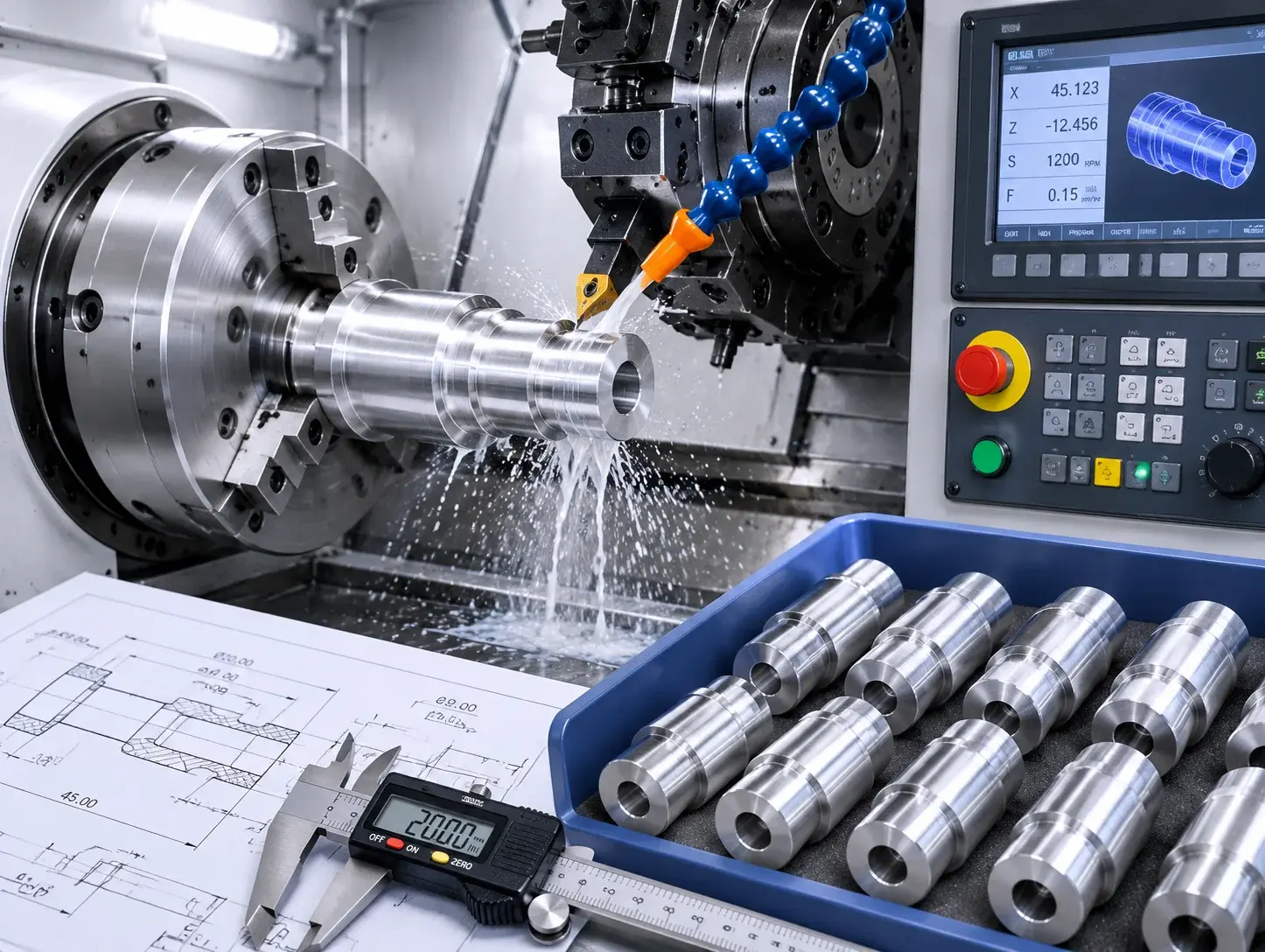
CNC turning is a subtractive manufacturing process where the workpiece rotates while cutting tools remove material from the outside diameter, inside diameter, face, grooves, threads, or tapered surfaces. The process is performed on CNC lathes, turning centers, Swiss-type lathes, or mill-turn machines.
Unlike milling, where the cutting tool rotates and the workpiece usually remains fixed, turning is optimized for parts with circular geometry. This makes it especially efficient for producing smooth diameters, concentric features, threaded sections, shoulders, undercuts, and precision bores.
Common CNC turned parts include:
Shafts
Pins
Bushings
Sleeves
Spacers
Rollers
Nozzles
Inserts
Fittings
Standoffs
Valve components
Medical needles
Electrical connector pins
Automotive sensor bodies
Robotic transmission shafts
For B2B customers, CNC turning is valuable because it supports both fast prototyping and scalable production. A single prototype can be turned quickly for fit testing, while the same design can later move into automated bar-fed production for 50, 500, or even thousands of parts.
Understanding cnc turning vs milling for cylindrical parts
Cnc turning vs milling for cylindrical parts is one of the most important process-selection questions for engineers designing round components. If the part is mainly cylindrical, CNC turning is usually faster and more cost-effective because the workpiece itself rotates, allowing the cutting tool to shape the diameter efficiently.
CNC milling is excellent for prismatic parts, flat surfaces, pockets, slots, and complex 3D contours. However, when milling is used to create a round part, the machine must often interpolate around the diameter, which can take more time and may not achieve the same concentricity as a lathe.
Turning is naturally suited to circular features because every cut is referenced around the center axis of the rotating workpiece. This improves concentricity, roundness, and surface consistency. For parts like shafts, pins, spacers, bushings, or threaded sleeves, turning can often reduce cycle time and cost compared with milling.
| Factor | CNC Turning | CNC Milling |
| Best Geometry | Cylindrical, round, rotational parts | Flat, prismatic, complex 3D parts |
| Workpiece Motion | Workpiece rotates | Workpiece is usually fixed |
| Tool Motion | Cutting tool moves linearly | Cutting tool rotates |
| Best Features | Diameters, bores, grooves, threads | Pockets, slots, holes, contours |
| Concentricity | Excellent | Depends on setup |
| Cost for Round Parts | Usually lower | Usually higher |
| Surface Finish on OD | Very good | Depends on toolpath |
| Typical Parts | Shafts, sleeves, pins, bushings | Housings, brackets, plates |
For example, if an automotive supplier needs 200 stainless steel sensor sleeves, CNC turning is usually the smarter choice. If the same part includes side holes or milled flats, a turning center with live tooling or a secondary milling operation may be used.
The best design approach is to keep cylindrical parts as rotationally simple as possible. When non-round features are required, they should be designed only where functionally necessary.
What is swiss cnc turning vs conventional turning?
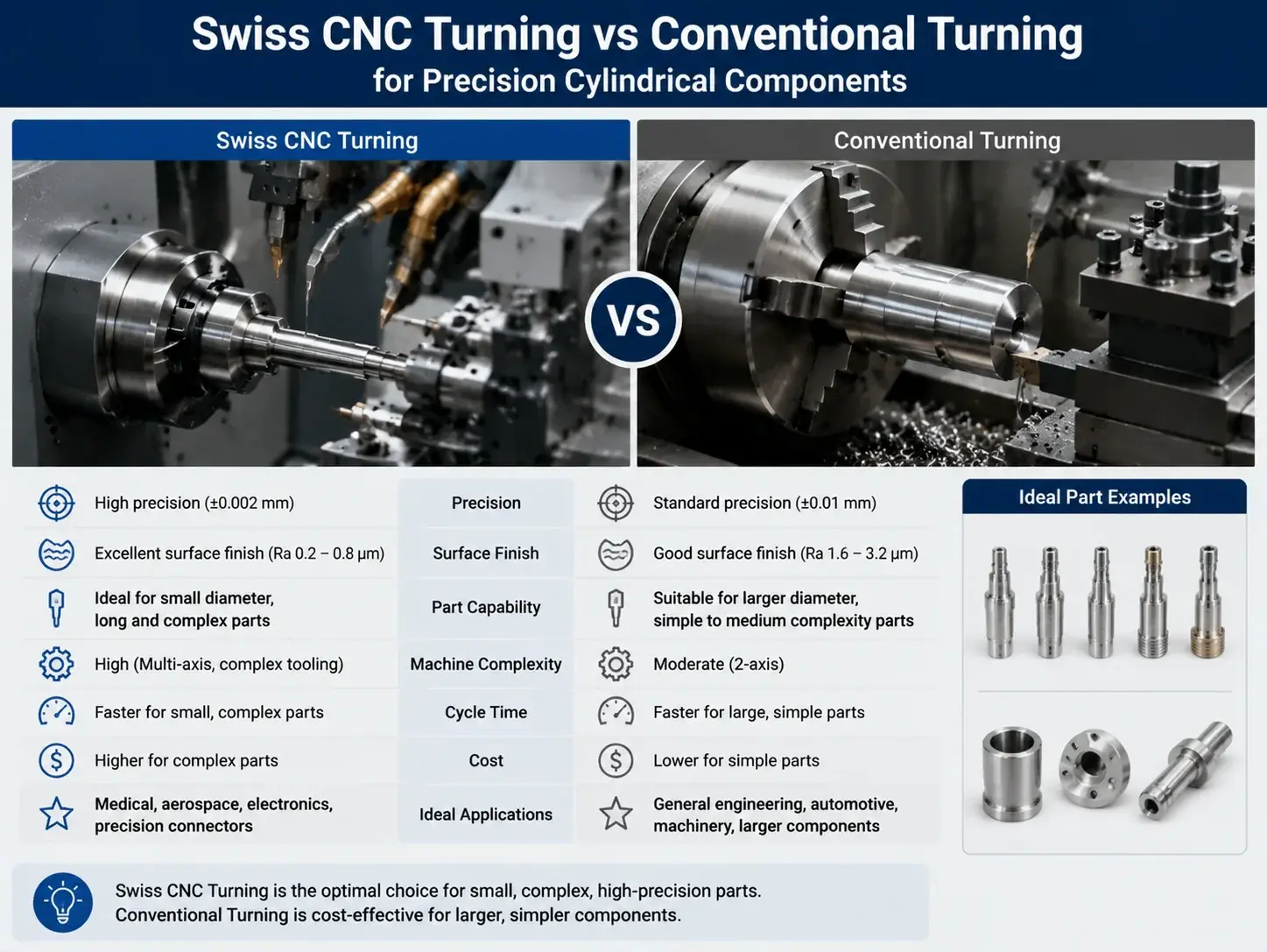
Swiss cnc turning vs conventional turning refers to the difference between Swiss-type lathes and standard CNC turning centers. Both processes can produce round parts, but Swiss turning is especially powerful for small, slender, high-precision components.
In conventional turning, the workpiece is held in a chuck and extends from the spindle. If the part is long and thin, unsupported material can deflect under cutting forces, creating vibration, poor surface finish, or dimensional variation.
In Swiss CNC turning, the bar stock is supported close to the cutting zone by a guide bushing. This means the tool cuts very near the point of support, greatly reducing deflection. As a result, Swiss turning is ideal for long, slender, miniature, and highly precise parts.
Swiss CNC turning is commonly used for:
Medical needles
Dental components
Surgical pins
Electronic connector pins
Micro shafts
Watch components
Precision fasteners
Aerospace miniature parts
Sensor components
Conventional turning is better suited for larger shafts, bushings, sleeves, housings, fittings, and general cylindrical parts. It is usually more flexible and cost-effective for standard turned components that are not extremely small or slender.
| Factor | Swiss CNC Turning | Conventional CNC Turning |
| Best For | Small, slender, precision parts | Larger standard turned parts |
| Work Support | Guide bushing near cutting zone | Chuck or collet support |
| Deflection Control | Excellent | Good for shorter parts |
| Part Diameter | Usually small to medium | Small to large |
| Complexity | High, often with live tooling | Medium to high |
| Cost | Higher setup, efficient for precision runs | Lower for standard turning |
| Applications | Medical, electronics, micro components | Industrial, automotive, machinery |
For engineers working on medical or electronic applications, Swiss turning can provide unmatched precision for small-diameter components. For sourcing managers, the key is to match the machine type to the part geometry rather than assuming all turned parts require the same equipment.
Material Selection and Precision
Material selection has a major impact on turning cost, machinability, surface finish, tool wear, dimensional stability, and part performance. A material that looks good on paper may not always be the most economical or practical choice for turning.
For prototype and low-volume turning projects, engineers usually need to balance five factors:
1.Mechanical strength
2.Machinability
3.Surface finish requirements
4.Corrosion or wear resistance
5.Material cost and availability
A good turning supplier should review not only the CAD model but also the application. A shaft for a robotic actuator, a brass electrical connector, a POM bushing, and a stainless steel surgical pin all require different material logic.
The best materials for cnc turning prototypes
The best materials for cnc turning prototypes are materials that offer strong machinability, predictable dimensional behavior, good surface finish, and suitable mechanical performance. Common choices include brass, aluminum 6061, free-machining steel, stainless steel, POM, and other engineering plastics.
Brass is one of the easiest materials to machine. It cuts cleanly, produces excellent surface finish, and is ideal for fittings, bushings, electrical components, inserts, and precision turned parts. Although brass can cost more than some steels, its excellent machinability often reduces cycle time.
Aluminum 6061 is widely used for prototypes because it is lightweight, cost-effective, corrosion-resistant, and easy to machine. It is suitable for shafts, sleeves, rollers, lightweight fixtures, housings, and general engineering prototypes.
Free-machining steel is a good choice when strength and cost efficiency are important. It is commonly used for shafts, pins, spacers, threaded parts, and mechanical components. Stainless steel is more difficult to machine but offers better corrosion resistance, making it suitable for medical, food-grade, marine, and outdoor applications.
POM, also known as Delrin, is one of the best engineering plastics for turning. It offers low friction, good wear resistance, excellent dimensional stability, and clean machining behavior. It is often used for bushings, rollers, gears, spacers, and sliding components.
| Material | Machinability | Strength | Surface Finish | Typical Applications |
| Brass | Excellent | Medium | Excellent | Fittings, bushings, electrical parts |
| Aluminum 6061 | Excellent | Medium | Good | General prototypes, lightweight shafts |
| Free-Machining Steel | Very good | High | Good | Pins, shafts, threaded parts |
| Stainless Steel | Medium | High | Good | Medical, corrosion-resistant parts |
| POM / Delrin | Excellent | Medium | Good | Bushings, rollers, low-friction parts |
| PEEK | Medium | High | Good | Medical, aerospace, high-performance parts |
| Nylon | Good | Medium | Medium | Wear parts, rollers, guides |
For most general prototypes, aluminum 6061 and POM are cost-effective choices. For precision electrical or fluid fittings, brass may be ideal. For demanding medical or aerospace parts, stainless steel, titanium, or PEEK may be required.
Material choice should never be based only on strength. Machinability, finishing, tolerance stability, and final application all matter.
Achieving tight cnc lathe turning tolerances and surface finish
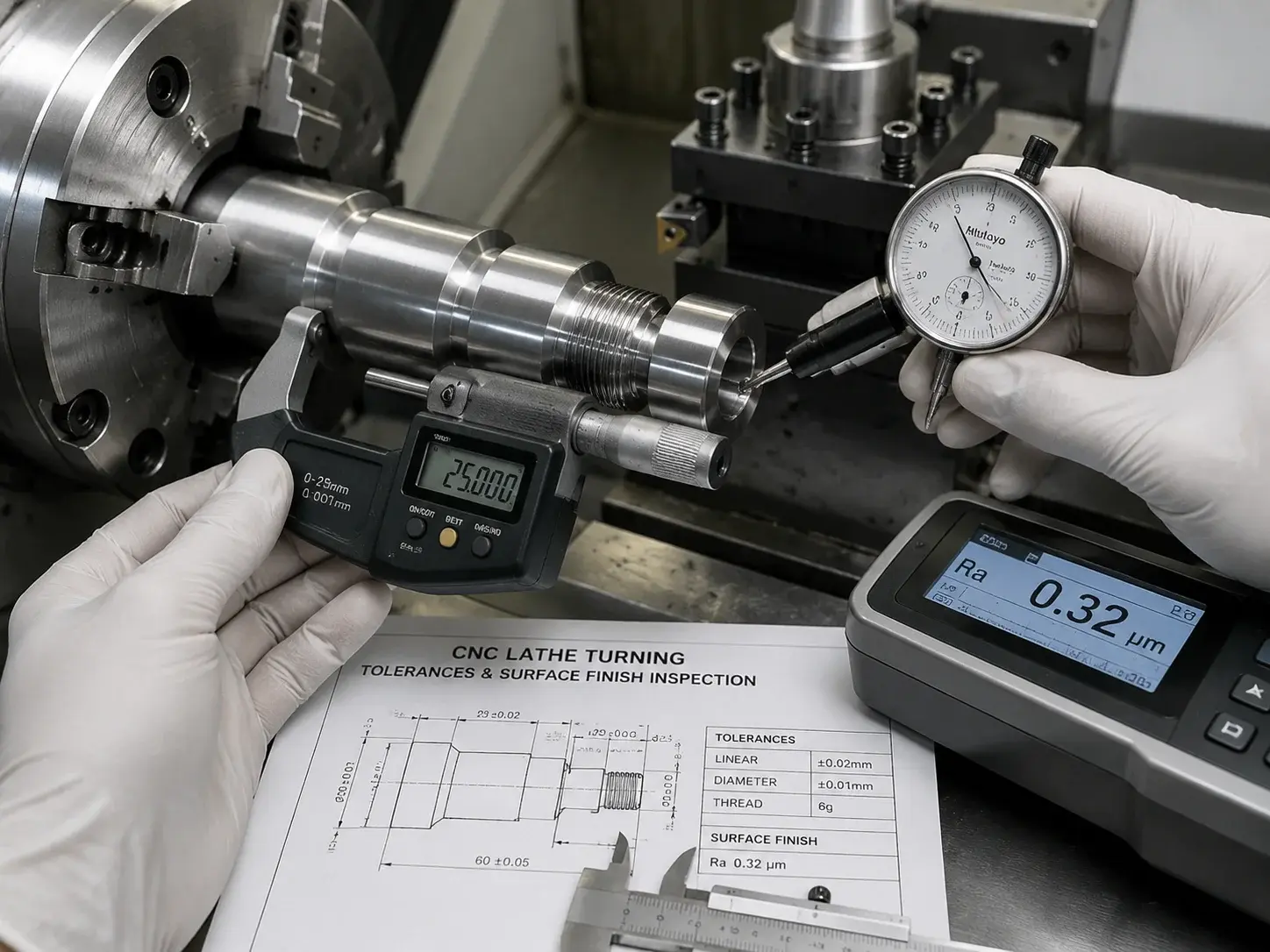
Cnc lathe turning tolerances and surface finish are major reasons engineers choose turning for cylindrical parts. Because the part rotates around a fixed centerline, CNC turning is naturally strong at controlling roundness, concentricity, outside diameter, inside diameter, and smooth circular surfaces.
For many turned prototypes, standard tolerances may be around ±0.1 mm. For precision turned parts, tolerances such as ±0.05 mm or ±0.02 mm may be achievable depending on material, geometry, machine condition, tooling, and inspection requirements. For highly critical features, tighter tolerances may be possible, but cost increases as tolerance requirements become more demanding.
Surface finish is also a major strength of turning. A well-machined turned surface can be smoother than many milled surfaces because the cutting tool follows a continuous path around the rotating workpiece. Fine finishing passes, sharp tools, optimized feeds, and proper material selection can significantly improve surface quality.
Important precision factors include:
Tool sharpness
Material hardness
Bar stock straightness
Workholding stability
Cutting speed and feed rate
Part length-to-diameter ratio
Coolant use
Inspection method
Thermal stability
Concentricity is especially important for rotating parts. A shaft, pulley, roller, or bearing-related component must maintain alignment around the central axis. Poor concentricity can cause vibration, noise, wear, and assembly problems.
| Feature | Typical Turning Capability | Cost Impact |
| General OD tolerance | ±0.1 mm | Low |
| Precision OD tolerance | ±0.05 mm | Medium |
| Tight OD tolerance | ±0.02 mm | Higher |
| High concentricity requirement | Application-specific | Higher |
| Fine surface finish | Requires finishing pass | Medium |
| Ultra-smooth cosmetic finish | May require polishing | Higher |
The best practice is to apply tight tolerances only to critical features. A bearing seat may need high precision, while a non-functional outside length may not. Over-tolerancing every dimension increases cost without improving performance.
Optimizing Your Designs
Design optimization is one of the fastest ways to reduce CNC turning cost. Many turned parts become expensive not because of material or quantity, but because the drawing includes avoidable complexity.
A part may look simple, but small design decisions can increase machining time. Examples include extremely deep internal bores, unnecessary tight tolerances, non-standard threads, sharp internal corners, thin unsupported sections, complex grooves, or cosmetic finish requirements on non-visible surfaces.
Good DFM allows a manufacturer to produce the part faster, more accurately, and at lower cost.
Key rules when designing for cnc turning manufacturability
Designing for cnc turning manufacturability means creating cylindrical parts that are easy to hold, support, cut, inspect, and repeat. The goal is not to weaken the design; it is to remove unnecessary machining difficulty.
One of the most important rules is to avoid excessive length-to-diameter ratios. Long, thin sections are more likely to deflect during machining. This can create chatter marks, poor surface finish, taper, or dimensional variation. If a long slender feature is required, consider Swiss turning, tailstock support, steady rest support, or design changes that increase rigidity.
Another important rule is to include proper relief grooves. Thread relief, undercut relief, and shoulder relief help cutting tools exit cleanly and allow mating parts to seat properly. Without relief, the manufacturer may need slower toolpaths or special tools.
Designers should also avoid unnecessary sharp internal corners. Turning tools have nose radii, and internal grooving tools require clearance. Specifying impossible or overly sharp features may increase cost or require secondary EDM or special tooling.
Practical DFM guidelines include:
Keep cylindrical geometry as simple as possible
Avoid long unsupported slender features
Use reasonable fillets and chamfers
Add thread relief where needed
Use standard thread sizes
Avoid extremely deep small-diameter holes
Minimize complex internal grooves
Clearly define critical surfaces
Avoid tight tolerances on non-functional areas
Consider bar stock diameter early
A good turning drawing should clearly show which dimensions matter most. For example, a bearing diameter, sealing surface, or thread may need strict control. A cosmetic groove or non-critical shoulder may allow more tolerance.
When engineers design with turning in mind, they often reduce cost before the quote is even sent.
Actionable tips on how to reduce cnc turning costs
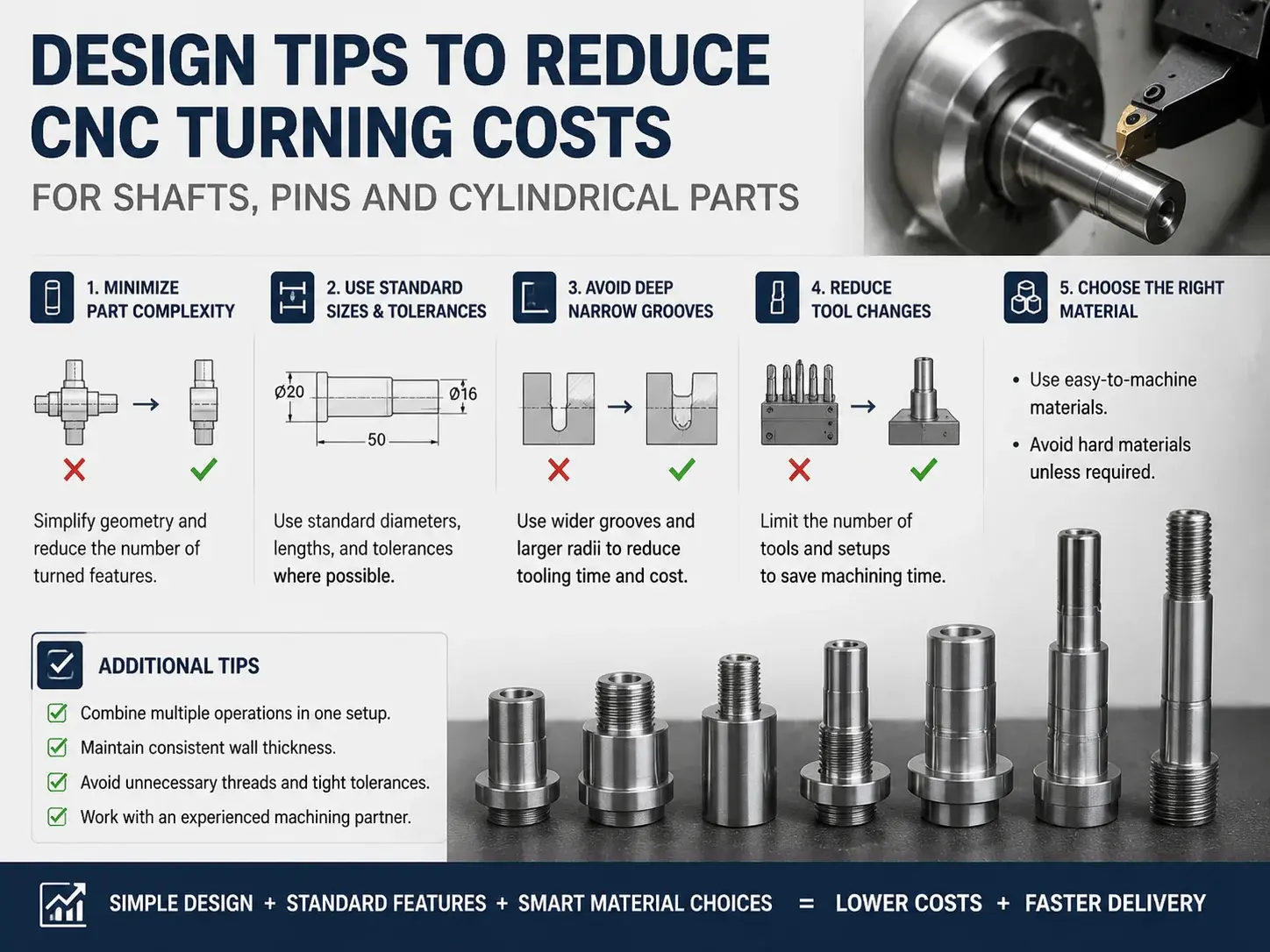
Knowing how to reduce cnc turning costs helps engineers and procurement teams control budgets without sacrificing performance. Turning cost is driven by material, setup time, cycle time, tool changes, tolerance requirements, finishing, inspection, and quantity.
Here are practical ways to reduce cost:
1. Use standard bar stock sizes
If the part can be made from standard bar stock with minimal material removal, machining time and material waste are reduced. Oversized stock increases cutting time and scrap.
2. Choose machinable materials
Brass, aluminum 6061, POM, and free-machining steel are often easier and faster to turn than stainless steel, titanium, or high-performance plastics. If the application does not require difficult materials, choose a more machinable option.
3. Avoid unnecessary tool changes
Every tool change adds time. Complex parts with many grooves, threads, bores, chamfers, and surface features may require multiple tools. Simplifying features can reduce cycle time.
4. Use standard threads
Standard metric or UNC/UNF threads are easier to produce and inspect. Custom thread forms require special tooling and increase cost.
5. Limit deep internal boring
Deep internal bores require long boring bars, which can vibrate and reduce accuracy. If possible, reduce bore depth, increase bore diameter, or split the design into multiple components.
6. Apply tight tolerances only where needed
Tight tolerances increase machining and inspection time. Use precision tolerances only on functional features.
7. Reduce cosmetic finishing on hidden surfaces
Polishing, plating, anodizing, passivation, and coating add cost. Apply finishing only where required for function or appearance.
8. Increase order quantity when possible
Setup and programming costs are spread across the batch. A 50-piece order usually has a much lower unit cost than a 5-piece order.
Cost Analysis Example
| Quantity | Setup Cost Impact | Unit Cost Trend | Best Use |
| 1–5 pcs | Very high per part | Highest | Prototype validation |
| 10–50 pcs | Shared across small batch | Lower | Engineering samples |
| 50–500 pcs | Efficient batch production | Much lower | Low-volume production |
| 500+ pcs | Automated feeding possible | Lowest for turning | Repeat production |
For turned parts, cost reduction often comes from design simplification, material selection, and quantity planning. A small change to the drawing can sometimes reduce machining time by 20–40%.
Scaling Your Production
CNC turning is not only useful for prototypes. It is also highly effective for low-volume and mid-volume production, especially for cylindrical parts that can be manufactured from bar stock.
When a product moves from concept to engineering validation, then to pilot production, the manufacturing strategy changes. At first, speed matters most. Later, consistency and cost become more important.
Turning supports this transition well because the same basic process can produce one prototype or hundreds of production parts.
Why utilize rapid prototyping cnc turning services?
Rapid prototyping cnc turning services help product teams validate cylindrical components quickly during new product development. In many cases, turned prototypes can be produced in a few working days, allowing teams to test assembly clearance, fit, thread engagement, bearing alignment, or shaft performance without waiting for tooling.
Rapid CNC turning is valuable when teams need:
Fast prototype shafts
Threaded inserts
Precision pins
Spacer samples
Sensor sleeves
Medical device components
Robotic transmission parts
Electrical connector prototypes
Automotive test components
For mechanical engineers, speed is not the only benefit. CNC turned prototypes are produced from real materials, so they provide more reliable feedback than visual models. If a prototype shaft must rotate under load, a real aluminum, steel, or POM turned part is more useful than a weak printed approximation.
For procurement managers, rapid turning reduces sourcing risk. Instead of committing to a large order immediately, buyers can test a small batch, confirm fit and performance, and then scale production.
Application Scenarios for Rapid CNC Turning
| Industry | Typical Turned Parts | Why CNC Turning Works |
| Medical Devices | Pins, sleeves, surgical components | Precision, small diameters, clean finish |
| Automotive | Sensor housings, shafts, bushings | Strength, repeatability, production testing |
| Aerospace & Defense | Fasteners, spacers, precision shafts | Tight tolerances, strong materials |
| Consumer Electronics | Connector pins, small housings | High accuracy, small features |
| Automation & Machinery | Rollers, shafts, fittings, spacers | Durability, repeat production |
A strong rapid prototyping supplier should provide DFM feedback before machining. This helps identify thread issues, tolerance problems, deep bore risks, and unnecessary cost drivers early.
Transitioning to custom cnc turning parts low volume production
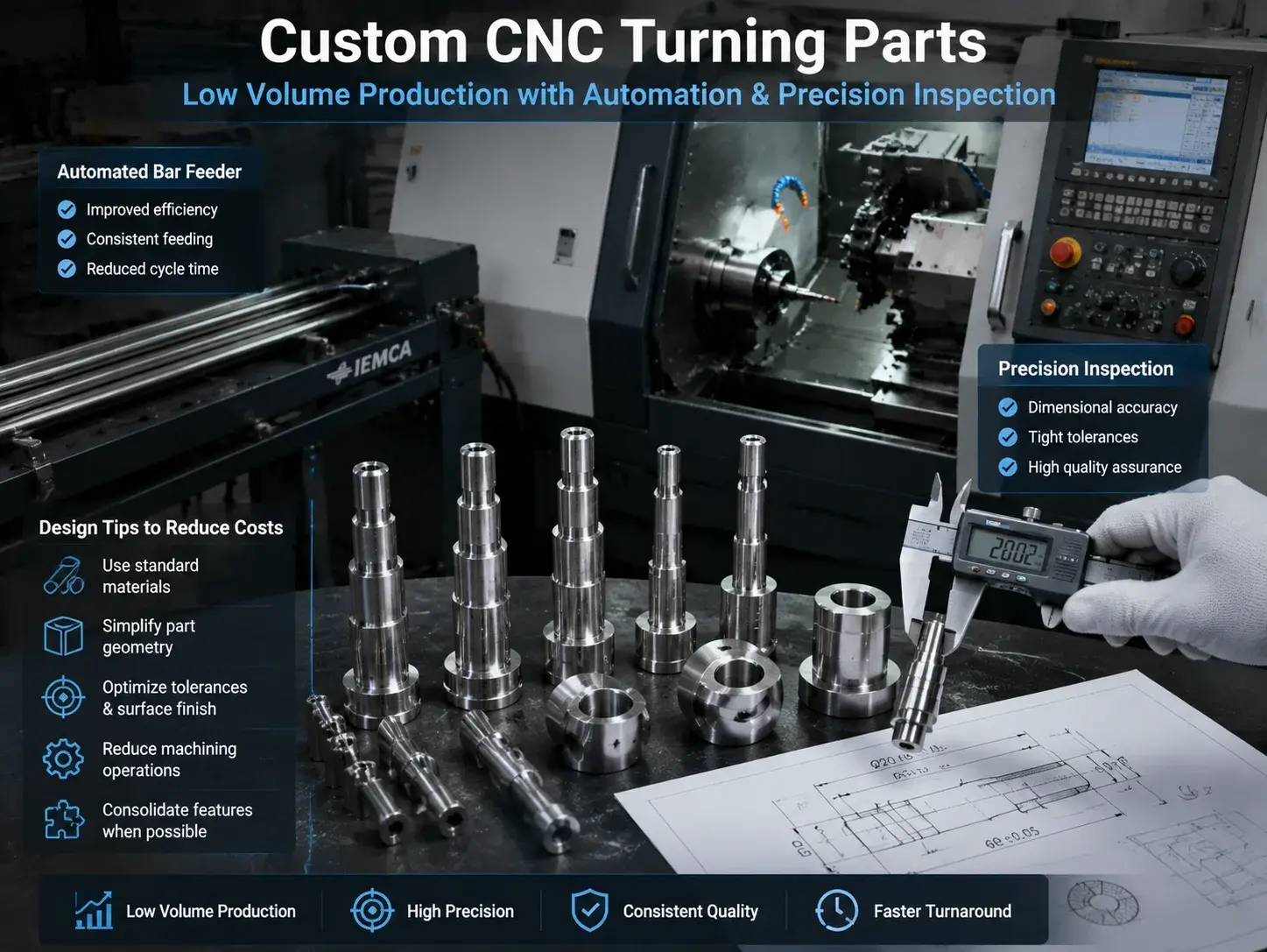
Custom cnc turning parts low volume production becomes especially attractive when quantities reach 50–500 pieces. At this stage, CNC turning can use automation strategies such as bar feeders, optimized toolpaths, batch inspection, and repeatable setups to reduce unit cost.
A bar feeder allows long bar stock to feed automatically into the lathe. After one part is cut off, the next section of material advances into position. This reduces manual handling and improves efficiency for repeated cylindrical parts.
Low-volume CNC turning is ideal when:
The design may still change
Tooling would be too expensive
The part requires real material performance
Production quantity is not high enough for dedicated tooling
Delivery speed matters
Multiple versions are needed
Quality consistency is required
For example, a robotics company may need 300 custom steel shafts for a pilot production build. Injection molding is irrelevant because the part is metal, and high-volume automated screw machining may not be justified yet. CNC turning with a bar feeder provides an efficient bridge between prototype and mass production.
A medical device company may need 100 stainless steel sleeves for validation units. CNC turning allows production from the correct material with controlled tolerances before the design is locked for larger production.
Low-Volume Turning Cost Logic
| Production Quantity | Recommended Strategy | Cost Logic |
| 1–10 pcs | Prototype turning | Fast validation, higher unit cost |
| 10–50 pcs | Small batch turning | Setup cost begins to spread |
| 50–500 pcs | Bar-fed CNC turning | Strong unit cost reduction |
| 500+ pcs | Automated turning or dedicated production | Best for repeat demand |
Compared with making each part manually, low-volume turning production allows better consistency and lower unit cost. It is also easier to maintain quality when the same setup, same toolpath, and same inspection plan are used across the batch.
CNC Turning Cost Analysis
CNC turning cost depends on more than part size. A small part can be expensive if it requires tight tolerances, difficult material, deep bores, custom threads, or multiple secondary operations. A larger part can be cost-effective if it has simple geometry and uses machinable material.
The main cost drivers include:
Material type
Bar stock diameter
Setup and programming time
Cycle time per part
Tool changes
Threading operations
Internal boring depth
Tolerance requirements
Surface finish
Heat treatment
Coating or plating
Inspection requirements
Quantity
Material Cost
Material cost increases when using stainless steel, titanium, PEEK, or specialty alloys. Brass may also be more expensive as raw material, but its machinability can reduce cycle time. Aluminum 6061 and POM are often cost-effective for many prototypes.
Cycle Time
Cycle time is the machining time required for each part. Deep bores, fine threads, complex grooves, and tight finishes increase cycle time. Faster cycle time means lower unit cost, especially in production runs.
Setup Time
Setup time includes programming, tooling preparation, machine setup, first article inspection, and workholding preparation. For one part, setup cost has a large impact. For 100 parts, the same setup cost is spread across the batch.
Tolerance and Inspection
Tight tolerances require more careful machining and measurement. If a customer requires full dimensional inspection reports, CMM inspection, material certificates, or special quality documentation, cost may increase.
Finishing
As-turned surfaces are usually the most cost-effective. Additional processes such as polishing, passivation, anodizing, black oxide, plating, or laser marking add cost but may be necessary for performance or appearance.
| Cost Driver | Lower-Cost Choice | Higher-Cost Choice |
| Material | Aluminum 6061, POM, free-machining steel | Titanium, PEEK, stainless steel |
| Geometry | Simple OD/ID features | Deep bores, complex grooves |
| Threads | Standard threads | Custom thread forms |
| Tolerances | Standard tolerances | Ultra-tight tolerances |
| Finish | As-turned | Polished, coated, plated |
| Quantity | 50–500 pcs | 1–5 urgent parts |
| Inspection | Standard QC | Full dimensional report |
The best way to control cost is to share the function of the part with the supplier. When the manufacturer understands which features are critical, they can recommend smarter tolerances, materials, and machining strategies.
Frequently Asked Questions
What is CNC turning best used for?
CNC turning is best used for cylindrical and rotationally symmetrical parts such as shafts, pins, bushings, sleeves, rollers, threaded inserts, fittings, and spacers. It is highly efficient when the main geometry is round.
What is the difference between CNC turning and CNC milling?
The key difference is motion. In CNC turning, the workpiece rotates while the cutting tool removes material. In CNC milling, the cutting tool rotates while the workpiece is usually fixed. For cnc turning vs milling for cylindrical parts, turning is usually faster and more cost-effective.
When should I choose Swiss CNC turning?
Swiss turning is best for small, slender, high-precision parts. In swiss cnc turning vs conventional turning, Swiss turning provides better support near the cutting zone, reducing deflection and improving accuracy for miniature components.
What are the best materials for CNC turning prototypes?
The best materials for cnc turning prototypes include brass, aluminum 6061, free-machining steel, stainless steel, POM, PEEK, and nylon. The best choice depends on strength, machinability, corrosion resistance, friction, and cost.
What tolerances can CNC turning achieve?
Typical CNC turning tolerances may range from ±0.1 mm for general features to ±0.05 mm or tighter for precision features. Exact cnc lathe turning tolerances and surface finish depend on material, geometry, machine capability, and inspection requirements.
How can I reduce CNC turning costs?
The best ways for how to reduce cnc turning costs include using standard bar stock, choosing machinable materials, avoiding unnecessary tight tolerances, using standard threads, simplifying grooves, and increasing batch quantity.
What should I consider when designing for CNC turning?
When designing for cnc turning manufacturability, avoid long unsupported thin sections, use proper relief grooves, select standard threads, keep cylindrical geometry simple, and define only critical tolerances tightly.
Are CNC turned parts suitable for low-volume production?
Yes. Custom cnc turning parts low volume production is cost-effective for 50–500 pieces, especially when bar feeders and repeatable setups can reduce labor and unit cost.
How fast can CNC turning prototypes be delivered?
With rapid prototyping cnc turning services, simple turned prototypes can often be produced within several working days, depending on material availability, complexity, finishing, and inspection requirements.
Can CNC turning produce parts for medical or aerospace applications?
Yes. CNC turning is widely used for medical, aerospace, defense, automotive, electronics, and industrial machinery applications. Material documentation, tight tolerances, and inspection may be required for critical industries.
CNC turning is one of the most efficient manufacturing methods for cylindrical parts. When a component is round, shaft-like, or rotationally symmetrical, turning can deliver better concentricity, smoother surfaces, faster cycle times, and lower cost than many alternative machining methods.
For engineers, the key is to design with the turning process in mind. Keep geometry simple, avoid unnecessary complexity, select machinable materials, use standard threads, define tolerances carefully, and consider production quantity early. For procurement teams, the key is to provide complete drawings, clear material requirements, and accurate quantity targets so the supplier can recommend the most efficient process.
From one prototype to a 500-piece pilot run, CNC turning offers a practical path from design validation to production-ready parts.
Ready to Start Your CNC Turning Project?
Whether you need a single prototype or a batch of custom pins, GC-Prototype has you covered.
We provide professional CNC turning, CNC milling, Swiss turning, precision machining, rapid prototyping, and low-volume manufacturing services for global B2B customers.