Address:
Shenzhen Bao'an District Xinqiao Subdistrict Huangpu Community Huangpu East Ring Road No. 504 Shenzhen Yuan Industrial City Building C
Work Hours:
Monday to Friday: 9AM - 21PM
Weekend: 9AM - 21PM

Address:
Shenzhen Bao'an District Xinqiao Subdistrict Huangpu Community Huangpu East Ring Road No. 504 Shenzhen Yuan Industrial City Building C
Work Hours:
Monday to Friday: 9AM - 21PM
Weekend: 9AM - 21PM

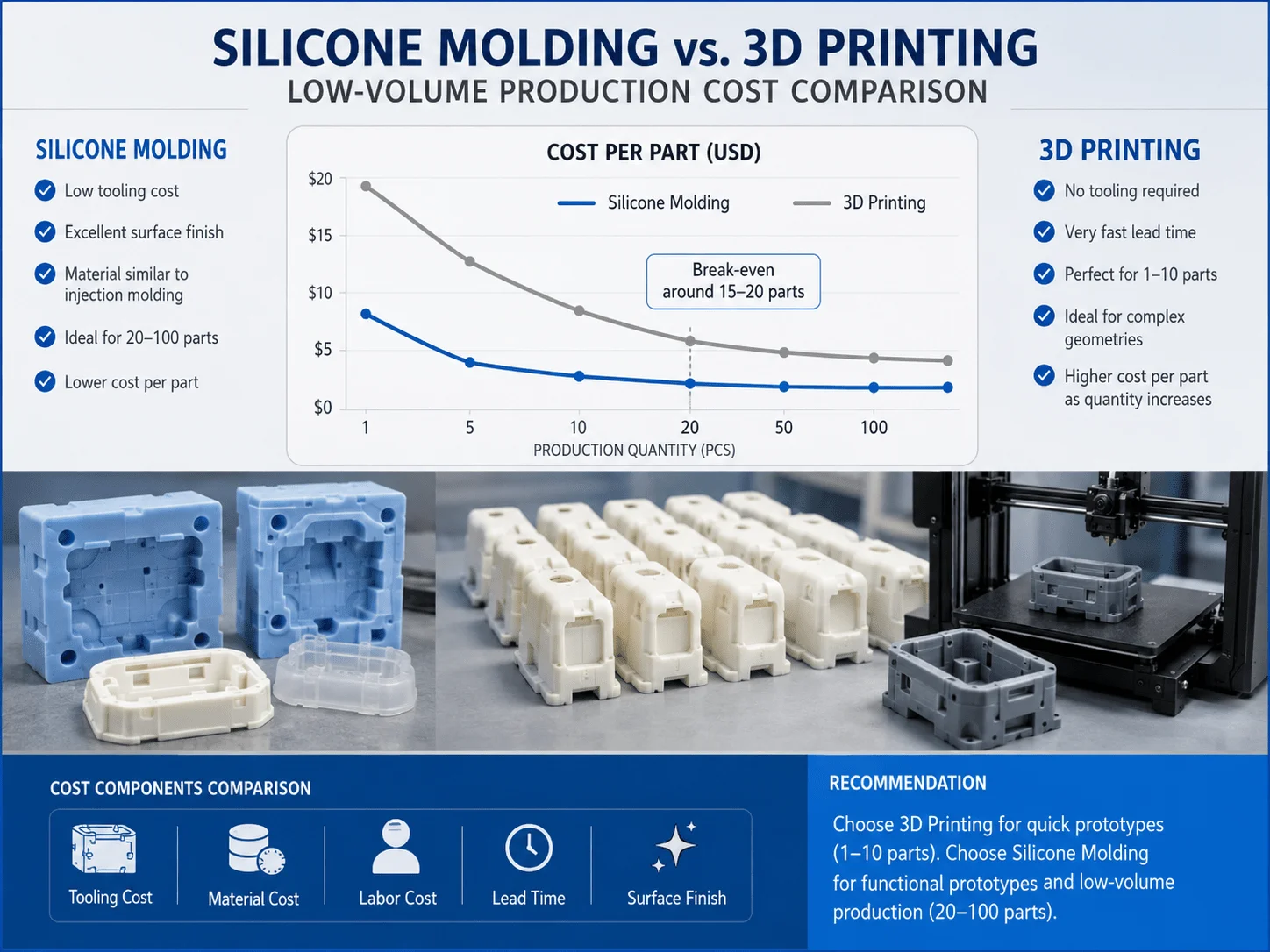
When choosing between Silicone Molding vs. 3D Printing for low-volume production, cost is often the deciding factor—but it’s far from the only one. Manufacturers, product designers, and procurement engineers also need to consider tooling investment, lead time, part quality, material performance, production volume, and scalability.
Both Silicone Molding and 3D Printing play important roles in modern Rapid Prototyping Services, yet they excel in different scenarios. Selecting the wrong process can increase production costs, delay product launches, or compromise product performance.
This guide compares these two manufacturing methods from a practical engineering perspective, helping you determine which solution delivers the best value for your project.
What Is Silicone Molding?
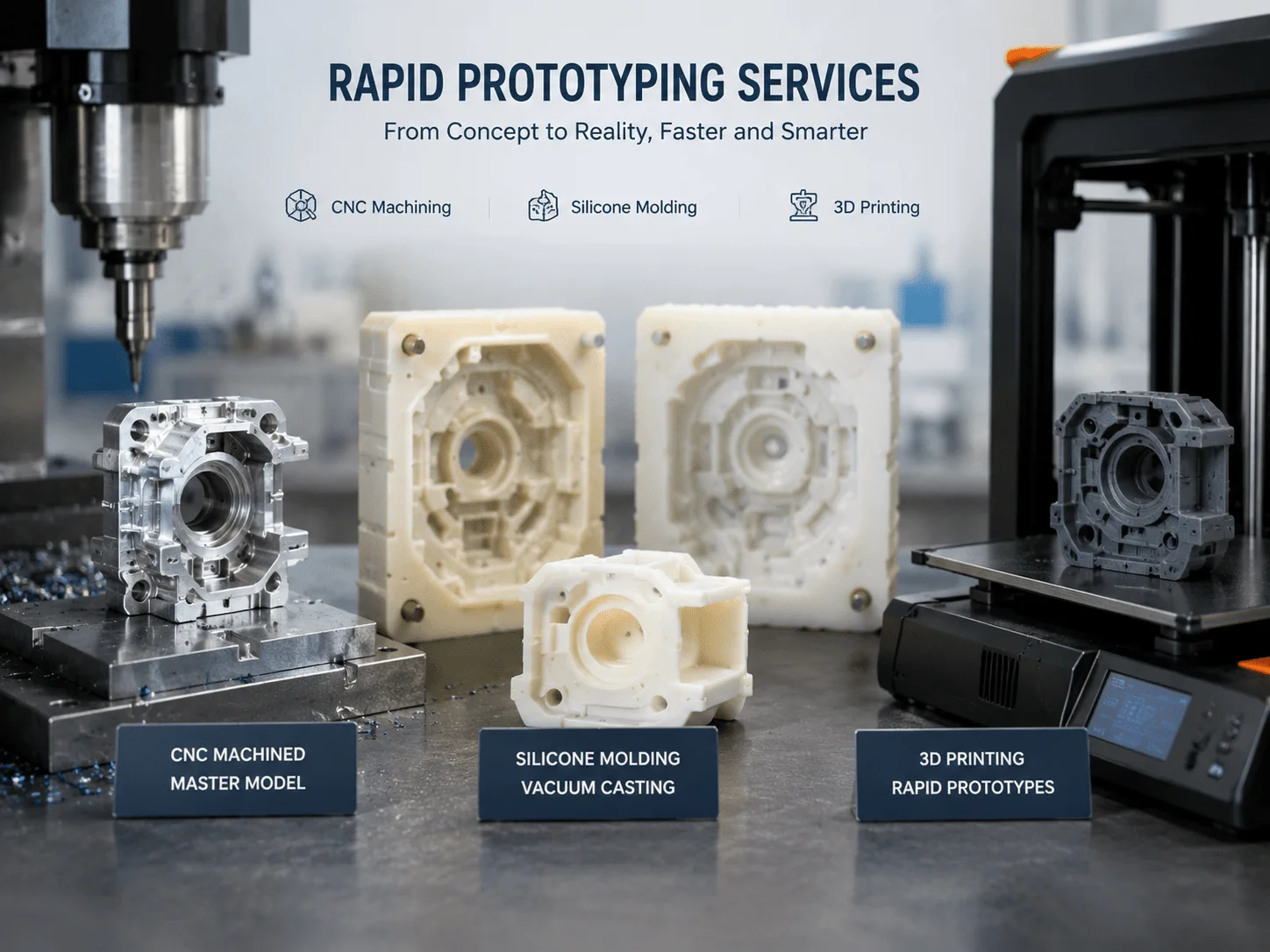
Silicone Molding, often called vacuum casting, is a manufacturing process that creates polyurethane parts using silicone molds copied from a master model.
The process typically involves:
1.Manufacturing a master model using Custom CNC Machining or 3D Printing
2.Creating a silicone mold around the master
3.Pouring liquid polyurethane resin into the mold
4.Vacuum degassing to eliminate air bubbles
5.Curing and removing the finished part
Because each silicone mold can usually produce 15–30 high-quality parts, the process is ideal for Low-Volume Production before investing in expensive injection molding tooling.
Key Advantages
•Excellent surface finish
•Near injection-molded appearance
•Wide selection of engineering-grade resins
•Low tooling cost
•Fast turnaround
•Ideal for functional prototypes and bridge production
What Is 3D Printing?
3D Printing, also known as additive manufacturing, builds parts layer by layer directly from a CAD model without requiring molds or tooling.
Common technologies include:
•SLA (Stereolithography)
•SLS (Selective Laser Sintering)
•FDM (Fused Deposition Modeling)
•MJF (Multi Jet Fusion)
•DLP
Unlike traditional manufacturing, 3D Printing allows engineers to move from CAD design to physical parts within hours.
Key Advantages
•No tooling required
•Extremely fast prototyping
•Complex geometries
•Internal channels
•Lightweight lattice structures
•Easy design modifications
This makes it one of the most widely used technologies in today’s Prototype Manufacturing industry.
Silicone Molding vs. 3D Printing: Cost Comparison
Although many people assume 3D Printing is always cheaper, that’s only true for very small quantities.
As production volume increases, Silicone Molding becomes increasingly cost-effective.
Initial Investment
3D Printing
Initial cost is extremely low.
There is:
•No mold
•No tooling
•No fixture
You simply upload the CAD file and begin printing.
This makes 3D Printing perfect for:
•One-off prototypes
•Product validation
•Design verification
•Concept models
Silicone Molding
The first step requires producing:
•A master pattern
•A silicone mold
This introduces an upfront tooling cost.
However, compared with steel tooling for injection molding, silicone molds are inexpensive and can usually be completed within a few days.
For engineering teams planning multiple prototype iterations, this investment is often worthwhile.
Cost Per Part
This is where the economics begin to shift.
For 1–5 Parts
3D Printing is usually the more economical choice.
Reasons include:
•Zero tooling
•Immediate production
•No mold preparation
•Lower upfront expense
For 20–100 Parts
This is where Silicone Molding becomes highly competitive.
Although a silicone mold must be produced first, the tooling cost is distributed across multiple parts.
As production quantity increases:
•Cost per part decreases
•Surface quality improves
•Production efficiency increases
This is why many manufacturers choose Vacuum Casting during pilot production.
For More Than 100 Parts
Neither process is usually the best long-term solution.
At this stage, Injection Molding generally provides the lowest cost per part despite its higher tooling investment.
Lead Time Comparison
Speed is another major consideration.
3D Printing
Typical lead time:
•1–3 days
There is virtually no setup.
Design changes can be implemented immediately.
This flexibility makes it ideal during product development.
Silicone Molding
Typical timeline:
•Master model: 1–3 days
•Silicone mold: 2–4 days
•Casting production: 1–3 days
Total lead time generally falls between 5–8 working days.
Although slightly longer than 3D Printing, it remains significantly faster than traditional manufacturing processes.
Surface Finish and Appearance
For products intended for customer presentations, exhibitions, or investor demonstrations, appearance matters.
Silicone Molding
One of the biggest strengths of Silicone Molding is its exceptional cosmetic quality.
Finished parts typically feature:
•Smooth surfaces
•Uniform texture
•Injection-molded appearance
•Excellent paintability
•High transparency (depending on resin)
Many customers find it difficult to distinguish vacuum-cast parts from injection-molded components.
3D Printing
Surface quality varies depending on the printing technology.
For example:
•FDM often shows visible layer lines.
•SLA offers excellent detail but may require post-processing.
•SLS produces slightly rough surfaces.
Additional sanding, polishing, or painting is often necessary for presentation-quality parts.
Material Performance
Material selection also affects the total cost of a project.
Silicone Molding Materials
Polyurethane resins can simulate:
•ABS
•PP
•PC
•Rubber
•Transparent plastics
•High-temperature materials
These materials are widely used for:
•Functional testing
•Appearance models
•Marketing samples
•Engineering validation
3D Printing Materials
Available materials include:
•PLA
•ABS
•Nylon
•Resin
•TPU
•Carbon fiber composites
Some engineering materials offer impressive strength, but others may not fully replicate the properties of injection-molded plastics.
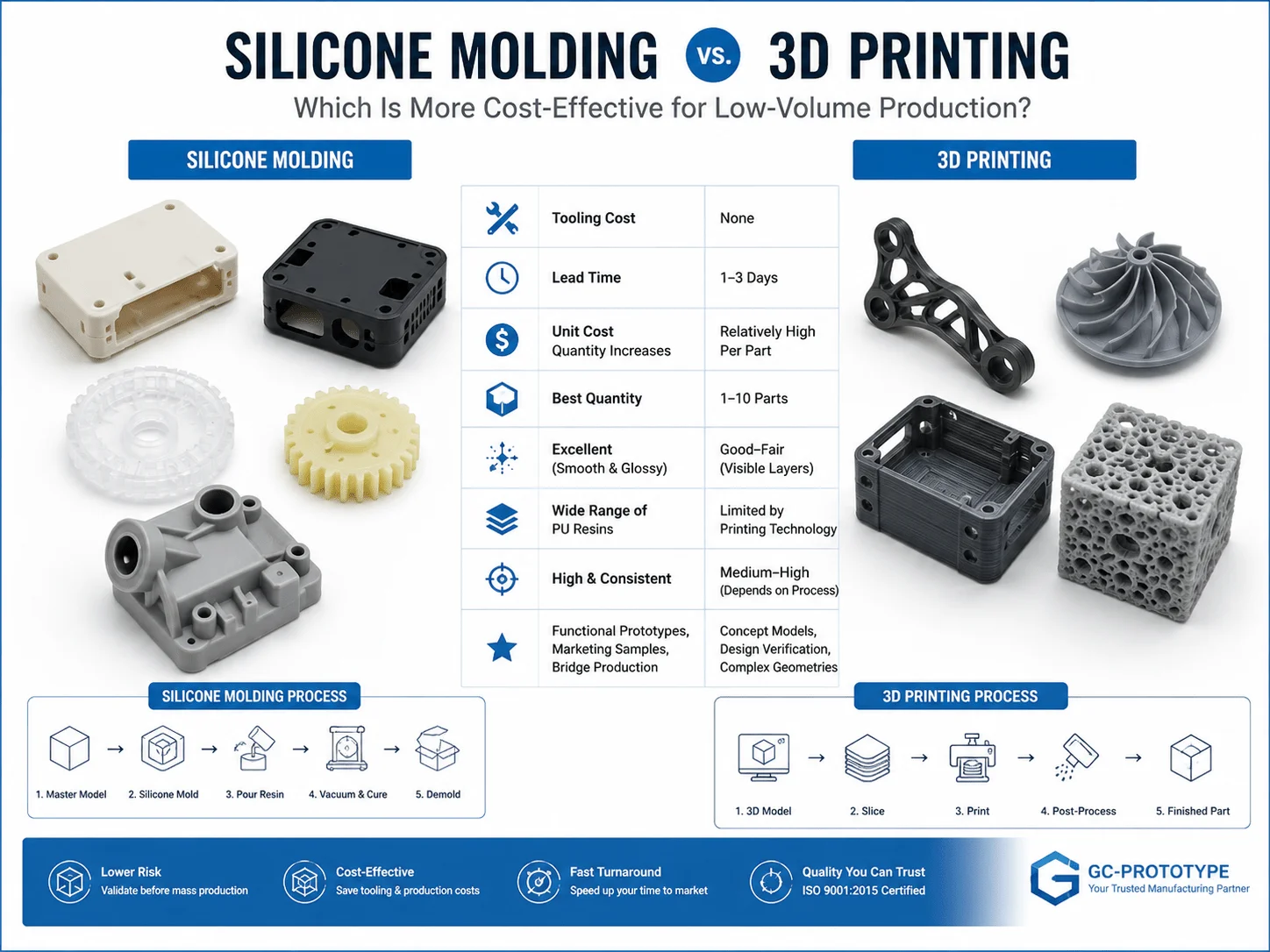
Best Applications for Silicone Molding and 3D Printing
Choosing the right manufacturing process depends on much more than cost. Engineers should evaluate production quantity, material properties, cosmetic requirements, and project timelines before making a decision.
When Silicone Molding Is the Better Choice
Silicone Molding is the preferred solution when you need multiple high-quality parts that closely resemble injection-molded products.
Typical applications include:
•Functional prototypes
•Marketing samples
•Engineering validation
•Bridge production
•Medical device prototypes
•Consumer electronics housings
•Automotive interior components
•Small-batch production
Because polyurethane materials can simulate ABS, PP, PC, and rubber, vacuum casting is widely used before investing in expensive injection molds.
When 3D Printing Is the Better Choice
3D Printing is ideal for projects requiring maximum design flexibility.
Typical scenarios include:
•One-off prototypes
•Design verification
•Concept models
•Complex internal structures
•Lightweight parts
•Rapid product development
Since there is no tooling, engineers can modify CAD files and print updated parts within hours.
This flexibility significantly shortens the product development cycle.
Silicone Molding vs. 3D Printing: Quality Comparison
Although both technologies produce prototype parts, their final quality differs considerably.
Dimensional Accuracy
Modern Rapid Prototyping Services can achieve impressive dimensional accuracy with both processes.
Generally speaking:
Silicone Molding
•Excellent dimensional consistency
•Suitable for batch production
•Stable repeatability
3D Printing
•Accuracy depends on printing technology
•May require support removal
•Shrinkage varies by material
Surface Finish
Surface appearance often determines whether a prototype is suitable for customer presentations.
Silicone Molding
Advantages include:
•Smooth glossy surface
•Injection-molded appearance
•Excellent paint adhesion
•Consistent color
3D Printing
Depending on the technology used, printed parts may exhibit:
•Layer lines
•Visible support marks
•Rough texture
Additional finishing processes such as sanding, polishing, or painting are often required.
Real Manufacturing Example
Imagine a customer developing a new smart home controller.
The engineering team requires:
•40 prototype housings
•Product testing
•Customer demonstrations
•Assembly verification
If every housing is produced by 3D Printing, the total manufacturing cost remains relatively high because every single part requires individual printing time.
Instead, producing one master model and several silicone molds allows Silicone Molding to manufacture all 40 parts much more efficiently.
In this case, the customer benefits from:
•Lower cost per part
•Better cosmetic quality
•Faster batch production
•Consistent dimensions
This is why many OEMs choose Vacuum Casting before moving to injection molding.
Silicone Molding vs. 3D Printing: Cost Comparison at Different Production Volumes
Choosing the most cost-effective manufacturing process largely depends on production volume. While 3D Printing has virtually no tooling cost, Silicone Molding becomes increasingly economical as the number of parts grows.
| Production Quantity | Recommended Process | Reason |
| 1–5 Parts | 3D Printing | No tooling cost, fastest delivery |
| 5–20 Parts | Either Process | Depends on material and surface requirements |
| 20–100 Parts | Silicone Molding | Lower cost per part, better consistency |
| 100+ Parts | Injection Molding | Lowest unit cost for mass production |
For most Low-Volume Production projects, Silicone Molding offers the best balance between cost, appearance, and production efficiency.
How to Choose the Right Manufacturing Process
Instead of asking which process is better, engineers should ask which process better fits their project goals.
Choose 3D Printing if you need:
•The fastest prototype turnaround
•Only one or two parts
•Frequent design modifications
•Complex internal geometries
•No tooling investment
Choose Silicone Molding if you need:
•20–100 functional parts
•Excellent cosmetic quality
•Injection-mold-like appearance
•Consistent dimensions
•Better unit cost
•Market validation before mass production
Many successful product launches actually use both technologies at different development stages.
Expert Recommendation
For most product development projects, there is no single “best” manufacturing method.
A common workflow adopted by experienced manufacturers is:
1.Use 3D Printing for early concept verification.
2.Switch to Silicone Molding for engineering validation and customer samples.
3.Move to Injection Molding once production volumes justify tooling investment.
This approach minimizes development risk while controlling manufacturing costs throughout the product lifecycle.
Frequently Asked Questions (FAQ)
Is Silicone Molding cheaper than 3D Printing?
For one or two parts, 3D Printing is usually less expensive because no mold is required. However, once production reaches around 20 parts or more, Silicone Molding generally offers a lower cost per part.
How many parts can one silicone mold produce?
Most silicone molds can produce approximately 15–30 high-quality parts, depending on the geometry, resin material, and part complexity.
Which process provides a better surface finish?
Silicone Molding generally produces smoother surfaces that closely resemble injection-molded parts, making it ideal for customer presentations and product demonstrations.
Can Silicone Molding produce functional prototypes?
Yes. Polyurethane materials used in Silicone Molding can simulate engineering plastics such as ABS, PP, and PC, making them suitable for many functional testing applications.
Is 3D Printing suitable for end-use parts?
Certain industrial 3D Printing technologies can manufacture end-use components, but the suitability depends on the required mechanical properties, accuracy, and production quantity.
There is no universal winner in the comparison of Silicone Molding vs. 3D Printing. The most cost-effective solution depends on your production volume, quality requirements, delivery schedule, and project budget.
If your project requires only a few prototypes with frequent design revisions, 3D Printing is often the best choice. If you need dozens of high-quality functional parts with excellent surface finish and lower unit costs, Silicone Molding becomes the smarter investment.
Ready to Start Your Rapid Prototyping Project?
Whether you need Rapid Prototyping Services, Custom CNC Machining, Silicone Molding, Vacuum Casting, or Low-Volume Manufacturing, the engineering team at GC-Prototype is ready to help.