Address:
Shenzhen Bao'an District Xinqiao Subdistrict Huangpu Community Huangpu East Ring Road No. 504 Shenzhen Yuan Industrial City Building C
Work Hours:
Monday to Friday: 9AM - 21PM
Weekend: 9AM - 21PM

Address:
Shenzhen Bao'an District Xinqiao Subdistrict Huangpu Community Huangpu East Ring Road No. 504 Shenzhen Yuan Industrial City Building C
Work Hours:
Monday to Friday: 9AM - 21PM
Weekend: 9AM - 21PM

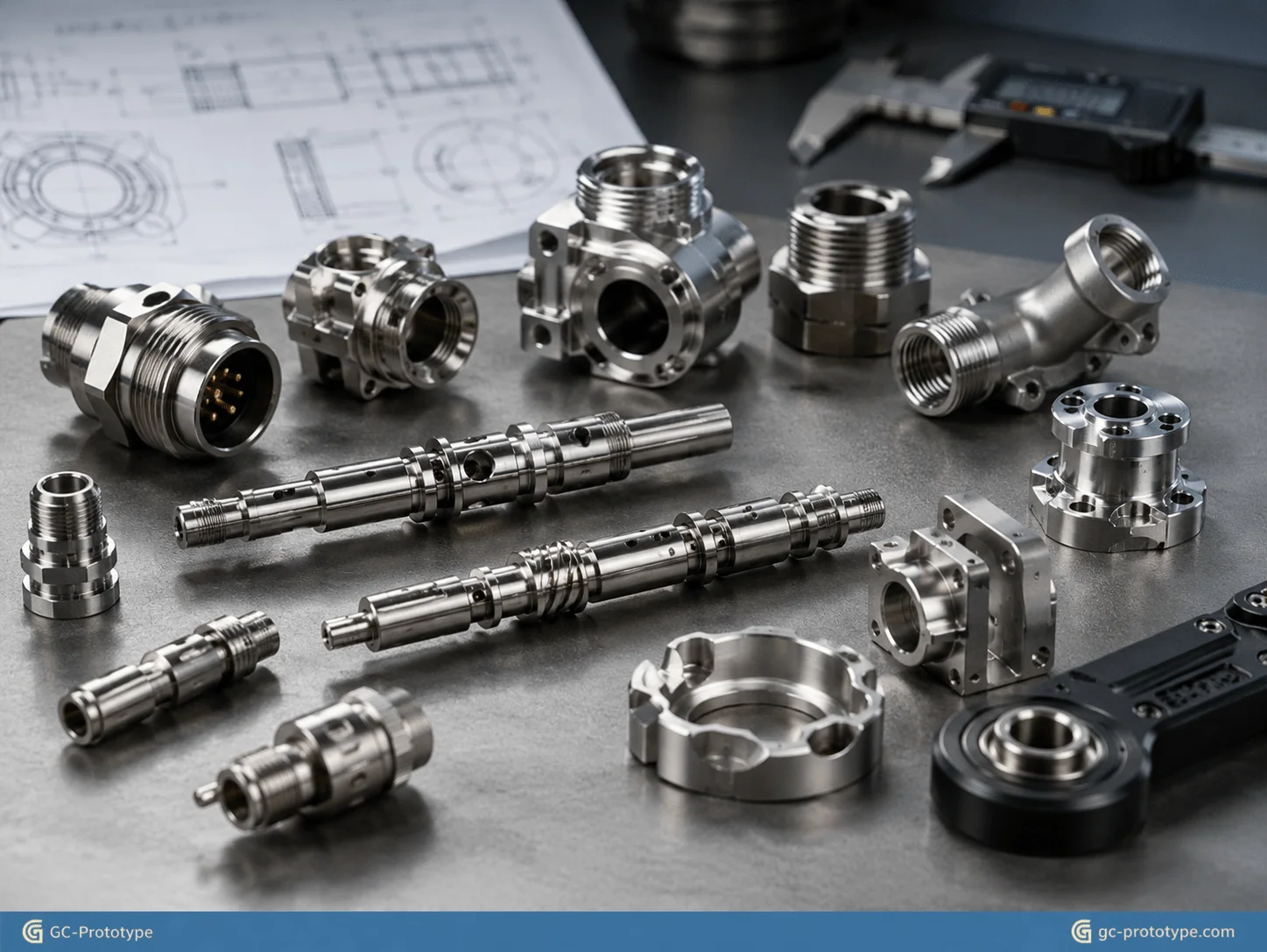
CNC Turning is one of the most efficient manufacturing methods for producing precision cylindrical components, shafts, pins, bushings, connectors, and rotating mechanical parts for prototypes and low-volume production. Unlike molding processes that require expensive tooling, CNC turning creates functional parts directly from metal or plastic bar stock, allowing engineers to validate designs quickly with production-grade materials.
For Senior Mechanical Engineers, Product Designers, R&D Engineers, and Procurement Managers, choosing the right turning process requires more than comparing machining prices. Material selection, tolerance requirements, surface finish, production quantity, machine capability, automation level, and inspection standards all influence the final cost and performance of a turned component.
This CNC Turning Guide explains how to select the right turning process, optimize low-volume production costs, compare Swiss turning and conventional CNC turning, achieve medical and automotive precision requirements, control surface finish, and design parts for efficient manufacturing.
What Is CNC Turning and Why Is It Important for Low-Volume Manufacturing?
CNC turning is a subtractive manufacturing process where a rotating workpiece is cut by a stationary cutting tool controlled through computer numerical programming. Unlike CNC milling, where the cutting tool rotates around the part, turning primarily uses rotational movement to create cylindrical or symmetrical geometries.
Common CNC turned components include:
Precision shafts
Pins
Bushings
Spacers
Threaded connectors
Medical instrument components
Automotive sensor housings
Hydraulic components
Industrial machine parts
Robotic transmission components
The biggest advantage of CNC turning is flexibility. Engineers can manufacture one prototype, several validation units, or thousands of low-volume components without investing in dedicated molds or dies.
For product-development teams, this makes CNC turning especially valuable during:
Concept validation
Engineering testing
Pilot production
Replacement-part manufacturing
Custom equipment development
Low-volume commercial production
Compared with injection molding or die casting, CNC turning requires minimal upfront investment. A CAD file and engineering drawing can often move directly into programming and machining.
| Manufacturing Process | Tooling Requirement | Best Quantity | Material Options | Typical Application |
|---|---|---|---|---|
| CNC Turning | No dedicated tooling | 1–10,000+ | Metals and plastics | Shafts, pins, precision parts |
| CNC Milling | No dedicated tooling | 1–5,000 | Metals and plastics | Complex prismatic parts |
| Swiss Turning | No dedicated tooling | Medium/high volume | Metals and plastics | Small precision components |
| Injection Molding | High tooling cost | High volume | Thermoplastics | Plastic production parts |
| Die Casting | High tooling cost | Medium/high volume | Aluminum, zinc, magnesium | Metal production parts |
CNC turning is especially competitive when parts have rotational symmetry. A component containing multiple diameters, grooves, threads, tapers, bores, and precision shoulders can often be manufactured efficiently in a single setup.
However, cost depends heavily on design complexity. A simple aluminum spacer may require only minutes of machining, while a medical shaft containing multiple precision diameters, surface requirements, and inspection requirements may require significantly more processing.
The goal is not simply to choose the cheapest machining method. The goal is selecting the manufacturing process that provides the best combination of:
Functional performance
Production reliability
Lead time
Unit cost
Future scalability
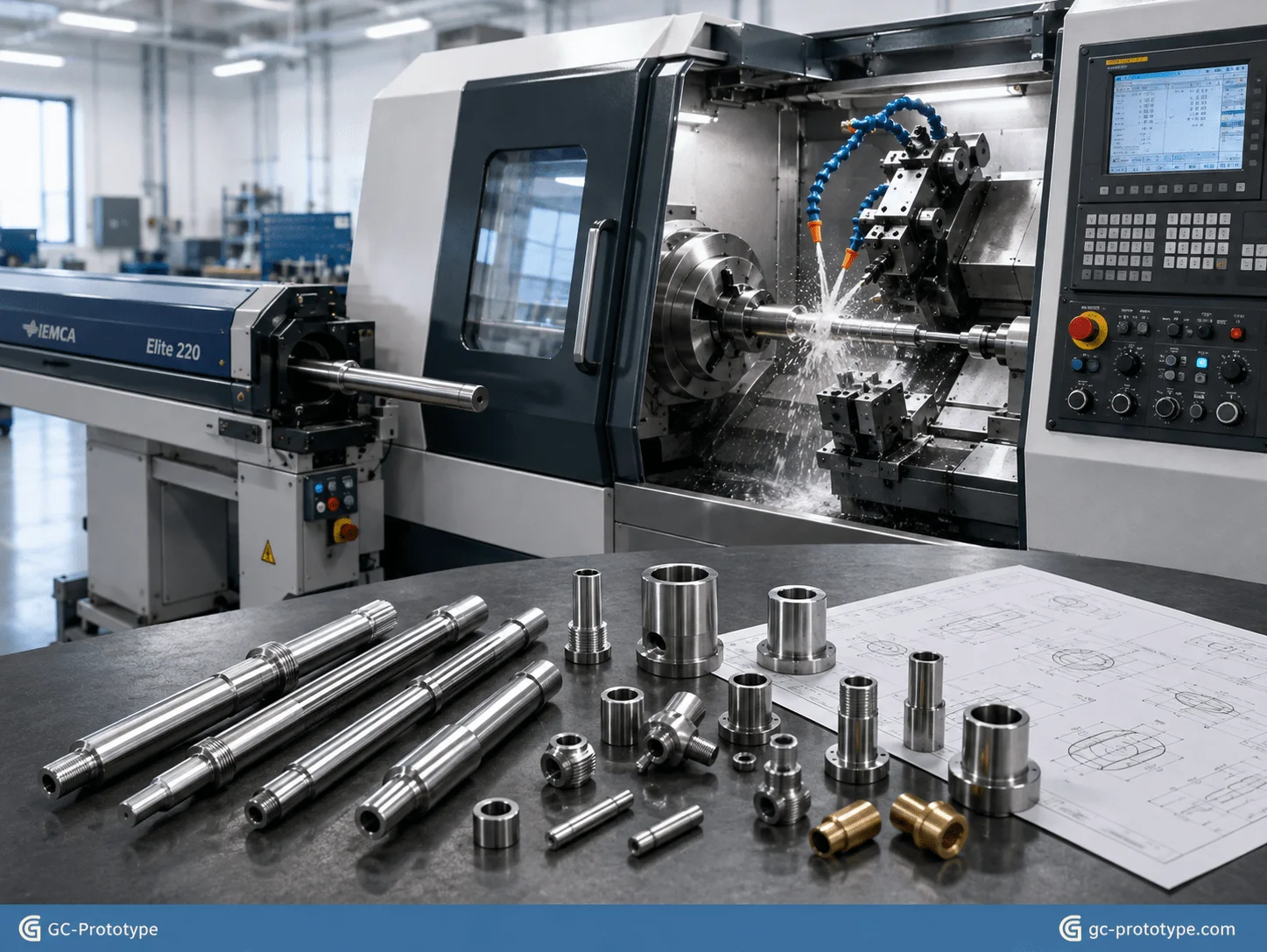
Industry Applications & Material Selection
CNC turning is used across industries because rotating components appear in almost every mechanical system. From medical instruments to aerospace mechanisms, manufacturers rely on turning for repeatable geometry and excellent dimensional control.
Typical applications include:
Medical shafts and surgical components
Automotive sensor parts
Aerospace fasteners and actuator components
Hydraulic fittings
Robotics joints
Industrial automation parts
Electronic connectors
Optical equipment components
Material selection plays a major role in machining performance and final part quality.
Common CNC turning materials include:
| Material | Advantages | Typical Applications |
|---|---|---|
| Aluminum 6061 | Lightweight, machinable, corrosion resistant | Housings, prototypes |
| Aluminum 7075 | High strength-to-weight ratio | Aerospace components |
| Stainless Steel 304 | Corrosion resistance | Industrial and medical parts |
| Stainless Steel 316L | Excellent corrosion resistance | Medical applications |
| Titanium Ti6Al4V | High strength, lightweight | Aerospace and medical |
| Brass | Excellent machinability | Connectors and fittings |
| PEEK | Chemical resistance, high temperature | Medical and industrial |
Material choice should consider:
Mechanical loading
Temperature exposure
Corrosion environment
Wear requirements
Sterilization requirements
Surface finishing
Machining difficulty
Cost targets
A common mistake in product development is selecting materials only based on performance without considering manufacturing economics.
For example, titanium provides excellent strength and corrosion resistance, but machining titanium requires specialized tooling, slower cutting speeds, and stronger process control compared with aluminum.
For prototype validation, engineers should determine whether the final production material is required or whether a lower-cost engineering material can provide sufficient test results.
Medical Precision: Achieving precision cnc turning tolerances for medical shafts
Achieving precision cnc turning tolerances for medical shafts requires careful coordination between design requirements, machining capability, inspection methods, and material selection.
Medical shafts are commonly used in:
Surgical instruments
Robotic medical equipment
Diagnostic systems
Implant manufacturing tools
Precision mechanical assemblies
These components often require:
Tight diameter control
Excellent concentricity
Controlled surface finish
Corrosion resistance
Repeatable mechanical performance
A medical shaft may include multiple functional zones:
Bearing surfaces
Rotating interfaces
Threaded sections
Alignment areas
Assembly features
Each area may require different specifications.
For example, a rotating medical instrument shaft may require extremely tight diameter tolerance and low surface roughness on the bearing section, while the non-functional gripping area may use standard machining requirements.
Applying the highest tolerance requirement to every feature increases cost unnecessarily.
A better engineering approach is separating:
Critical functional dimensions
General dimensions
Cosmetic areas
Assembly surfaces
Inspection requirements
Precision CNC turning can achieve excellent repeatability when supported by:
Stable machine platforms
Proper tooling
Controlled cutting parameters
Workholding optimization
Temperature management
CMM inspection
For medical applications, documentation is also important. Depending on the project, manufacturers may need:
Material certificates
Inspection reports
Dimensional records
Process documentation
Traceability information
The machining process itself does not automatically make a component medical-grade. The final application requirements determine the necessary validation, cleaning, finishing, and documentation.
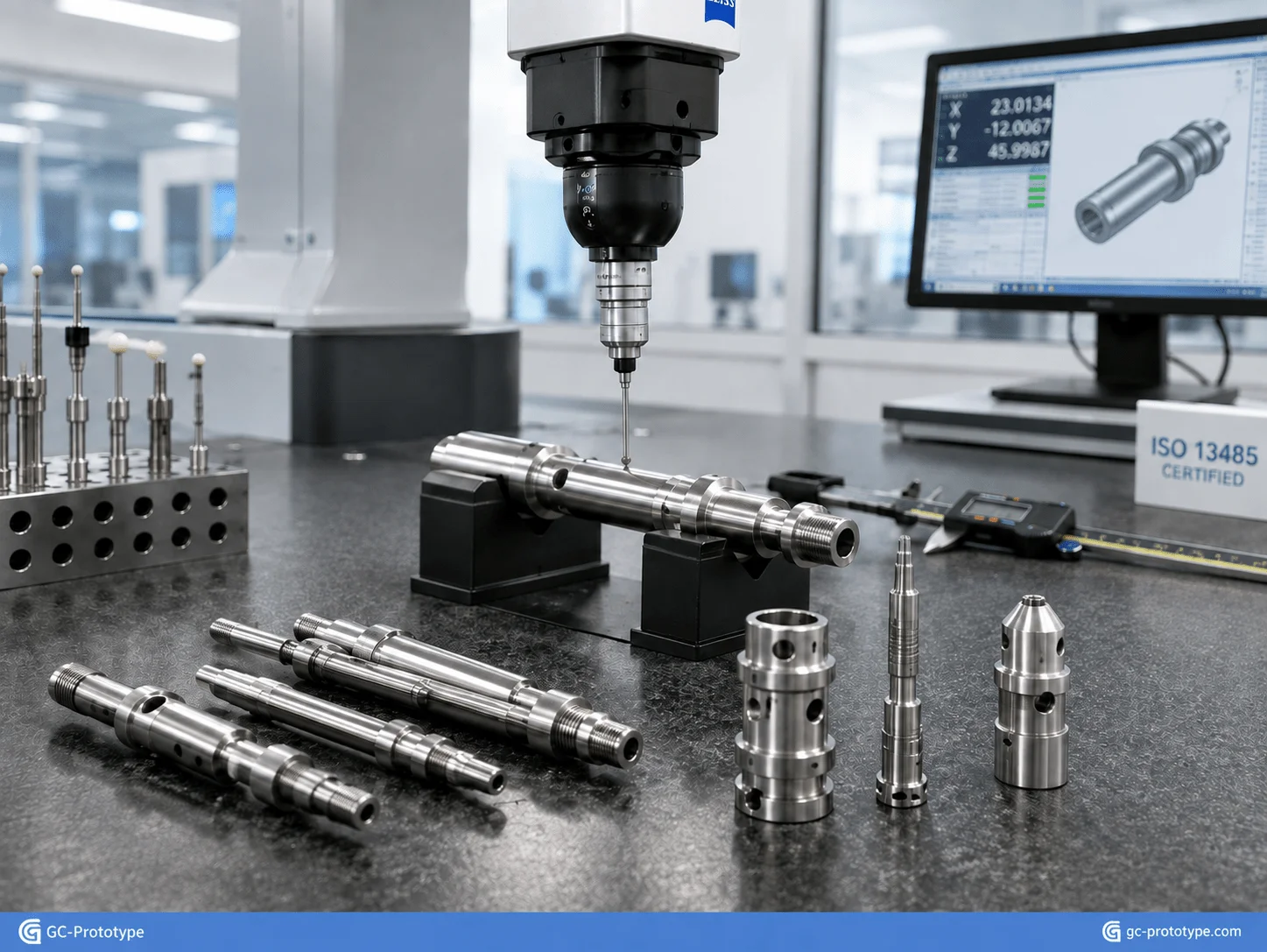
Process Comparison & Cost Analysis
Cost Comparison: swiss turning vs conventional cnc turning cost
The decision between Swiss turning and conventional CNC turning depends on part size, geometry, production quantity, tolerance requirements, and automation needs. A simple assumption that Swiss turning is always more expensive or always more precise can lead to incorrect manufacturing decisions.
Both processes use CNC-controlled turning technology, but their mechanical structures are different.
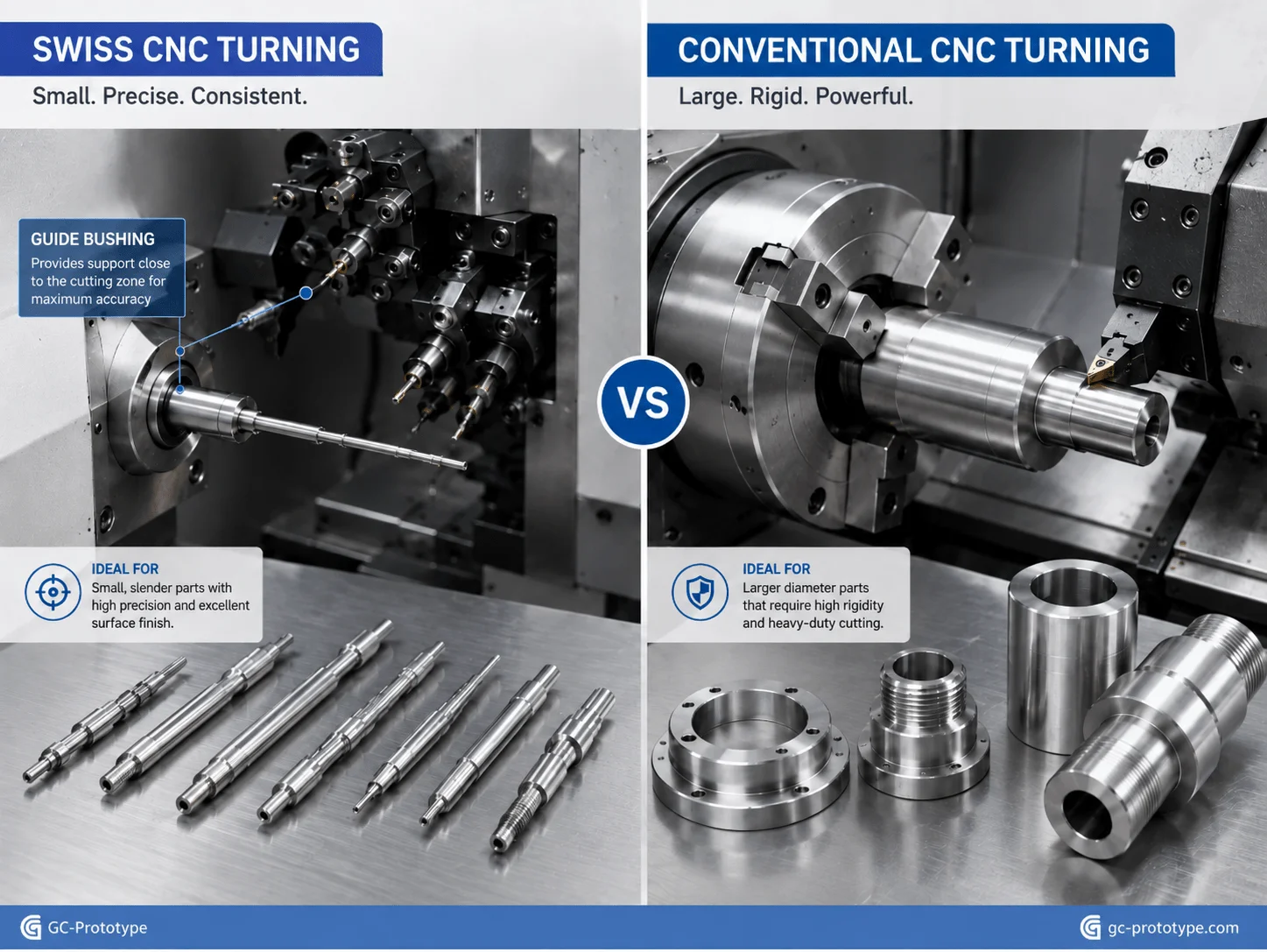
Conventional CNC turning typically holds the workpiece in a chuck while the cutting tools move along the part. It is highly effective for medium and larger cylindrical components with relatively stable geometry.
Swiss turning machines use a sliding headstock design where the bar stock moves through a guide bushing while the cutting tools operate close to the support point. This reduces deflection and improves stability when machining long, thin, or miniature components.
| Comparison Factor | Swiss Turning | Conventional CNC Turning |
|---|---|---|
| Part Size | Small diameter parts | Small to large cylindrical parts |
| Workpiece Support | Guide bushing support | Chuck or collet holding |
| Long Thin Shafts | Excellent | More challenging |
| Complex Small Features | Excellent | Good |
| Setup Cost | Higher | Lower |
| Production Volume | Medium/high volume | Prototype to medium volume |
| Automation Capability | Excellent | Good |
| Material Waste | Low | Moderate |
| Best Application | Precision small components | General turned parts |
For example, a 2 mm diameter medical shaft with multiple grooves, cross holes, and tight concentricity requirements may be ideal for Swiss turning.
A 50 mm diameter aluminum housing component with external threads and several machining operations may be more economical using conventional CNC turning.
The cost difference is mainly influenced by:
Machine investment
Programming complexity
Setup time
Tooling requirements
Cycle time
Production quantity
Part geometry
When Swiss Turning Provides Better Economics
Swiss turning becomes financially attractive when:
Part diameter is small
Parts are long and slender
Large quantities are required
Multiple operations can be completed automatically
Tight tolerances are required
The ability to complete multiple operations in one setup reduces handling and secondary machining.
A typical Swiss-machined component may include:
Turning
Threading
Grooving
Drilling
Milling
Cross-hole machining
Deburring
Completing these operations without removing the part improves consistency and reduces labor.
When Conventional CNC Turning Is More Cost Effective
Traditional CNC turning remains the better choice for:
Larger components
Shorter parts
Prototype quantities
Low-volume custom components
Larger diameter materials
Parts requiring frequent design changes
For product development teams, conventional turning often provides more flexibility during early design iterations because programming changes are simpler and setup investment is lower.
The correct process selection should always consider total project cost rather than machine hourly rate alone.
CNC Turning Surface Quality & Finishing Requirements
Controlling cnc turning surface finish ra values
Understanding cnc turning surface finish ra values helps engineers specify realistic requirements while controlling manufacturing cost.
Surface roughness affects:
Friction
Wear
Sealing performance
Appearance
Assembly performance
Fatigue behavior
Ra (average roughness) is one of the most common surface-finish measurements used in CNC machining.
Typical CNC turning surface finishes include:
| Surface Finish | Approximate Ra Range | Typical Application |
|---|---|---|
| Standard machined finish | Ra 3.2 µm | General industrial components |
| Improved finish | Ra 1.6 µm | Precision housings and shafts |
| Fine turning finish | Ra 0.8 µm | Sliding surfaces and precision parts |
| Very fine finish | Ra 0.4 µm or lower | High-performance interfaces |
However, specifying the lowest possible Ra is not always the best engineering decision.
For example:
A rotating shaft may require Ra 0.4–0.8 µm on the bearing surface because friction and wear are important.
The same shaft’s external cosmetic area may only require Ra 3.2 µm because it does not affect function.
Applying Ra 0.4 µm to the entire component increases machining time without improving performance.
Factors Affecting CNC Turning Surface Finish
Several factors influence the final surface quality:
Cutting Tool Condition
A worn insert creates increased friction and vibration, resulting in poorer surface quality.
Cutting Parameters
Speed, feed rate, and depth of cut directly influence surface texture.
Higher feed rates generally create more visible tool marks.
Material Characteristics
Different materials respond differently to machining.
Aluminum typically allows excellent surface finishes, while stainless steel and titanium require more careful parameter control.
Machine Stability
Machine rigidity, vibration control, workholding, and tool overhang all affect final results.
Part Geometry
Long slender shafts may experience deflection, which can create dimensional variation and inconsistent finish.
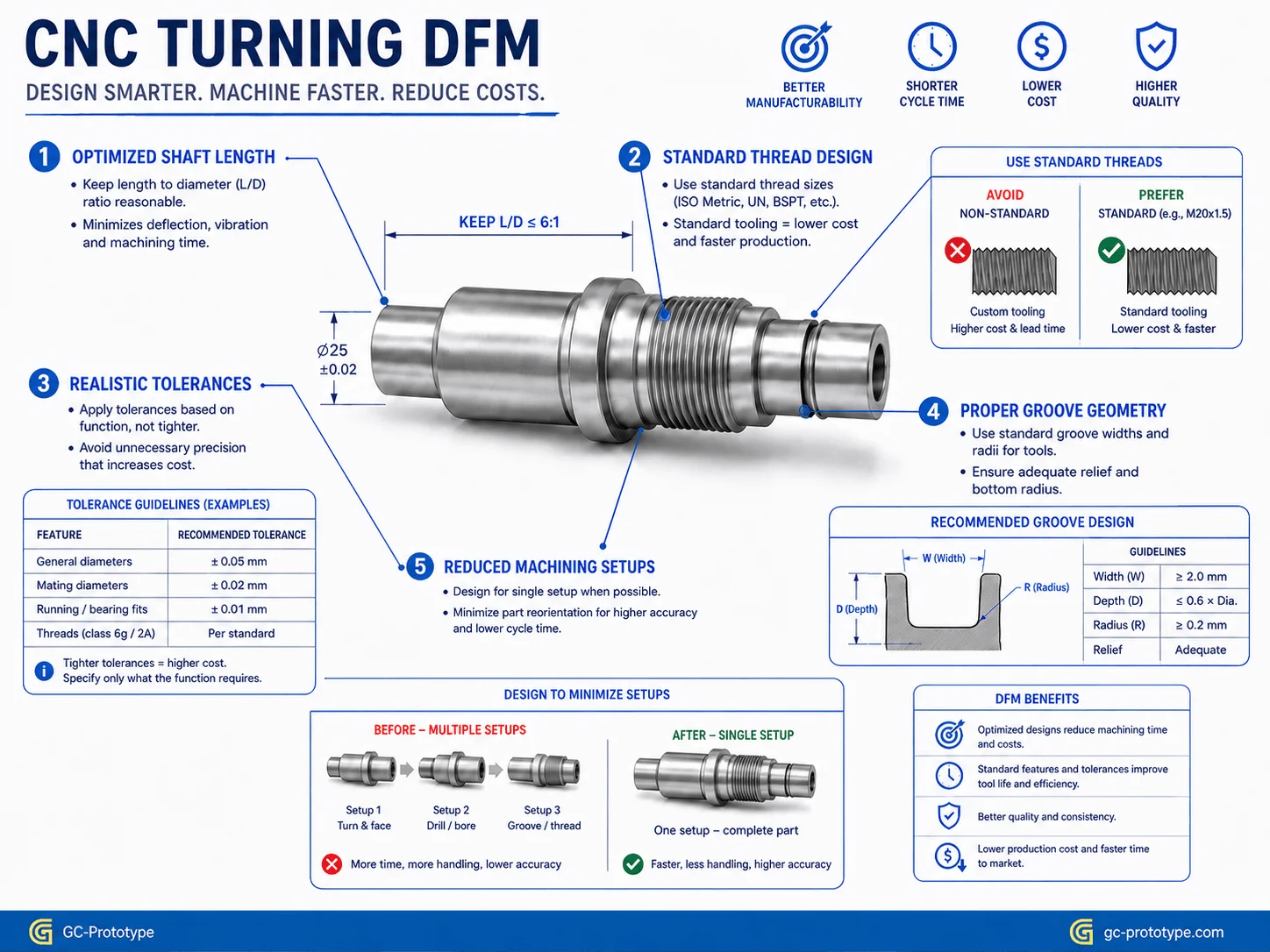
Design for Manufacturing (DFM) Guidelines for CNC Turning
A well-designed turned component can significantly reduce machining time and cost.
Avoid Excessive Length-to-Diameter Ratios
Long thin components are more difficult to machine because they are more likely to deflect during cutting.
Where possible:
Reduce unnecessary length
Increase diameter
Add support features
Consider Swiss turning for slender parts
Standardize Diameters and Features
Using standard dimensions helps reduce:
Tool changes
Programming complexity
Special tooling requirements
Standard threads, grooves, and hole sizes usually improve manufacturing efficiency.
Minimize Complex Secondary Operations
Parts requiring multiple repositioning operations generally cost more.
A better design approach is combining features into one machining setup whenever possible.
Design Practical Threads
Thread requirements should consider:
Thread depth
Thread length
Standard sizes
Material strength
Deep internal threads in difficult materials can significantly increase machining time.
Consider Bar Stock Size
The starting material diameter influences cost.
Using a diameter close to the finished component reduces:
Material waste
Cutting time
Production cost
Use Functional Tolerances
Not every dimension requires maximum precision.
Critical areas may include:
Bearing seats
Alignment diameters
Sealing surfaces
Mating interfaces
Non-critical areas should use practical tolerances.
| DFM Consideration | Cost Impact | Recommended Approach |
|---|---|---|
| Excessive tight tolerance | Higher inspection and machining cost | Apply only where needed |
| Long thin geometry | More vibration risk | Improve support or redesign |
| Custom threads | Additional tooling | Use standards |
| Large material removal | Longer cycle time | Optimize stock size |
| Multiple setups | Higher labor cost | Consolidate operations |
Procurement Strategy & Scaling CNC Turning Production
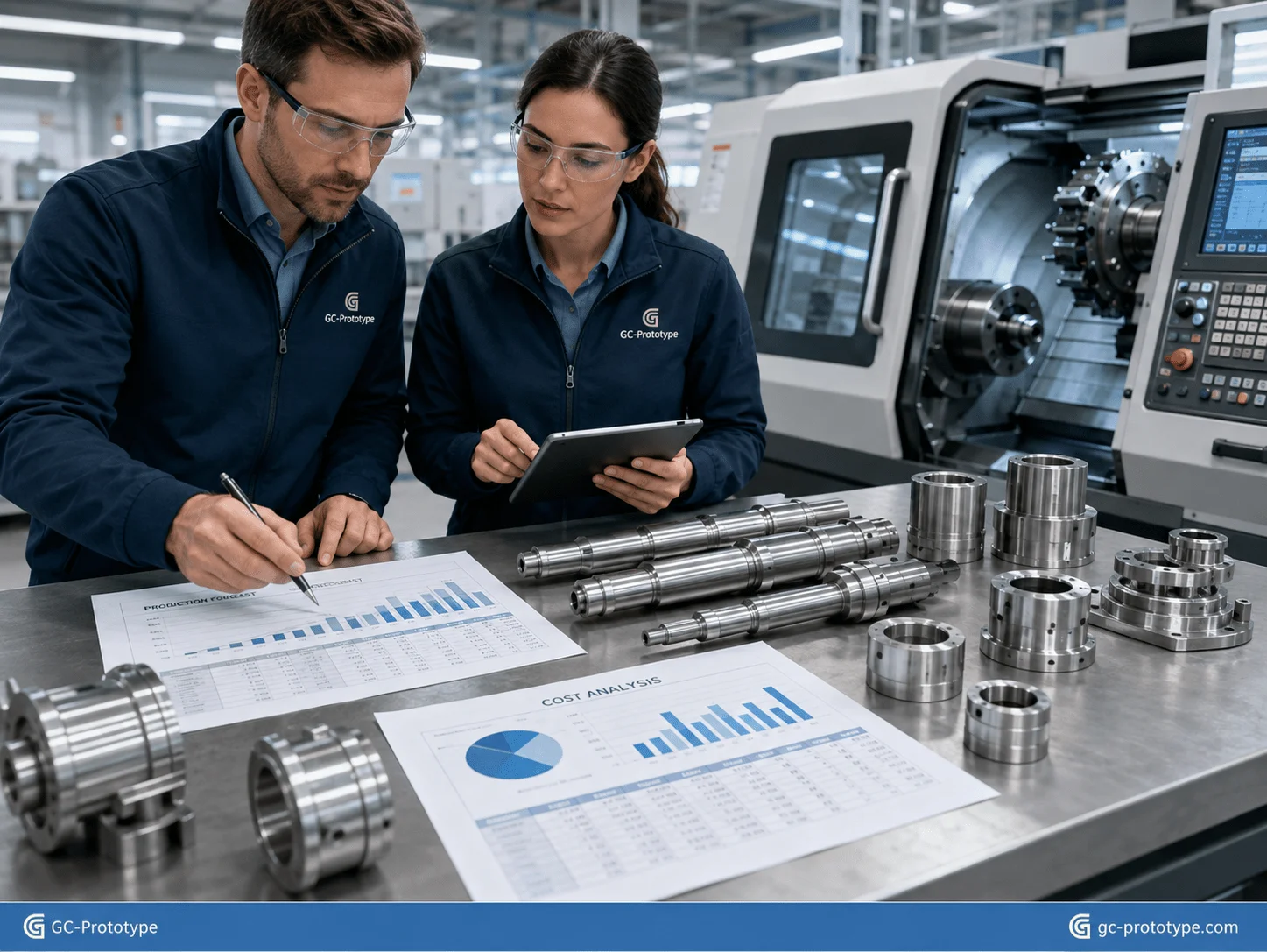
For Procurement Managers and Strategic Buyers, CNC turning offers an important advantage: production flexibility without tooling investment.
This makes it especially valuable for:
New product introduction
Custom industrial equipment
Replacement parts
Low-volume production
Engineering changes
Market testing
Unlike molding processes, CNC turning does not require expensive production tooling before manufacturing begins.
A company can produce:
5 prototype shafts
50 validation components
500 pilot-production parts
Several thousand low-volume components
using the same basic manufacturing approach.
Cost Structure of CNC Turning
The total cost of a turned component typically includes:
| Cost Factor | Description |
|---|---|
| Material | Raw bar stock cost |
| Programming | CNC code development |
| Setup | Machine preparation and tooling |
| Cycle Time | Actual machining duration |
| Tool Wear | Cutting insert consumption |
| Inspection | Measurement and quality control |
| Finishing | Anodizing, polishing, coating, etc. |
| Packaging | Protection and shipping |
For procurement teams, reducing cost does not always mean choosing the lowest hourly machining rate.
A supplier with stronger process control may provide lower total cost because of:
Fewer rejected parts
Better first-pass yield
More accurate quoting
Reduced rework
Faster delivery
Scaling From Prototype to Production
A typical product-development path may look like:
Prototype CNC Turning → Low-Volume Production → Automated Turning → Alternative Mass Production
For example:
A robotics company may initially require 20 custom shafts for testing.
After validation, demand increases to 2,000 units annually.
At this stage, the company may evaluate:
Swiss turning automation
Bar feeders
Multi-axis turning centers
Secondary finishing automation
The manufacturing strategy should evolve as demand becomes predictable.
CNC Turning Application Scenarios Across Industries
CNC turning continues to play an essential role in industries where precision cylindrical components, repeatability, and material flexibility are required. From medical instruments to automotive systems, manufacturers rely on turning because it provides a balance between engineering performance and production efficiency.
The following applications demonstrate where CNC turning creates the most value.
Medical Shaft and Instrument Components
Medical equipment often requires small, highly precise rotating components. CNC turning is widely used for manufacturing:
Surgical instrument shafts
Robotic medical joints
Precision guide pins
Diagnostic equipment components
Instrument connectors
Mechanical adjustment components
A typical medical shaft may require:
Tight diameter control
Excellent concentricity
Smooth surface finish
Corrosion-resistant material
Reliable repeatability
For example, a stainless-steel surgical shaft may contain multiple precision diameters, grooves, and threaded sections. CNC turning can complete these features in a controlled process while maintaining the required dimensional relationships.
The key manufacturing considerations include:
Material certification
Surface finish requirements
Cleaning compatibility
Inspection documentation
Dimensional verification
Medical manufacturers should work with suppliers that understand both machining capability and quality expectations.
Automotive Sensor Components
Modern vehicles contain hundreds of sensors that require compact and precise mechanical components.
CNC turning is commonly used for:
Sensor housings
Connector bodies
Rotating shafts
Mounting rings
Threaded adapters
Precision sleeves
Using custom cnc turning parts for automotive sensors
Using custom cnc turning parts for automotive sensors allows automotive suppliers to create lightweight, durable, and dimensionally accurate components for systems such as:
Engine monitoring
Brake systems
Battery management
Autonomous driving sensors
Thermal-control systems
Automotive sensor components often require:
Tight thread accuracy
Sealing surfaces
Repeatable assembly dimensions
Corrosion-resistant materials
High-volume consistency
Aluminum alloys are often selected for lightweight housings, while stainless steel may be preferred for harsh environments.
A major advantage of CNC turning is that manufacturers can support both prototype validation and production scaling.
During early automotive development:
Engineers may need 20–50 test parts
Design changes may occur frequently
Production volume may not be confirmed
CNC turning provides flexibility without requiring expensive tooling.
Once demand increases, automated turning systems can improve production efficiency through:
Bar feeders
Multi-axis turning
Robotic loading
Automated inspection
Aerospace Precision Components
Aerospace applications require strict control of weight, strength, and reliability.
Common CNC turned aerospace components include:
Actuator shafts
Fasteners
Hydraulic components
Precision spacers
Structural connectors
Materials commonly include:
Titanium alloys
Aluminum 7075
Stainless steel
Inconel alloys
Aerospace machining challenges include:
Difficult materials
Tight tolerances
Documentation requirements
Low-volume production
Unlike consumer products, aerospace components may have relatively low annual quantities but extremely high engineering requirements.
CNC turning provides a practical solution because manufacturers can produce small quantities without expensive tooling investment.
Robotics and Automation Components
Robotics systems require many precision mechanical interfaces.
CNC turning is frequently used for:
Gear shafts
Bearing shafts
Motor connectors
Joint components
Spacer rings
Precision pins
Robot manufacturers often require:
High concentricity
Low runout
Smooth bearing surfaces
Repeatable assembly dimensions
For robotic joints, even small dimensional errors can affect:
Motion accuracy
Mechanical vibration
Service life
Positioning performance
CNC turning combined with CMM inspection provides the accuracy required for these demanding systems.
Industrial Equipment and Custom Machinery
Industrial automation companies often require customized mechanical components in small quantities.
Examples include:
Hydraulic fittings
Machine shafts
Rollers
Bushings
Fixtures
Replacement parts
Because industrial equipment designs frequently change, CNC turning provides significant advantages:
No tooling investment
Fast design updates
Flexible batch sizes
Easy replacement production
This makes CNC turning especially valuable for maintenance parts and specialized machinery.
How to Select the Right CNC Turning Supplier
Selecting a CNC turning supplier is not only about machine availability or hourly pricing. A reliable supplier should provide engineering support throughout the manufacturing process.
A strong CNC turning partner should have experience with:
Prototype machining
Low-volume production
Automated turning
Swiss turning
Multi-axis machining
Precision inspection
Surface finishing
Material sourcing
Important supplier capabilities include:
Engineering Review
Before production begins, the supplier should review:
Drawing requirements
Tolerance specifications
Material selection
Machining accessibility
Surface finish requirements
A professional DFM review can identify cost-saving opportunities before machining starts.
Machine Capability
The supplier should have suitable equipment for the component type.
Examples:
| Component Type | Recommended Equipment |
|---|---|
| Small precision shafts | Swiss CNC turning |
| Large cylindrical parts | Conventional CNC turning |
| Complex turned parts | Multi-axis turning |
| High-volume components | Automated turning cells |
| Prototype components | Flexible CNC lathes |
Inspection Capability
Precision turning requires reliable measurement.
Common inspection equipment includes:
CMM machines
Optical measurement systems
Micrometers
Height gauges
Surface roughness testers
Thread gauges
For critical applications, inspection reports should confirm:
Diameter accuracy
Position tolerance
Concentricity
Surface finish
Material verification
RFQ Information Required
To receive an accurate CNC turning quotation, provide:
3D CAD files
2D drawings
Material requirements
Quantity
Tolerances
Surface finish requirements
Thread specifications
Heat treatment requirements
Surface treatment
Inspection expectations
Incomplete information often leads to inaccurate quotations and unexpected manufacturing changes.
Frequently Asked Questions About CNC Turning
What Is CNC Turning Used For?
CNC turning is used to manufacture cylindrical and rotational components such as shafts, pins, bushings, connectors, housings, and precision mechanical parts.
It is widely used in medical, aerospace, automotive, robotics, electronics, and industrial applications.
What Is the Difference Between CNC Turning and CNC Milling?
CNC turning rotates the workpiece while the cutting tool removes material.
CNC milling rotates the cutting tool around a stationary workpiece.
Turning is ideal for cylindrical parts, while milling is better suited for complex non-rotational geometries.
When Should I Use Swiss Turning Instead of Conventional CNC Turning?
Swiss turning is preferred when:
Parts are small diameter
Components are long and slender
Extremely tight tolerances are required
Production quantities are higher
Conventional CNC turning is usually better for larger parts, prototypes, and lower-volume production.
What CNC Turning Tolerances Are Possible?
Tolerance capability depends on:
Machine condition
Material
Part geometry
Tooling
Inspection method
High-precision CNC turning can achieve very tight tolerances for critical features when the process is properly controlled.
How Does Surface Finish Affect CNC Turning Cost?
Better surface finish usually requires:
Additional finishing passes
Lower feed rates
More precise tooling
Longer cycle time
Engineers should specify surface finish according to function rather than requesting the lowest possible roughness everywhere.
What Materials Can Be CNC Turned?
Common CNC turning materials include:
Aluminum
Stainless steel
Titanium
Brass
Copper
Plastics
Engineering polymers
The best material depends on mechanical requirements, environment, and cost targets.
Is CNC Turning Suitable for Low-Volume Production?
Yes.
CNC turning is one of the most effective solutions for low-volume production because it does not require expensive tooling.
It is suitable for:
10 pieces
100 pieces
1,000 pieces
Customized production batches
How Can CNC Turning Costs Be Reduced?
Costs can be reduced by:
Increasing standardization
Avoiding unnecessary tight tolerances
Reducing setups
Selecting machinable materials
Optimizing geometry
Using standard threads
Improving batch quantities
Can CNC Turning Parts Be Surface Finished?
Yes.
Common finishing options include:
Anodizing
Polishing
Bead blasting
Plating
Passivation
Coating
Surface finishing can improve appearance, corrosion resistance, wear performance, and functionality.
CNC turning remains one of the most versatile manufacturing solutions for producing precision cylindrical components from prototype quantities to low-volume production.
Its greatest advantage is flexibility. Engineers can validate designs quickly, use production-grade materials, achieve tight tolerances, and scale production without expensive tooling investment.
For medical shafts, automotive sensor components, aerospace hardware, robotics assemblies, and industrial equipment, successful CNC turning depends on more than machining capability. The best results come from combining optimized design, realistic tolerances, appropriate materials, controlled surface finishes, and professional manufacturing support.
A well-planned CNC turning strategy can reduce development risk, shorten product launch timelines, and provide reliable production parts before larger manufacturing investments are required.
Moving from prototype concepts to precision production parts should be fast, reliable, and cost-effective. Whether you are a Senior Mechanical Engineer developing medical shafts or a Procurement Manager sourcing custom automotive components, GC Prototype delivers professional CNC turning solutions.