Address:
Shenzhen Bao'an District Xinqiao Subdistrict Huangpu Community Huangpu East Ring Road No. 504 Shenzhen Yuan Industrial City Building C
Work Hours:
Monday to Friday: 9AM - 21PM
Weekend: 9AM - 21PM

Address:
Shenzhen Bao'an District Xinqiao Subdistrict Huangpu Community Huangpu East Ring Road No. 504 Shenzhen Yuan Industrial City Building C
Work Hours:
Monday to Friday: 9AM - 21PM
Weekend: 9AM - 21PM

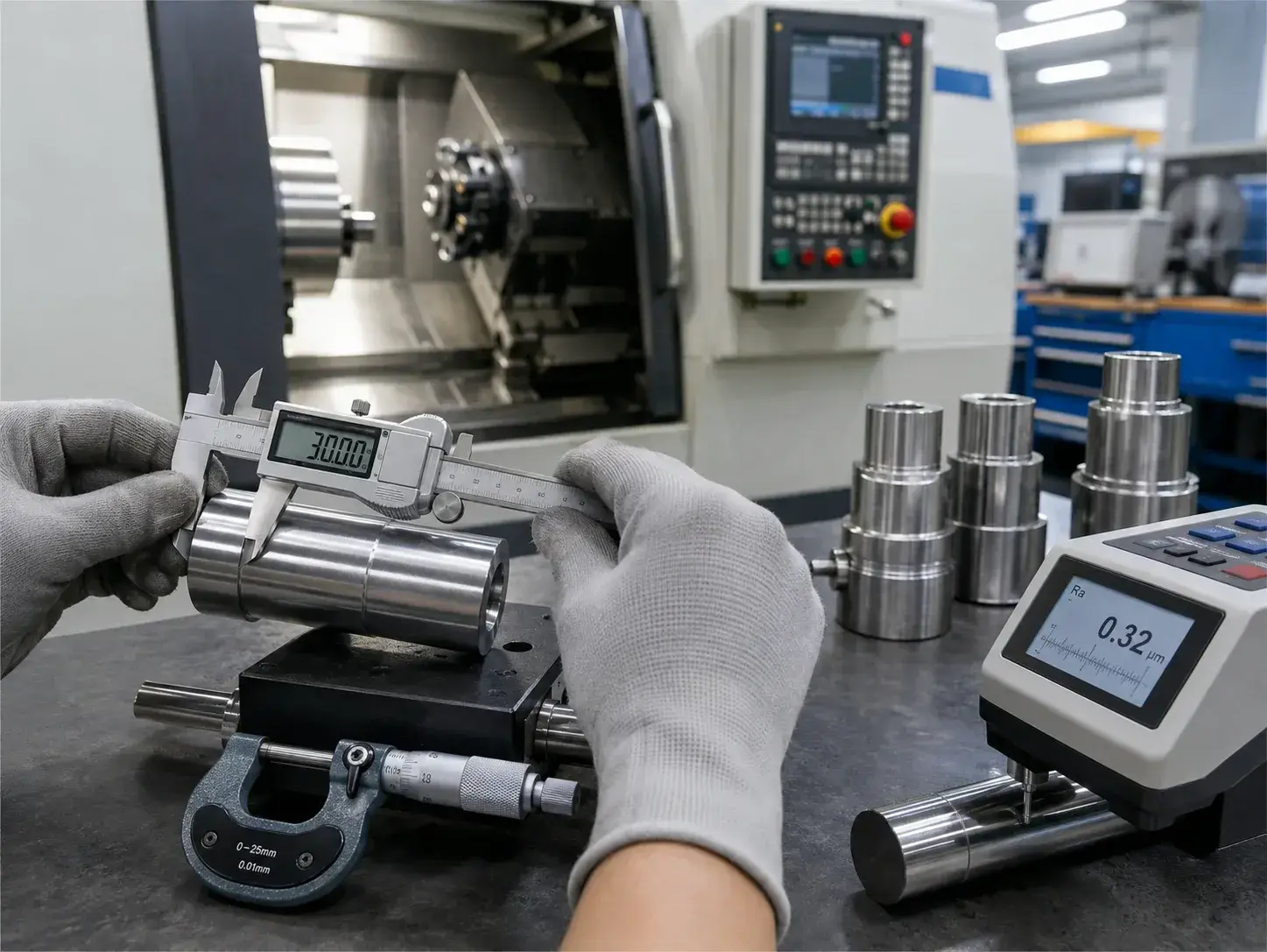
CNC turning is one of the most efficient manufacturing processes for shafts, pins, bushings, threaded components, sleeves, rollers, and other rotationally symmetrical parts. By rotating the workpiece against computer-controlled cutting tools, a CNC lathe can maintain excellent concentricity, produce smooth cylindrical surfaces, and complete complex features with fewer setups.
For Senior Mechanical Engineers, Product Developers, NPI Managers, and Sourcing Professionals, successful turning requires more than selecting a capable machine. Material machinability, part rigidity, tool access, tolerance strategy, surface finish, inspection, and order quantity all influence cost and quality.
This guide explains conventional and Swiss turning, engineering materials, realistic tolerances, DFM principles, rapid prototyping, and low-volume production for medical devices, automotive systems, aerospace hardware, robotics, electronics, and industrial machinery.
Technical Selection & Advanced Capabilities
Efficiency Analysis: cnc turning vs milling for cylindrical parts
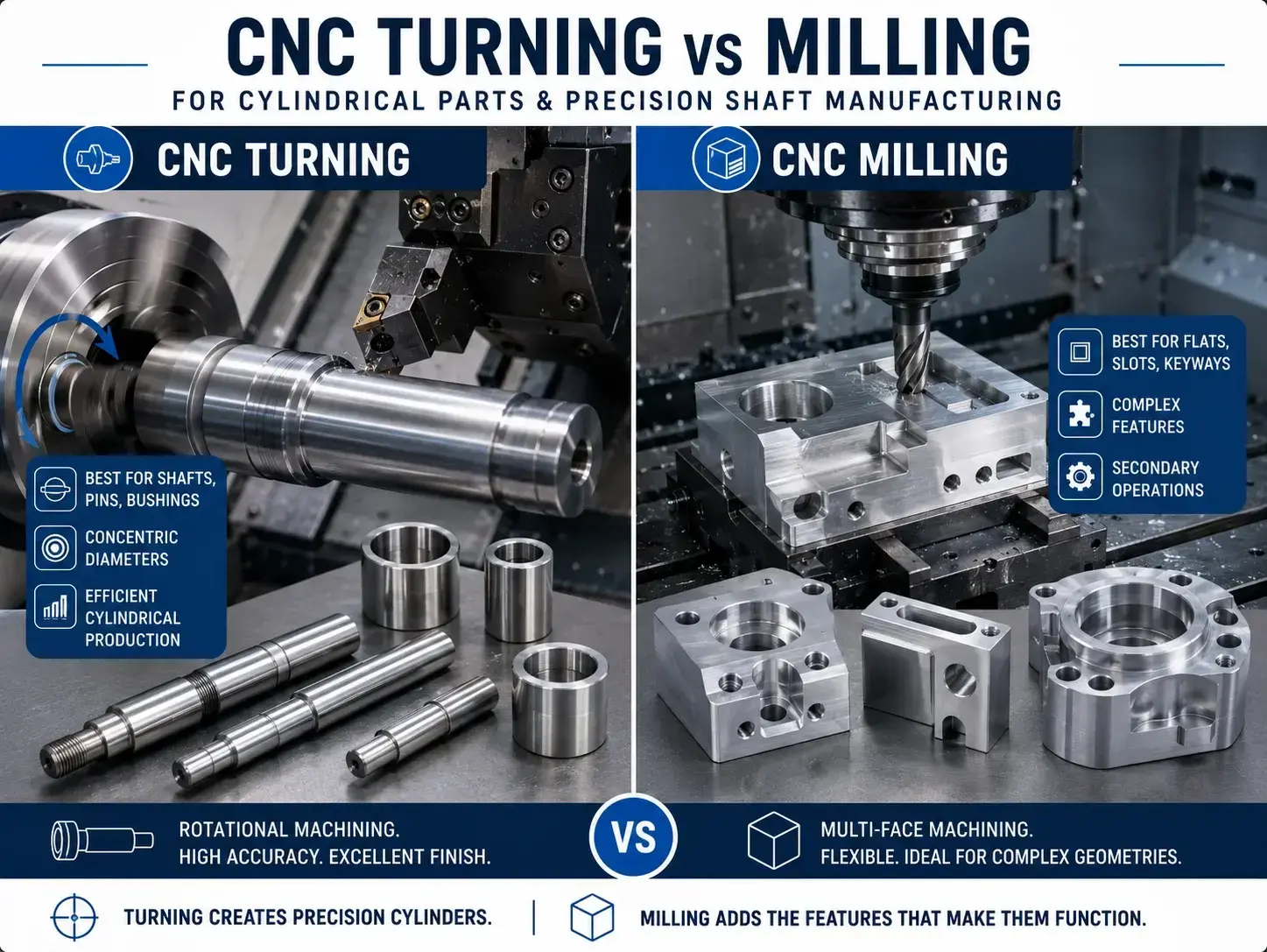
The comparison of cnc turning vs milling for cylindrical parts starts with the dominant geometry of the component. In turning, the workpiece rotates while a stationary cutting tool moves along or across its central axis. In milling, the cutting tool rotates while the workpiece remains fixed or moves between programmed positions.
When most critical features are cylindrical, turning is usually faster and more economical. Diameters, tapers, shoulders, grooves, axial holes, and threads can all be generated around the same centerline. This naturally supports good roundness, runout, and concentricity.
A milling machine can produce round geometry through circular interpolation or rotary workholding, but this often requires longer toolpaths or additional setups. Every new setup introduces handling time, fixture cost, and the possibility of datum-transfer error.
| Decision factor | CNC turning | CNC milling |
| Best geometry | Shafts, pins, sleeves, bushings | Brackets, housings, plates, pockets |
| Primary movement | Workpiece rotates | Cutting tool rotates |
| Concentricity | Naturally strong | Highly dependent on setup |
| Cylindrical finish | Generally excellent | Toolpath-dependent |
| Side holes and flats | Live tooling or secondary operation | Straightforward |
| Cost for simple round parts | Usually lower | Usually higher |
Turning is normally the first choice when most functional features share one rotational axis. Milling becomes more suitable when flat faces, deep pockets, complex side features, or non-round contours dominate the design.
Modern turning centers can also include live tooling, Y-axis movement, sub-spindles, and automatic tool changers. These features allow the machine to turn the main diameters and then add cross-holes, flats, keyways, or slots without moving the component to a separate milling machine.
This combined approach can improve alignment and reduce setup time. However, it should only be used where the additional machine complexity creates measurable manufacturing value.
Micro-Precision: swiss cnc turning vs conventional turning
The swiss cnc turning vs conventional turning decision is especially important for miniature, slender, and high-precision parts.
A conventional CNC lathe holds the material in a chuck or collet. The bar extends from the spindle while tools remove material. This configuration works efficiently for general shafts, bushings, sleeves, fittings, and threaded components.
A Swiss-type lathe supports the bar close to the cutting zone with a guide bushing. Instead of leaving a long section unsupported, the machine cuts only a short distance from the support point. This reduces deflection, vibration, and chatter.
Swiss turning is particularly effective for:
Medical pins and bone screws
Surgical needles
Dental components
Electronic connector pins
Miniature robotic shafts
Precision fasteners
Sensor sleeves
Small fluid-control parts
| Process factor | Swiss CNC turning | Conventional CNC turning |
| Best application | Small, slender, complex parts | General cylindrical parts |
| Material support | Guide bushing near cutting zone | Chuck or collet |
| Deflection resistance | Excellent | Good for rigid components |
| Typical diameter | Small to medium | Small to large |
| Setup complexity | Higher | Usually lower |
| Automation | Excellent with bar stock | Excellent with suitable equipment |
Swiss machines often incorporate multiple tool stations, live tooling, and sub-spindles. A small medical pin can be turned, drilled, threaded, cross-milled, and finished on the back end in one automated cycle.
Conventional turning remains more cost-effective for larger diameters, shorter components, simpler geometries, and low-volume parts that do not need guide-bushing support.
Machine selection should therefore be based on geometry, length-to-diameter ratio, tolerance, complexity, quantity, and cycle time—not simply on which machine appears more advanced.
Industry Applications & Precision Engineering
Material Optimization: The best materials for cnc turning prototypes
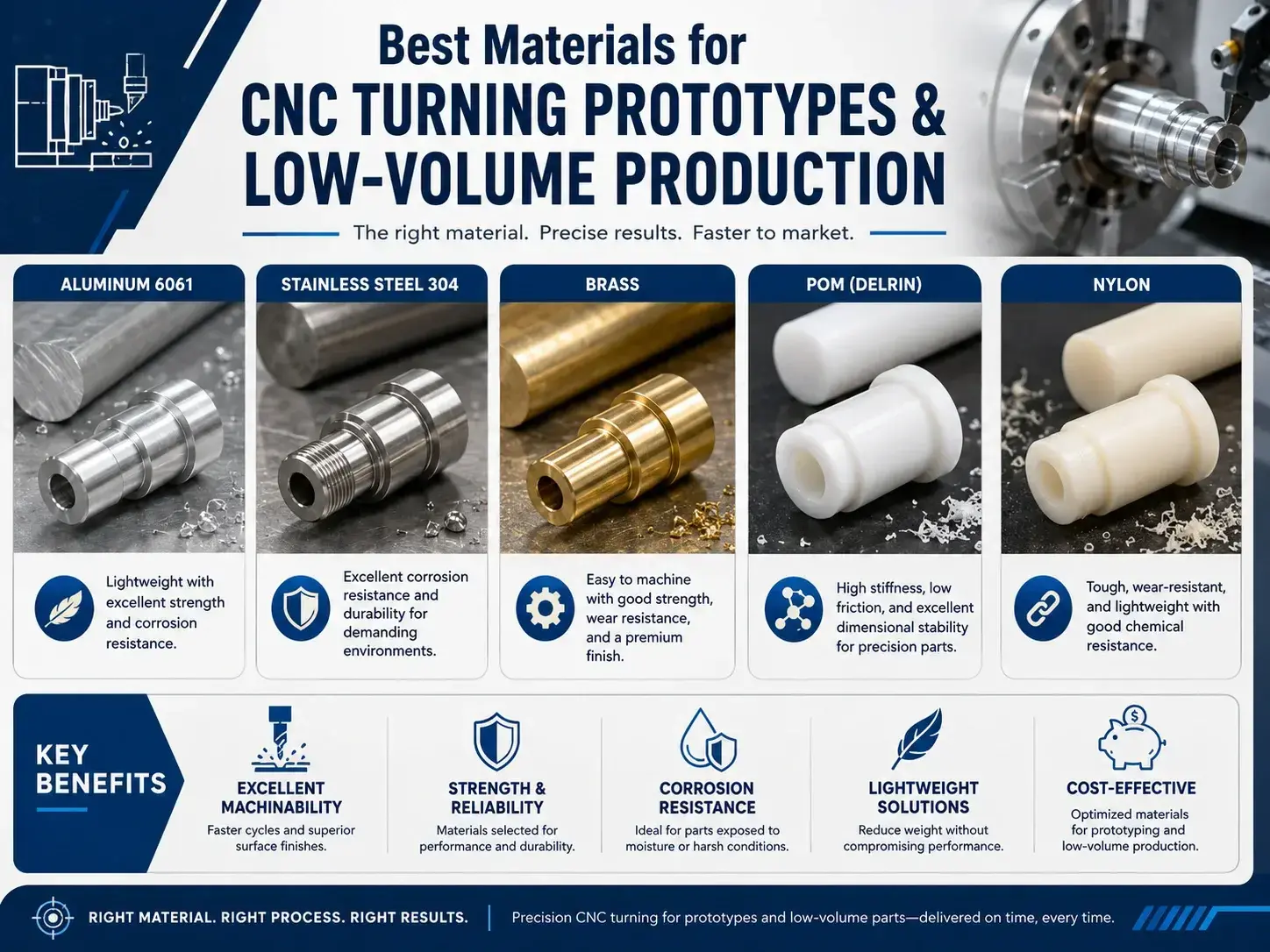
The best materials for cnc turning prototypes balance mechanical performance, machinability, availability, dimensional stability, and price.
Brass 360 is among the easiest metals to turn. It forms manageable chips, produces excellent detail, and supports smooth finishes. It is frequently used for electrical contacts, fittings, bushings, valves, and threaded inserts.
Aluminum 6061 offers strong machinability, moderate strength, corrosion resistance, and competitive cost. It is suitable for lightweight shafts, housings, spacers, rollers, and general engineering prototypes.
Aluminum 7075 provides considerably higher strength and is often chosen for aerospace, defense, motorsport, and high-load robotics components. It is more expensive than 6061 and may require additional corrosion protection.
Stainless steel 303 machines more easily than many other stainless grades. Stainless steel 304 provides broader corrosion resistance but normally requires slower cutting conditions and more tool control.
POM, commonly called Delrin, is one of the most practical plastics for turning. It machines cleanly, maintains dimensions well, and provides low friction for bushings, rollers, spacers, and moving mechanisms.
| Material | Machinability | Primary advantage | Typical application |
| Brass 360 | Excellent | Fine detail and smooth finish | Fittings and inserts |
| Aluminum 6061 | Excellent | Balanced cost and performance | General prototypes |
| Aluminum 7075 | Good | High strength-to-weight ratio | Aerospace and robotics |
| Stainless steel 303 | Good | Easier stainless machining | Pins and fittings |
| Stainless steel 304 | Moderate | Corrosion resistance | Medical and industrial parts |
| POM/Delrin | Excellent | Stability and low friction | Bushings and rollers |
| PEEK | Moderate | Heat and chemical resistance | Medical and aerospace parts |
Material selection should follow the application rather than machinability alone. A corrosion-resistant medical part, for example, may justify the higher machining cost of stainless steel or PEEK.
Bar-stock quality also matters. Straightness, hardness, internal stress, and diameter variation can influence the accuracy of long shafts and thin-walled components.
Strict Standards: cnc lathe turning tolerances and surface finish
Effective cnc lathe turning tolerances and surface finish specifications begin by identifying the features that control function.
Bearing journals, sealing surfaces, press-fit diameters, precision bores, and threaded interfaces may require tight control. Clearance diameters, non-contact shoulders, and hidden cosmetic surfaces normally do not.
On suitable geometry, a capable supplier may hold approximately ±0.005 mm on selected diameters. This should not be treated as a default tolerance for the entire part. Material stability, part length, wall thickness, tool access, workholding, temperature, and measurement method all affect the achievable result.
Surface finish is commonly specified using Ra. A general turned surface may be acceptable for a static component, while a seal or bearing surface may require Ra 0.8 μm, Ra 0.4 μm, or another defined value.
| Feature | Important requirement | Manufacturing consideration |
| Bearing journal | Diameter, roundness, Ra | May require a fine finishing pass |
| Seal diameter | Smooth continuous surface | Avoid chatter and spiral marks |
| Precision bore | Diameter and concentricity | Deep boring reduces tool rigidity |
| Long shaft | Straightness and runout | Requires proper support |
| Thread | Pitch, class, and runout | Include a thread-relief groove |
| Cosmetic diameter | Visual consistency | Polishing adds cost |
Specifying an extremely fine finish on every surface may require slower feeds, extra passes, polishing, grinding, or superfinishing. These processes can significantly increase lead time and unit cost.
Inspection requirements should be included in the RFQ. Micrometers, bore gauges, and height gauges may be sufficient for standard dimensions. Roundness equipment, profilometers, optical systems, or coordinate measuring machines may be required for critical specifications.
Design for Manufacturability & Cost Reduction
Engineering Rules: designing for cnc turning manufacturability
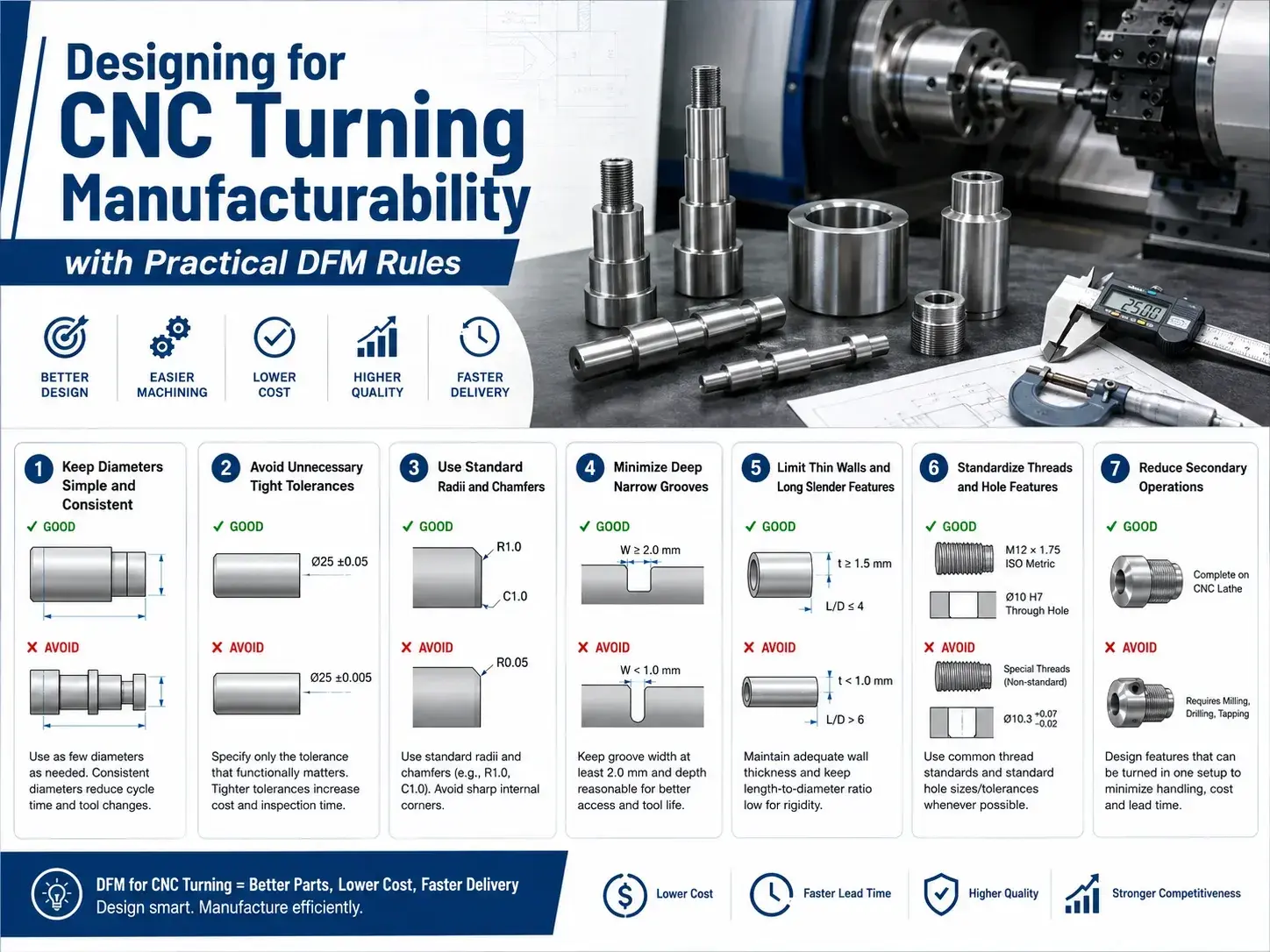
Successful designing for cnc turning manufacturability creates geometry that can be held securely, reached with standard tools, inspected reliably, and repeated without excessive manual work.
One of the most important rules is to control the unsupported length of slender shafts. Long, thin sections can bend under cutting pressure, producing taper, chatter, or poor surface finish. Solutions may include increasing the diameter, reducing the unsupported length, using a tailstock or steady rest, or selecting Swiss turning.
Tool access is equally important. Turning tools have physical nose radii and need space to enter and exit each feature. Perfectly sharp internal corners cannot be produced with standard turning tools.
Practical DFM recommendations include:
Add suitable thread-relief and tool-exit grooves.
Use standard thread sizes and pitches.
Avoid deep, narrow internal bores.
Replace sharp internal corners with practical radii.
Minimize unnecessary grooves and undercuts.
Keep important diameters on a common centerline.
Avoid abrupt transitions between thick and thin walls.
Define functional datums clearly.
Use common bar-stock diameters.
Consider second-end workholding during design.
If both ends require precision features, the supplier may need a sub-spindle or an additional setup. A component that can be completed automatically in one cycle will normally cost less than one that must be manually removed, reversed, realigned, and re-inspected.
Threads should include sufficient relief for the cutting tool to exit cleanly. Deep blind threads, custom pitches, and extremely short runout areas can require special tools and slower machining.
Financial Edge: Actionable Tips on how to reduce cnc turning costs
Understanding how to reduce cnc turning costs requires separating one-time setup expenses from recurring production costs.
Programming, workholding, jaw preparation, tool selection, and first-article inspection create setup cost. Material, machine cycle time, tool wear, finishing, and recurring inspection affect every part.
Use standard bar-stock sizes
A design that fits a common bar diameter reduces both material waste and roughing time. Oversized stock means paying for extra material and additional machine time to remove it.
Reduce tool changes
Every groove, thread, bore, radius, and finish may require a separate tool. Simplifying non-functional details can shorten the cycle and reduce tooling expense.
Simplify second-end machining
Sub-spindles can capture and finish the rear of a component automatically. Designs that require manual reversal or complex custom fixtures increase labor and alignment time.
Apply tight tolerances selectively
Reserve demanding tolerances for bearings, seals, fits, and alignment features. Use wider general tolerances for non-functional lengths, chamfers, and clearance diameters.
Select machinable materials
When performance permits, brass, aluminum, free-machining steel, or POM can reduce cycle time compared with difficult stainless alloys, titanium, or high-temperature polymers.
Order economical quantities
A prototype order confirms the design. Once approved, combining requirements into a stable batch allows setup expenses to be distributed across more components.
CNC Turning Cost Breakdown
| Cost driver | Typical impact | Cost-reduction strategy |
| Raw material | Alloy price and waste | Use common grades and bar sizes |
| Setup | Programming, jaws, tools | Consolidate approved quantities |
| Cycle time | Geometry and tool changes | Simplify features |
| Tolerance | Finishing and inspection | Tighten only critical dimensions |
| Surface finish | Extra machining or polishing | Specify by functional surface |
| Secondary setup | Additional handling | Use live tooling or sub-spindles |
| Documentation | Reporting and traceability | Define requirements before quoting |
A transparent quotation should separate setup cost, recurring machining, finishing, inspection, and packaging. This helps procurement teams compare pricing at 10, 50, 100, and 500 pieces.
Supply Chain Scaling & Procurement
Fast Iteration: Leveraging rapid prototyping cnc turning services
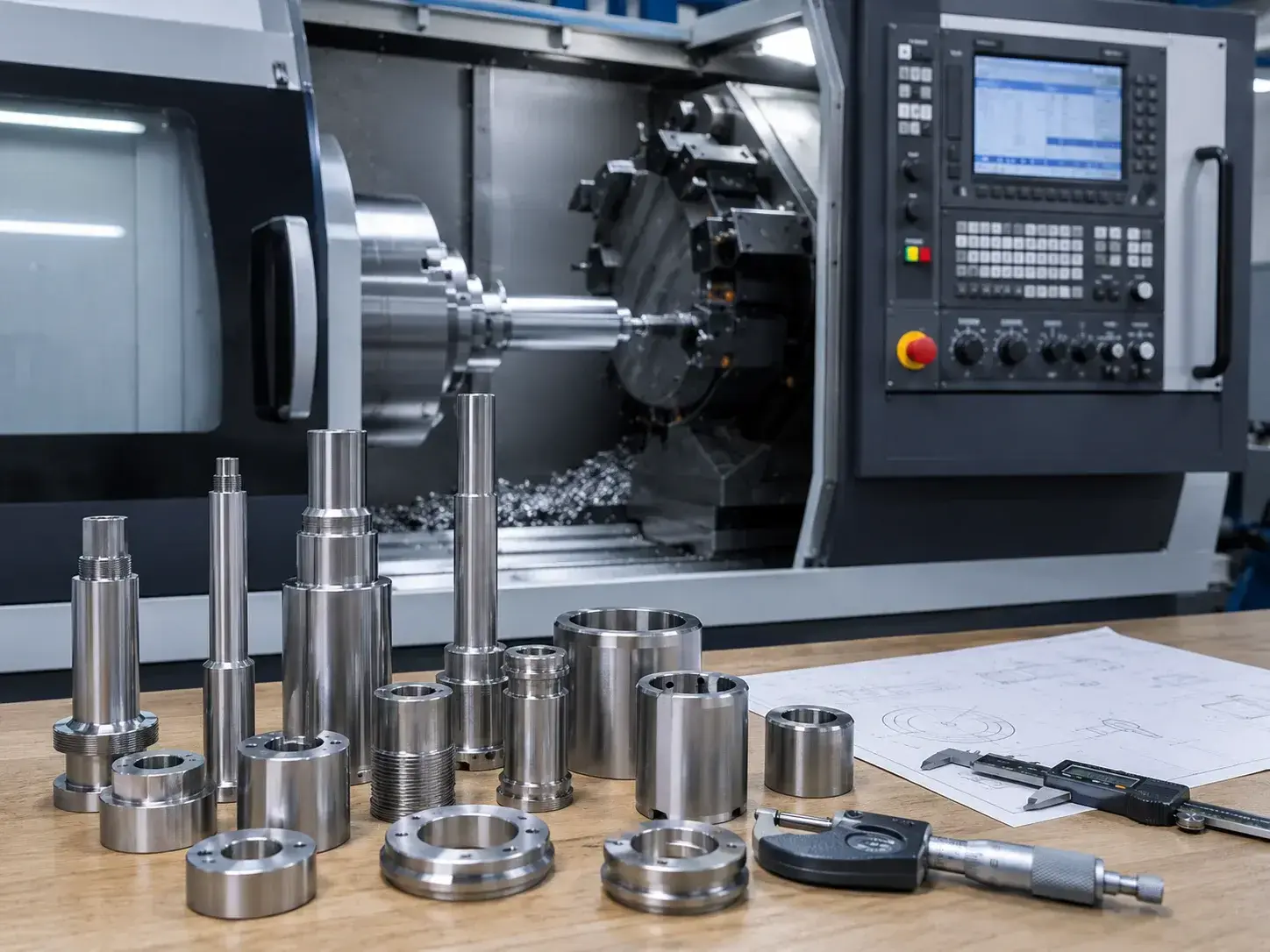
Professional rapid prototyping cnc turning services help engineering teams validate real cylindrical components without waiting for molds, dies, or dedicated production tooling.
Typical prototypes include:
Surgical pins
Automotive sensor sleeves
Robotic shafts
Aerospace spacers
Electronic connector bodies
Industrial nozzles
Threaded fittings
Precision bushings
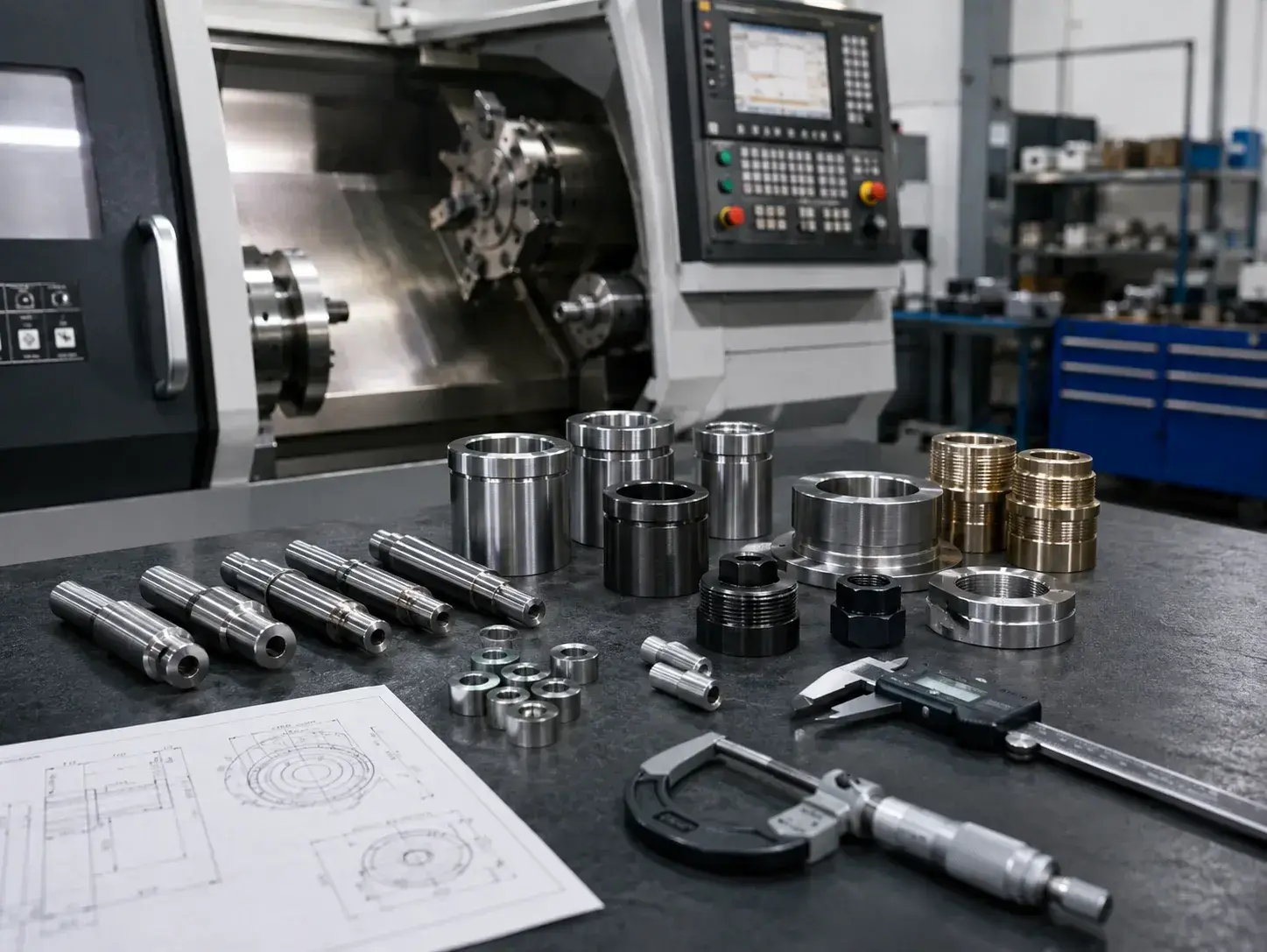
The advantage is not limited to delivery speed. Turned prototypes use real engineering materials and can validate bearing fit, thread engagement, seal compression, rotation, assembly clearance, and load performance.
Design changes can be implemented directly in the CAD model. A revised shaft diameter or groove position does not require mold modification.
A complete quotation package should include:
STEP or native solid CAD file
Dimensioned 2D PDF drawing
Material and material condition
Required quantity
Critical tolerances
Threads and surface finishes
Inspection requirements
Coating or heat treatment
Desired delivery date
A clear drawing allows the supplier to focus engineering attention on the features that affect function rather than treating every dimension as equally critical.
Transitioning to Market: custom cnc turning parts low volume production
Custom cnc turning parts low volume production is particularly effective for quantities between approximately 50 and 1,000 pieces, depending on part complexity, material, and annual demand.
At this stage, automated bar feeders, parts catchers, sub-spindles, live tooling, and repeatable inspection methods can substantially reduce manual handling.
A bar feeder advances stock automatically after each component is completed. This allows the machine to produce repeated shafts, sleeves, pins, and fittings with limited operator intervention.
| Quantity | Manufacturing strategy | Primary objective |
| 1–10 pieces | Prototype setup | Validate geometry and function |
| 10–50 pieces | Engineering batch | Complete assembly and testing |
| 50–250 pieces | Optimized turning process | Reduce unit cost |
| 250–1,000 pieces | Automated bar-fed production | Stabilize supply and quality |
| Higher recurring volume | Dedicated automation | Maximize cycle efficiency |
Unlike injection molding or die casting, turning requires no product-specific mold. This keeps upfront investment low and allows engineering changes between batches.
Low-volume turning is suitable for medical development, industrial automation, aerospace testing, specialized vehicles, aftermarket parts, replacement components, and products with several configuration variants.
Procurement teams should evaluate material control, revision management, inspection equipment, finishing capability, communication, packaging, and repeat-order consistency—not only the lowest quoted unit price.
CNC Turning Application Scenarios
Medical Pin or Bone Screw
A medical-development team requires small stainless steel or titanium parts with fine threads and controlled diameters. Swiss turning supports long, slender geometry and multiple miniature features in one cycle.
Automotive Sensor Sleeve
An automotive supplier needs 500 sleeves with internal bores, external threads, and sealing surfaces. Bar-fed turning reduces unit cost while dedicated gauges control critical diameters.
Robotic Joint Shaft
A robotics company requires bearing journals, retaining grooves, a threaded end, and a cross-hole. Turning establishes concentric diameters, while live tooling creates the cross-hole in the same setup.
Aerospace Spacer
Aerospace engineers need lightweight 7075 spacers with traceable material. CNC turning provides repeatable length and diameter control without dedicated tooling.
Electronics Threaded Insert
A smart-hardware manufacturer requires brass inserts for molded plastic housings. Brass provides excellent machinability, detailed threads, and short cycle times.
Frequently Asked Questions
What types of parts are best suited to CNC turning?
CNC turning is ideal for shafts, pins, bushings, sleeves, rollers, spacers, nozzles, threaded fittings, and other rotationally symmetrical parts.
Is CNC turning cheaper than milling?
Turning is generally more economical when the component is dominated by cylindrical geometry. Milling is usually more appropriate for parts with extensive pockets, flat surfaces, or non-round contours.
When should Swiss turning be selected?
Swiss turning is recommended for small, long, slender, or complex components that may deflect on a conventional lathe.
Can CNC turning hold a tolerance of ±0.005 mm?
Selected features may achieve ±0.005 mm under suitable conditions. Material, geometry, temperature, tool condition, workholding, and inspection method all influence capability.
What surface finish can a CNC lathe achieve?
Finishing passes can achieve smooth surfaces such as Ra 0.8 μm or Ra 0.4 μm on appropriate geometry. The supplier should confirm capability for the selected material and feature.
Which material is easiest to turn?
Brass 360, aluminum 6061, free-machining steels, and POM generally provide strong machinability.
How can chatter on a long shaft be prevented?
Reduce unsupported length, use tailstock or guide-bushing support, optimize cutting parameters, use sharp tools, or increase shaft rigidity.
Is CNC turning suitable for 500 parts?
Yes. Automated bar feeding and repeatable setups can make quantities of 50–1,000 parts cost-effective without mold investment.
What files are required for a CNC turning quote?
Provide a solid 3D CAD file, dimensioned 2D drawing, material, quantity, tolerances, threads, finish, inspection needs, and delivery date.
Can turned and milled features be made in one setup?
A live-tool turning center can produce diameters, threads, flats, cross-holes, and selected slots without transferring the part to another machine.
CNC turning provides speed, concentricity, repeatability, and low tooling investment for cylindrical components. Conventional turning offers flexibility for general shafts, fittings, bushings, and medium-size parts, while Swiss turning excels at miniature and slender components that require close support near the cutting zone.
The most successful projects combine the right machine with practical DFM. Use standard stock sizes, accessible grooves, realistic internal radii, standard threads, supported slender sections, and demanding tolerances only where they create functional value.
Accelerate Your CNC Turning Project with GC Prototype
Engineering reliable cylindrical components requires balancing sub-millimeter concentricity requirements with predictable production efficiency. Whether you are a Senior Mechanical Engineer designing high-precision medical pins or a Procurement Manager sourcing low-volume turned shafts for robotics, GC Prototype delivers the Swiss and conventional CNC turning precision your project needs.
Our capabilities include conventional CNC turning, Swiss turning, live-tool machining, metal and engineering-plastic processing, precision inspection, rapid prototypes, and low-volume production.