Address:
Shenzhen Bao'an District Xinqiao Subdistrict Huangpu Community Huangpu East Ring Road No. 504 Shenzhen Yuan Industrial City Building C
Work Hours:
Monday to Friday: 9AM - 21PM
Weekend: 9AM - 21PM

Address:
Shenzhen Bao'an District Xinqiao Subdistrict Huangpu Community Huangpu East Ring Road No. 504 Shenzhen Yuan Industrial City Building C
Work Hours:
Monday to Friday: 9AM - 21PM
Weekend: 9AM - 21PM

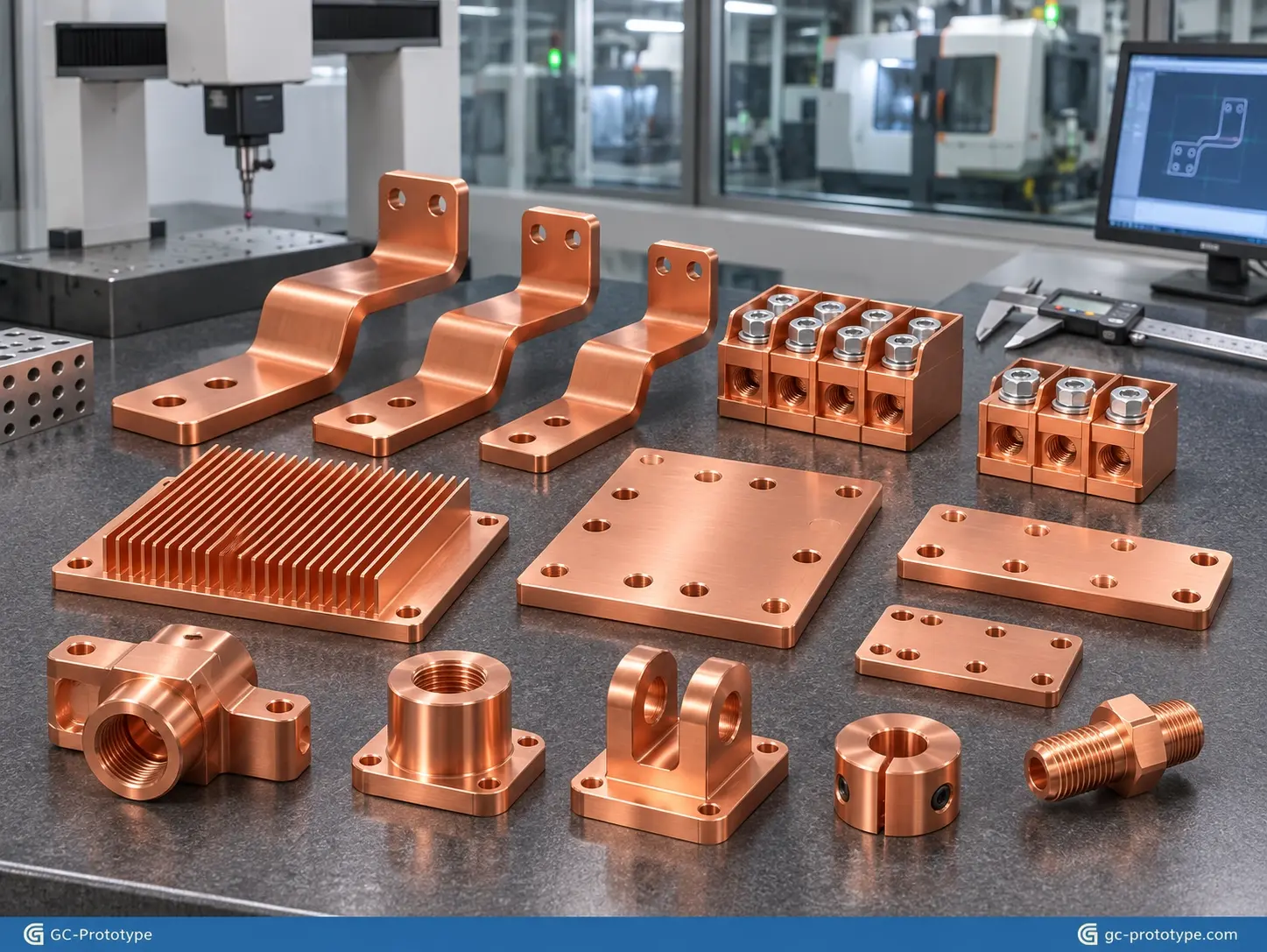
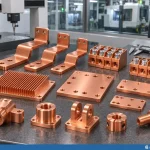
CNC machined copper parts are widely used in electrical power systems, thermal management assemblies, industrial electronics, and custom mechanical equipment. For OEM engineers, choosing between high-conductivity copper and manufactured brass parts requires understanding electrical performance, machinability, and functional requirements.
While copper is often preferred for current-carrying components and heat-transfer applications, custom brass parts may offer advantages for threaded fittings and mechanical connectors where maximum conductivity is unnecessary.
Successful copper component manufacturing requires more than selecting a metal grade. Material behavior, workholding, burr control, contact surface quality, and dimensional inspection all influence the finished component.
At GC-Prototype, we support custom CNC machining projects through CAD review, prototype development, CNC milling, turning, and low-volume manufacturing. This guide explains copper material selection, common applications, machining challenges, quality inspection, and practical RFQ requirements for international OEM customers.
Copper is widely selected for components requiring excellent electrical conductivity, thermal conductivity, or a combination of these properties.
Unlike general-purpose structural metals, copper is often chosen because of the function it performs within an electrical or thermal system.
Copper is commonly used in power distribution equipment, electrical connections, and industrial electrical assemblies.
Its conductivity makes it suitable for components designed to transfer current between connected systems.
Typical applications include:
Electrical connector blocks.
Busbar connection components.
Power distribution terminals.
Conductive mounting elements.
Custom electrical contact parts.
The component design must account for current requirements, contact resistance, mechanical connections, and operating temperature.
Copper is also valued for its ability to transfer heat.
Precision-machined copper components may be used as heat spreaders, thermal interface plates, or conductive bases within cooling assemblies.
For these applications, surface flatness, contact area, thermal interface materials, and mounting pressure can be important.
Beyond electrical systems, copper components are used in industrial manufacturing equipment, selected electrodes, and specialized mechanical assemblies.
However, copper’s mechanical properties differ from those of aluminum, steel, and brass.
Material selection should reflect the component’s actual functional requirements.
Different copper components require different machining strategies.
For OEM manufacturers, the most important consideration is not simply the component’s shape, but how its geometry supports electrical, thermal, or mechanical performance.
Copper busbar connectors are used to connect conductive elements within electrical power systems.
Although straight copper busbars may be produced efficiently through other fabrication processes, customized connector blocks and connection interfaces can require CNC machining.
Important features include:
Mounting-hole locations.
Contact surface flatness.
Threaded mounting features.
Edge condition.
Specified material conductivity.
Poor contact geometry can contribute to unwanted electrical resistance or assembly problems.
Precision copper terminals are used in electrical equipment, electronic assemblies, and selected power distribution applications.
These components may contain mounting holes, slots, contact surfaces, and customized connection features.
Critical dimensions should be clearly identified in engineering drawings.
For example, a terminal block may require accurate mounting-hole spacing and a controlled mating surface to maintain the specified electrical connection.
Copper heat spreaders distribute thermal energy across a contact area.
They may be used in industrial electronics, power equipment, and thermal management systems.
Important manufacturing requirements can include:
Contact face flatness.
Surface roughness.
Component thickness.
Mounting-hole position.
Interface geometry.
Complex cooling plates containing internal fluid channels may require additional manufacturing, joining, and leak-testing operations.
CNC milling alone does not necessarily complete every feature of a sealed cooling assembly.
Copper can be used for suitable electrical contacts, electrodes, and specialized industrial components.
The appropriate copper grade depends on conductivity, mechanical strength, thermal performance, and the operating environment.
Certain electrode applications may require copper alloys with properties different from high-purity C101 or C110 copper.
| Copper Component | Typical Application | Critical Manufacturing Requirement |
| Busbar Connector | Power distribution | Contact geometry and mounting accuracy |
| Electrical Terminal | Industrial electronics | Hole position and surface quality |
| Heat Spreader | Thermal management | Flatness and contact surface finish |
| Copper Contact Block | Electrical assembly | Conductive interface and dimensional fit |
| Copper Electrode | Industrial equipment | Material properties and geometry |
| Custom Copper Adapter | Specialized machinery | Material grade and mating dimensions |
Identifying the intended function helps manufacturers determine which dimensions, surfaces, and material properties require the greatest attention.
Copper grades differ in purity, machinability, conductivity, and suitability for particular applications.
Choosing the correct grade is important because a material offering excellent conductivity may not provide the most economical machining performance.
C10100 is commonly known as oxygen-free electronic copper.
It has high copper purity and excellent electrical and thermal conductivity.
It may be considered for specialized electrical and electronic applications where material purity and conductivity are important.
Potential uses include:
Specialized electrical contacts.
High-conductivity components.
Selected electronic equipment parts.
Components requiring a specified oxygen-free material.
C101 can be more demanding to machine than free-cutting copper alloys because of its high ductility and chip-forming behavior.
The exact grade and material specification should be confirmed before purchasing stock.
C11000, also called electrolytic tough pitch copper, is widely used in electrical applications.
It offers excellent electrical and thermal conductivity and is commonly considered for:
Electrical busbars.
Power distribution connectors.
Conductive mounting components.
Electrical terminals.
Thermal transfer parts.
C110 is often a practical starting point when a project requires highly conductive copper.
However, its relatively soft and ductile behavior can create machining challenges involving burr formation, chip control, and workholding.
C14500 is a tellurium-containing copper alloy designed to improve machinability while retaining useful electrical conductivity.
It can be considered for precision machined electrical connectors, contacts, and other components where machining efficiency is important.
Compared with high-purity copper grades, C145 typically offers improved chip formation.
However, alloying additions affect material properties, and it should not automatically be substituted for C101 or C110.
Engineers should verify the required conductivity and applicable material specifications before approving an alternative.
| Copper Grade | Main Characteristic | Potential Application | Engineering Consideration |
| C101 | High-purity oxygen-free copper | Specialized electrical components | Purity and material documentation |
| C110 | Excellent electrical and thermal conductivity | Busbars, terminals, heat spreaders | Machining and burr control |
| C145 | Improved machinability | Precision conductive connectors | Conductivity and alloy requirements |
A useful material-selection process starts with the required electrical or thermal performance, followed by mechanical strength, stock availability, manufacturability, and total cost.
The exact copper grades available for an individual GC-Prototype project should be confirmed during engineering review.
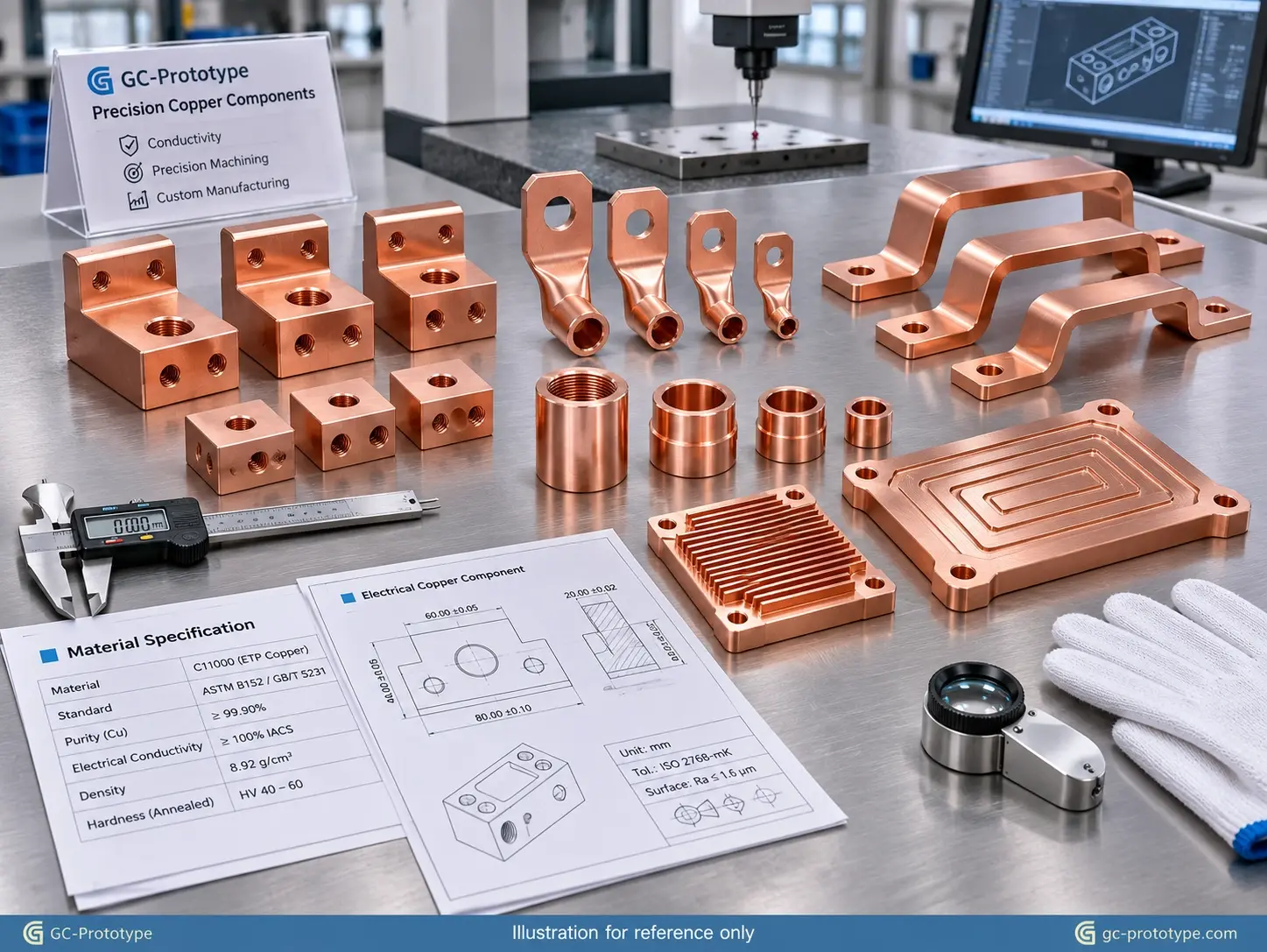
Copper has excellent functional properties, but high-purity grades can be more difficult to machine efficiently than free-cutting brass.
Successful CNC machining requires suitable cutting tools, stable workholding, appropriate cutting conditions, and an effective inspection strategy.
Copper’s ductility can affect how chips form during cutting.
Under unsuitable conditions, material may adhere to the cutting edge, contributing to built-up edge, inconsistent cutting behavior, and poor surface quality.
Suitable tool geometry, cutting conditions, and chip evacuation can help manage these effects.
The correct cutting strategy depends on the copper grade, tool material, machine capability, and component geometry.
Burr formation is a common concern when machining soft copper.
Burrs may appear around:
Drilled holes.
Milled slots.
Cross-holes.
External edges.
Threaded features.
For electrical connectors, burrs can affect assembly or contact surfaces.
Designers should identify critical edges and specify appropriate deburring requirements.
Relatively soft copper components may be damaged by excessive clamping force.
Thin plates and delicate features are particularly sensitive to poor workholding.
Manufacturers should consider suitable contact surfaces, fixture support, and clamping methods.
Copper surfaces can show machining marks, scratches, and handling damage.
If the component includes a critical electrical or thermal contact surface, surface condition should be reviewed carefully.
The objective is to produce a surface that meets the actual functional requirement, rather than applying unnecessarily expensive polishing to every face.
The appropriate machining process depends primarily on component geometry and the location of critical features.
CNC milling is suitable for components with flat surfaces, pockets, mounting holes, and non-rotational geometry.
Common examples include busbar connection blocks, thermal plates, and custom electrical mounting components.
Important considerations include workholding, burr control, contact surface finish, and dimensional accuracy.
CNC turning is suitable for cylindrical and rotational components.
Examples include copper sleeves, round electrical contacts, threaded adapters, and precision spacers.
When machining these components, manufacturers should consider diameter accuracy, tool wear, internal bores, and surface quality.
Some copper parts contain angled holes, multi-face mounting features, or complex interfaces.
Multi-axis machining may help access multiple surfaces and reduce unnecessary repositioning.
However, not every complex copper part requires five-axis machining. A simpler process may be more economical depending on geometry and tolerances.
| Process | Suitable Components | Main Manufacturing Consideration |
| CNC Milling | Copper blocks and thermal plates | Flatness, burrs, hole position |
| CNC Turning | Sleeves and cylindrical contacts | Diameter and surface quality |
| Multi-Axis CNC | Multi-face copper components | Feature alignment and setup |
| Secondary Finishing | Contact and cosmetic surfaces | Functional requirements and dimensions |
For details about related machining capabilities, see our CNC machining services.
Copper and brass are both widely used in industrial components, but they serve different engineering priorities.
Copper is often selected for electrical and thermal performance, while many brass alloys provide useful mechanical properties and improved machining efficiency.
High-conductivity copper grades are often preferred for:
Electrical power connections.
Busbar components.
Heat spreaders.
Electrical terminals.
Components requiring specified high conductivity.
In these applications, the material’s electrical or thermal performance may justify the additional machining effort.
Brass may be more suitable for selected threaded fittings, mechanical connectors, adapters, and components where maximum copper conductivity is not required.
Certain free-cutting brass grades offer excellent machinability, making them useful for complex turned components.
However, brass conductivity varies significantly by alloy, so it should not automatically replace copper in current-carrying applications.
| Selection Factor | Copper | Brass |
| Electrical Conductivity | Generally higher | Lower, depending on alloy |
| Thermal Conductivity | Generally higher | Usually lower |
| Machinability | High-purity grades can be challenging | Free-cutting grades machine efficiently |
| Typical Applications | Busbars, contacts, heat spreaders | Fittings, threaded connectors |
| Mechanical Properties | Grade- and condition-dependent | Grade- and condition-dependent |
| Material Cost | Depends on grade and market | Depends on grade and market |
| Main Selection Priority | Electrical and thermal performance | Mechanical function and manufacturability |
For projects involving manufactured brass parts or specialized custom brass parts, our custom brass machining guide provides more detailed information about brass grades, fittings, threaded components, and manufacturing requirements.
The best material should be chosen according to the component’s function, not simply its machining cost.
Design for Manufacturability helps engineers identify features that may increase machining difficulty or compromise functional surfaces.
For copper components, DFM review should focus on contact geometry, burr control, workholding, and critical dimensions.
Electrical components often contain mounting holes, bolt connections, and conductive contact surfaces.
Hole positions and mating geometry should be specified according to the assembly requirements.
Avoid placing unnecessary features on critical contact areas.
Burrs around electrical mounting holes and edges may interfere with assembly.
Designers should identify critical edges and communicate deburring requirements clearly.
Where practical, suitable chamfers and accessible geometry can simplify edge finishing.
A copper heat spreader may require a controlled contact surface, while an electrical connection block may require flat mating faces.
Not every exterior surface needs the same level of finish.
Clearly distinguishing functional surfaces can help reduce unnecessary inspection and finishing costs.
Copper material and machining costs can be significant for large components.
Reducing unnecessary pockets, difficult internal features, and excessive machining operations may improve manufacturing efficiency.
However, electrical current paths and thermal performance must be evaluated before material is removed from a functional design.
| Design Feature | Manufacturing Risk | Recommended Review |
| Contact Surface | Burrs, scratches, poor fit | Contact area and surface condition |
| Mounting Hole | Positional variation | Hole location and tolerance |
| Thin Copper Plate | Clamping distortion | Workholding and flatness |
| Deep Slot | Limited tool accessibility | Tooling and geometry |
| Thermal Contact Face | Surface irregularity | Flatness and roughness |
| Complex Internal Features | Additional machining operations | Simplify where function allows |
The goal of DFM is to preserve electrical and thermal performance while improving manufacturability.
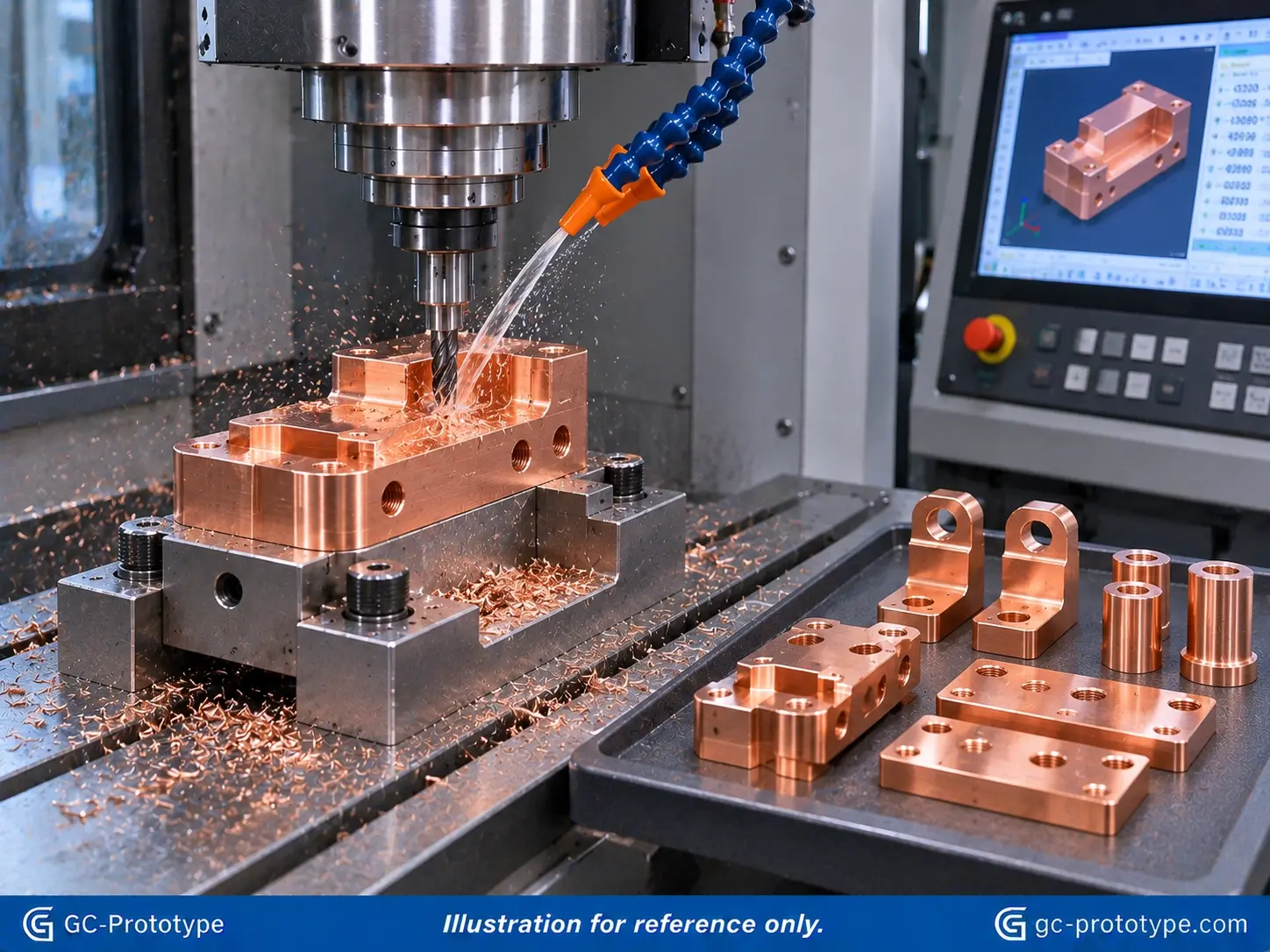
Quality inspection for copper components should reflect the part’s intended electrical, thermal, and mechanical functions.
A component may meet its overall dimensions but still require additional attention to contact surfaces, burrs, or material specifications.
Buyers should identify the required copper grade on the engineering drawing or purchase documentation.
For projects requiring material verification, relevant certificates or other agreed documentation should be requested.
Material identity alone does not establish that a finished component meets every electrical performance requirement.
Critical dimensions may include:
Mounting-hole positions.
Contact surface dimensions.
Plate thickness.
Bore diameters.
Mating surface flatness.
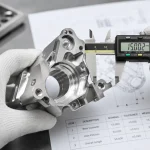
Suitable inspection tools may include micrometers, gauges, and coordinate measuring machines.
Contact surfaces should be checked according to the agreed acceptance criteria.
Possible concerns include scratches, burrs, deformation, and unwanted surface damage.
For critical electrical components, the buyer should define whether additional functional or electrical verification is required.
Depending on the application, copper components may require surface treatments such as tin, nickel, or silver plating.
The selection should consider corrosion resistance, contact behavior, operating environment, and applicable specifications.
Plating may also affect finished dimensions.
It is important to identify which surfaces require treatment and whether masking is necessary.
The available finishing process and any required coating verification should be confirmed with the supplier.
| Inspection Item | Typical Method | What It Verifies |
| External Dimensions | Micrometer / suitable CMM method | Drawing conformity |
| Mounting Holes | CMM / gauges | Hole position and diameter |
| Contact Surface Flatness | Suitable flatness measurement | Surface geometry |
| Surface Roughness | Profilometer | Specified roughness |
| Material Grade | Certificate / appropriate analysis | Material identity |
| Burrs and Edge Condition | Visual and suitable inspection | Assembly suitability |
| Coating Thickness | Suitable coating measurement, if required | Plating specification |
A complete inspection plan should be agreed upon before manufacturing begins.
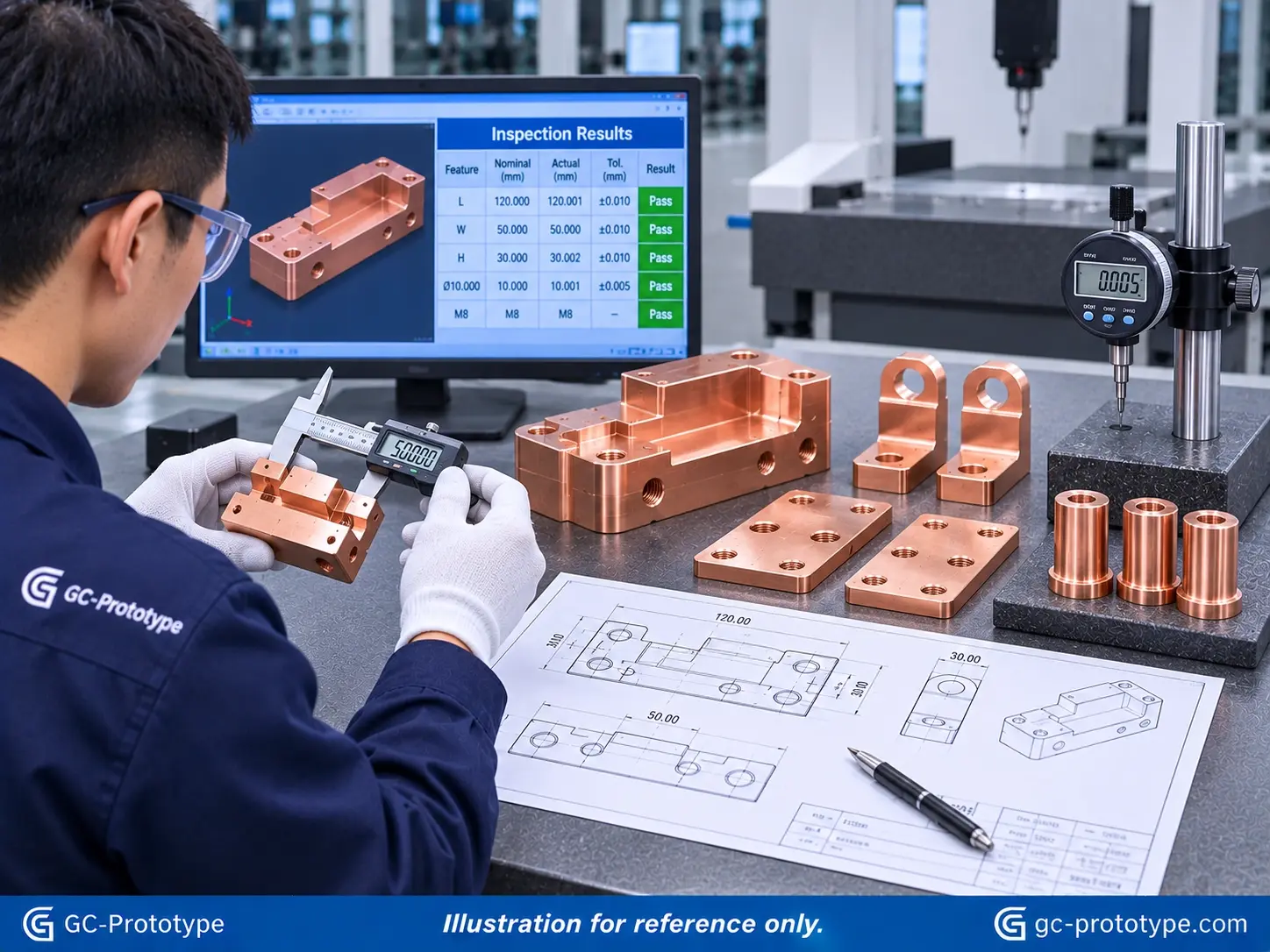
The cost of CNC machined copper parts depends on material grade, raw stock size, component geometry, machining time, surface finishing, inspection, and production quantity.
Different copper grades have different prices and availability.
C101, C110, and free-machining copper alloys may involve different sourcing and manufacturing costs.
Using appropriately sized stock can help reduce material waste.
Soft copper can require additional attention to chip control, deburring, and surface quality.
Complex geometry, deep features, and difficult-to-access edges may increase machining time.
Specified flatness, detailed dimensional reports, and additional plating requirements can affect total cost.
Buyers should distinguish critical functional requirements from optional cosmetic preferences.
CNC machining is suitable for many copper prototype and small-batch projects because it does not require dedicated casting or molding tools.
For OEM teams, producing initial samples allows assembly and performance requirements to be evaluated before repeat orders.
The transition from prototype to batch production should account for approved drawings, material consistency, and inspection requirements.
| Cost Factor | Cost Impact | Optimization Approach |
| Copper Grade | Material and sourcing cost | Choose according to function |
| Raw Stock | Material waste | Optimize stock dimensions |
| Complex Geometry | Longer machining time | Simplify noncritical features |
| Burr Removal | Additional finishing work | Improve edge accessibility |
| Plating | Additional processing | Define functional surfaces |
| Tight Tolerances | More machining and inspection | Prioritize critical dimensions |
| Quantity | Setup cost allocation | Plan suitable batch sizes |
For projects requiring prototypes followed by repeat small batches, our low-volume CNC machining guide explains broader manufacturing and production-planning considerations.
A complete Request for Quotation helps manufacturers evaluate copper component geometry, material specifications, and functional requirements.
For electrical and thermal applications, a CAD file alone may not provide all the necessary information.
Provide a 3D STEP or STP model and a corresponding 2D PDF engineering drawing.
The drawing should include dimensions, tolerances, units, and revision information.
Identify the required copper alloy or specify the performance requirements if material selection is still under review.
For electrical applications, provide conductivity requirements where relevant.
For thermal applications, specify critical contact surfaces and assembly conditions.
Highlight mounting interfaces, mating surfaces, hole positions, flatness requirements, and surface finish specifications.
Provide prototype and production quantities, required surface treatments, inspection documentation, and target delivery details.
| RFQ Information | Recommended Details |
| 3D CAD | STEP / STP |
| 2D Drawing | PDF with drawing revision |
| Material | C101, C110 or specified grade |
| Application | Electrical, thermal or mechanical |
| Critical Dimensions | Hole position, flatness, fit |
| Electrical Requirements | Conductivity specifications, if required |
| Contact Surfaces | Functional areas and finish requirements |
| Surface Treatment | Plating, masking or other finishing |
| Quantity | Prototype and batch quantity |
| Inspection | Dimensional and material documentation |
| Delivery | Target date and destination |
Providing complete information reduces quotation uncertainty and helps align manufacturing expectations before production begins.
CNC-machined copper components are commonly used in electrical connections, busbar systems, industrial electronics, thermal management equipment, and specialized manufacturing applications. The material and manufacturing process should be selected according to the component’s functional requirements.
C101 is an oxygen-free, high-purity copper commonly considered for specialized electrical applications. C110 is electrolytic tough pitch copper widely used for electrical and thermal components. Both offer excellent conductivity, but material purity and application requirements may influence the selection.
High-purity copper is relatively ductile and can create machining challenges involving chip formation, built-up edge, burrs, and surface quality. Certain free-cutting brass grades generally offer better machinability. The actual difference depends on the specific alloy and machining conditions.
Copper is generally preferred when high electrical or thermal conductivity is the primary requirement. Brass may be more suitable for certain mechanical fittings, threaded connectors, and components where improved machinability is beneficial and the electrical performance of copper is unnecessary.
Yes. CNC milling and turning can produce custom copper prototypes and suitable small production batches. Manufacturing feasibility and unit cost depend on material grade, geometry, quantity, inspection requirements, and finishing operations.
Buyers should provide a 3D CAD model, 2D engineering drawing, copper grade, critical dimensions, functional requirements, surface treatment specifications, quantity, and delivery information. Additional electrical or thermal requirements should be identified where relevant.
Manufacturing reliable CNC machined copper parts requires the right combination of material selection, machining strategy, dimensional inspection, and functional surface control.
GC-Prototype supports custom CNC machining projects for electrical, electronic, thermal management, and industrial OEM applications.
Whether your project involves copper electrical terminals, busbar connectors, heat spreaders, conductive mounting components, or other custom copper parts, our engineering team can review your drawings and evaluate suitable manufacturing options.
Send us your 3D CAD model and engineering drawings, together with:
Required copper grade or material specification.
Electrical or thermal performance requirements.
Critical dimensions and surface requirements.
Surface treatment specifications.
Prototype or production quantity.
Inspection and documentation requirements.
Target delivery schedule.
Our team can review the component’s manufacturability and discuss a project-specific CNC machining solution.