Address:
Shenzhen Bao'an District Xinqiao Subdistrict Huangpu Community Huangpu East Ring Road No. 504 Shenzhen Yuan Industrial City Building C
Work Hours:
Monday to Friday: 9AM - 21PM
Weekend: 9AM - 21PM

Address:
Shenzhen Bao'an District Xinqiao Subdistrict Huangpu Community Huangpu East Ring Road No. 504 Shenzhen Yuan Industrial City Building C
Work Hours:
Monday to Friday: 9AM - 21PM
Weekend: 9AM - 21PM

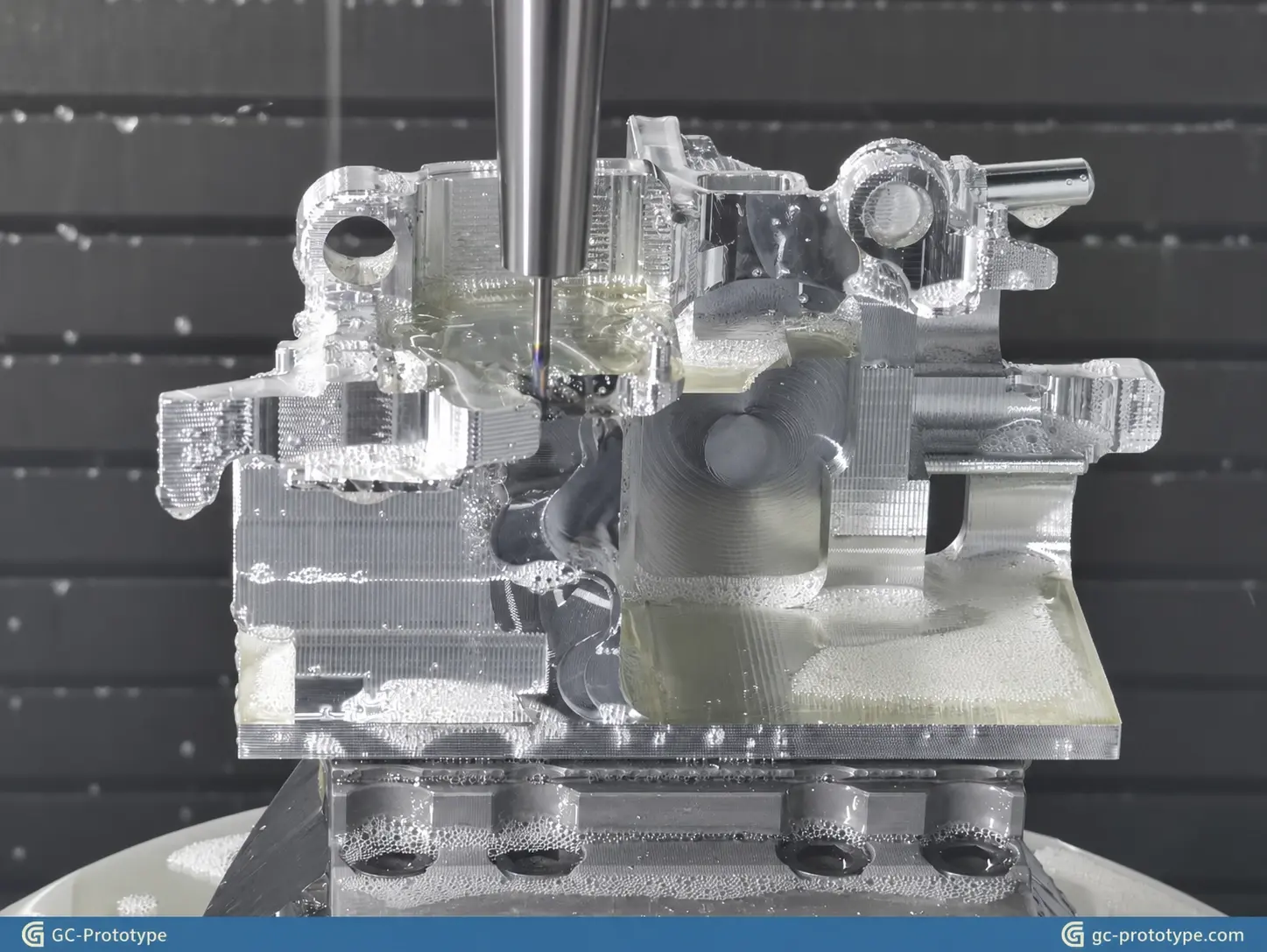
CNC plastic manufacturing helps OEM companies produce precision industrial components from engineering thermoplastics without investing in dedicated molding tools. Whether a project involves a custom plastic machine cover, a precision insulating component, or a low-friction mechanical part, successful manufacturing depends on material selection, part geometry, dimensional stability, and quality inspection.
Choosing the right plastic manufacturing service is especially important when components must fit existing equipment or support repeat production orders. For specialized applications, such as ptfe custom parts, understanding material behavior is equally important.
At GC-Prototype, we support custom plastic machining projects from CAD review and prototype samples to functional validation, low-volume pilot production, and mass production support. This guide explains common industrial plastic components, manufacturing challenges, quality requirements, and how to prepare an effective CNC plastic machining quotation.
CNC plastic manufacturing uses computer-controlled cutting tools to produce custom components from engineering plastic stock, including sheets, plates, rods, and blocks.
Unlike injection molding, CNC machining generally does not require a dedicated mold, making it suitable for prototypes, customized replacement parts, and selected low-volume production projects.
Manufacturers use customer-supplied CAD models and engineering drawings to produce components with specified dimensions, holes, pockets, threads, and assembly interfaces.
Typical applications include equipment covers, precision bushings, electrical insulators, mechanical guides, and industrial brackets.
CNC milling is commonly used for housings, covers, brackets, and components containing pockets or complex surfaces.
CNC turning is suitable for cylindrical components such as plastic sleeves, bushings, spacers, and sealing-related parts.
The appropriate process depends on component geometry, material behavior, and dimensional requirements.
CNC machining is valuable when engineers need functional components without investing in production tooling.
It also supports customized machine replacement parts and suitable low-volume manufacturing projects, particularly when specifications may change during product development.
Industrial equipment manufacturers use customized plastic components for mechanical support, equipment protection, electrical insulation, and controlled movement.
Different applications require different material properties and manufacturing methods.
Plastic machine covers protect internal components, provide mounting surfaces, and help organize equipment assemblies.
Examples include sensor covers, control equipment housings, small machine panels, and customized electronic enclosures.
Important requirements may include mounting-hole accuracy, wall thickness, dimensional fit, surface appearance, and environmental resistance.
Plastic bushings and guides are used in equipment where low friction, reduced weight, or electrical insulation is important.
POM, nylon, and selected PTFE grades are commonly considered for these components.
Critical features may include internal diameter, external diameter, wall thickness, and the fit with mating parts.
Engineering plastics can provide electrical insulation while allowing customized mechanical geometries.
Typical components include insulating spacers, terminal supports, electrical mounting blocks, and specialized connectors.
Material selection must account for the required electrical properties, operating temperature, and applicable safety requirements.
PTFE is used in selected applications requiring low friction, chemical resistance, or electrical insulation.
Common components include washers, sleeves, valve seats, sealing rings, and insulating parts.
Its suitability depends on operating temperature, loading conditions, dimensional requirements, and contact media.
Plastic brackets and supports are used in industrial automation, robotics, electronic equipment, and specialized machinery.
These components may require controlled mounting positions, sufficient mechanical strength, and stable dimensions during assembly.
| Industrial Plastic Part | Potential Materials | Main Functional Requirements |
| Machine Covers | ABS, PC | Fit, impact resistance, appearance |
| Sensor Housings | ABS, PC, POM | Mounting accuracy, dimensional stability |
| Bushings | POM, Nylon, PTFE | Friction, wear, dimensional fit |
| Electrical Insulators | PEEK, PTFE, PEI | Insulation, temperature resistance |
| Valve Seats | Suitable PTFE grades | Chemical compatibility, sealing |
| Mechanical Brackets | POM, PEEK, PC | Strength, mounting position |
| Precision Spacers | POM, PTFE, PEEK | Thickness, fit, dimensional stability |
These materials are potential options rather than universal recommendations. Final selection should reflect the component’s actual operating conditions.
A custom plastic machine cover must match the equipment’s mechanical design while providing suitable protection and access to internal components.
The manufacturing method should be selected according to cover size, material, geometry, and functional requirements.
ABS is commonly considered for industrial covers requiring good machinability and general impact performance.
Polycarbonate may be useful for components requiring transparency or improved impact resistance.
However, material selection should also consider operating temperature, chemical exposure, UV exposure, and mechanical loads.
For machinery safety guards, material selection and validation must meet the applicable safety requirements.
Machine covers frequently include mounting holes, cable openings, threaded inserts, and mating surfaces.
These features should be clearly defined in engineering drawings.
For example, a CNC-machined sensor cover must align with the sensor mounting interface without interfering with adjacent mechanical components.
Critical mounting dimensions should be identified separately from nonfunctional exterior dimensions.
Not every plastic cover should be produced by machining a solid block.
Small covers containing precision pockets or mounting features may be suitable for CNC milling.
Larger thin-wall covers may be more economical through plastic sheet cutting, bending, thermoforming, or another appropriate process.
Selecting the manufacturing method according to geometry and order quantity helps control material waste and project cost.
Industrial covers may require smooth visible surfaces, transparent sections, specified colors, or controlled edge quality.
Appearance and functional requirements should be communicated before manufacturing so that suitable materials and finishing methods can be selected.
PTFE custom parts are used in industrial applications requiring low friction, electrical insulation, or resistance to compatible chemicals.
However, PTFE behaves differently from many rigid engineering plastics. Its flexibility, thermal expansion, and tendency to deform under sustained loading require careful consideration.
Typical PTFE components include:
Bushings for low-friction mechanical interfaces.
Valve seats for compatible fluid-handling systems.
Washers and sealing rings.
Electrical insulating sleeves.
Precision spacers.
Customized industrial fittings.
Each application has different performance and dimensional requirements.
PTFE can deform when excessive clamping force is applied.
During CNC machining, unsuitable workholding may affect the component’s dimensions or surface quality.
Manufacturers should consider suitable support methods, controlled clamping pressure, and machining strategies that minimize distortion.
After machining, the component may also require appropriate dimensional verification under defined measurement conditions.
PTFE can experience creep, sometimes called cold flow, under sustained mechanical loading.
This means a part may gradually change shape even when the applied load remains constant.
For example, a PTFE washer subjected to continuous compression may experience dimensional changes over time.
Engineers should evaluate operating loads, temperature, service life, and whether an alternative or filled PTFE grade would better meet the application requirements.
PTFE valve seats and sealing rings may require carefully controlled mating surfaces, dimensions, and edge conditions.
However, a tight machining tolerance alone does not guarantee sealing performance.
The complete design must consider material deformation, compression, operating pressure, temperature, and chemical compatibility.
| PTFE Part | Typical Application | Critical Engineering Requirement |
| PTFE Bushing | Low-friction movement | Fit, load, creep |
| PTFE Valve Seat | Fluid systems | Sealing geometry, chemical compatibility |
| PTFE Insulator | Electrical equipment | Dielectric requirements, dimensions |
| PTFE Washer | Mechanical assembly | Thickness, compression |
| PTFE Sleeve | Mechanical guides | Bore size, thermal stability |
For reliable results, customers should provide both engineering drawings and the intended operating conditions.
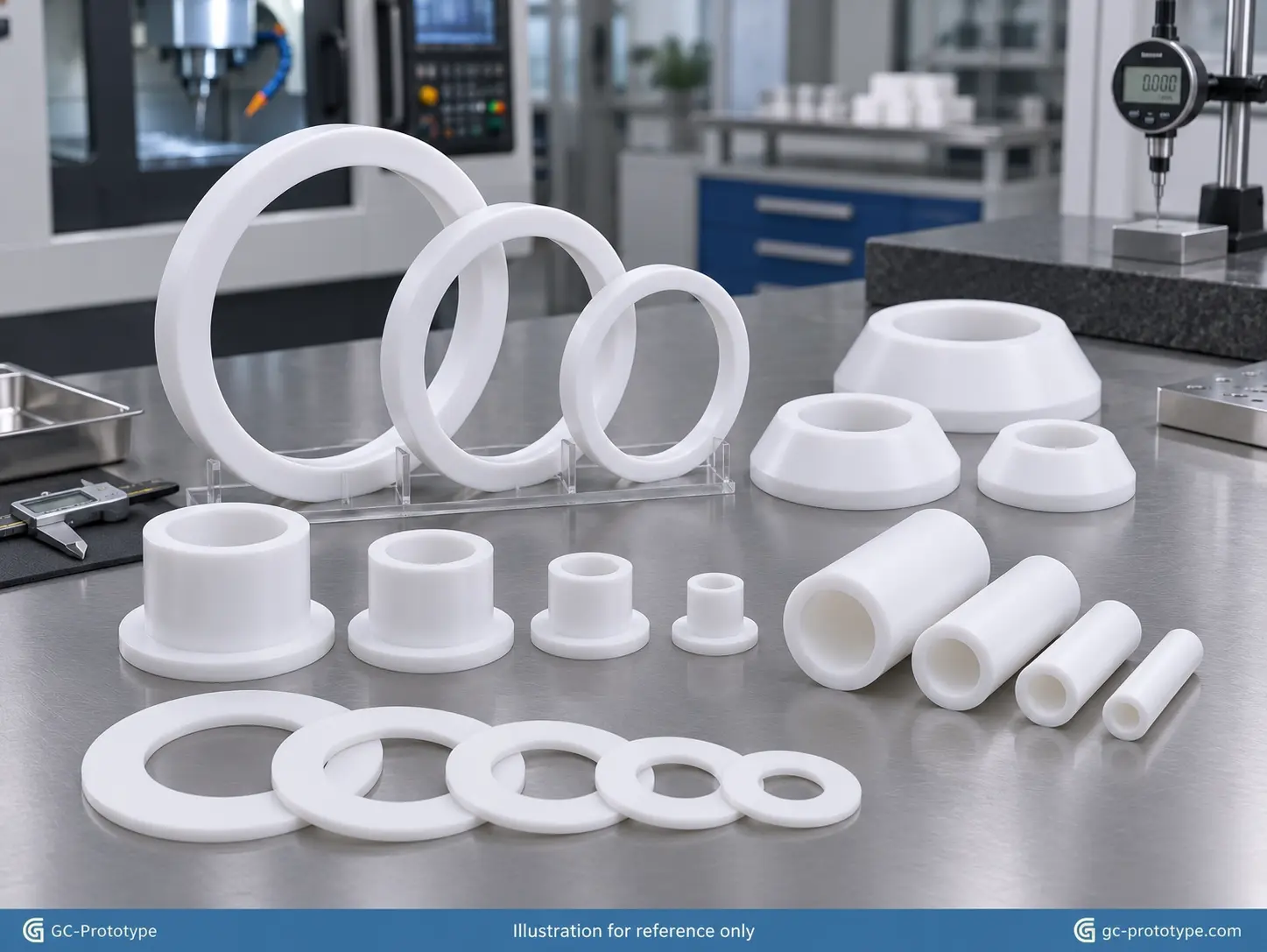
Choosing a plastic material should begin with the component’s intended function rather than selecting a familiar polymer grade.
ABS is useful for many equipment housings and protective covers.
PC may be preferred when transparency or higher impact resistance is required.
Actual performance depends on the specific material grade and application environment.
POM offers low friction and good dimensional stability for many precision mechanical applications.
Nylon can provide toughness and wear resistance, but certain grades absorb moisture, which can affect dimensions.
PTFE is suitable for selected low-friction, insulating, and chemical-resistant applications.
Its creep behavior and dimensional stability must be evaluated when components operate under sustained loads.
PEEK and PEI are high-performance engineering thermoplastics.
They may be considered for applications requiring elevated-temperature performance or specialized mechanical and electrical properties.
Their higher material cost should be justified by the actual performance requirements.
Precision plastic machining requires a different manufacturing approach from metal machining.
Polymers vary significantly in stiffness, thermal behavior, moisture response, and cutting characteristics.
Some plastics deform easily under clamping pressure.
Manufacturers should choose suitable fixture support and avoid excessive forces on thin walls or delicate features.
This is particularly important for PTFE components and thin plastic housings.
Many engineering plastics have relatively high thermal expansion compared with metals.
Heat generated during machining can affect dimensions and surface quality.
Cutting conditions, tool geometry, and temperature control should be considered when manufacturing precision components.
Thin-wall covers and complicated internal pockets may be difficult to machine without deformation.
Deep cavities and narrow slots also limit cutting tool accessibility.
A DFM review can identify opportunities to improve feature geometry while maintaining the component’s intended function.
Plastic machining can generate burrs or unwanted material at the edges of holes, slots, and cut surfaces.
For components used in mechanical assemblies or electrical equipment, burrs may interfere with proper fit.
Deburring methods should avoid damaging critical dimensions or cosmetic surfaces.
Some plastic components may change dimensions because of residual stress, thermal expansion, moisture absorption, or relaxation after machining.
For critical applications, manufacturers should establish appropriate inspection conditions and discuss any necessary stabilization requirements with the customer.
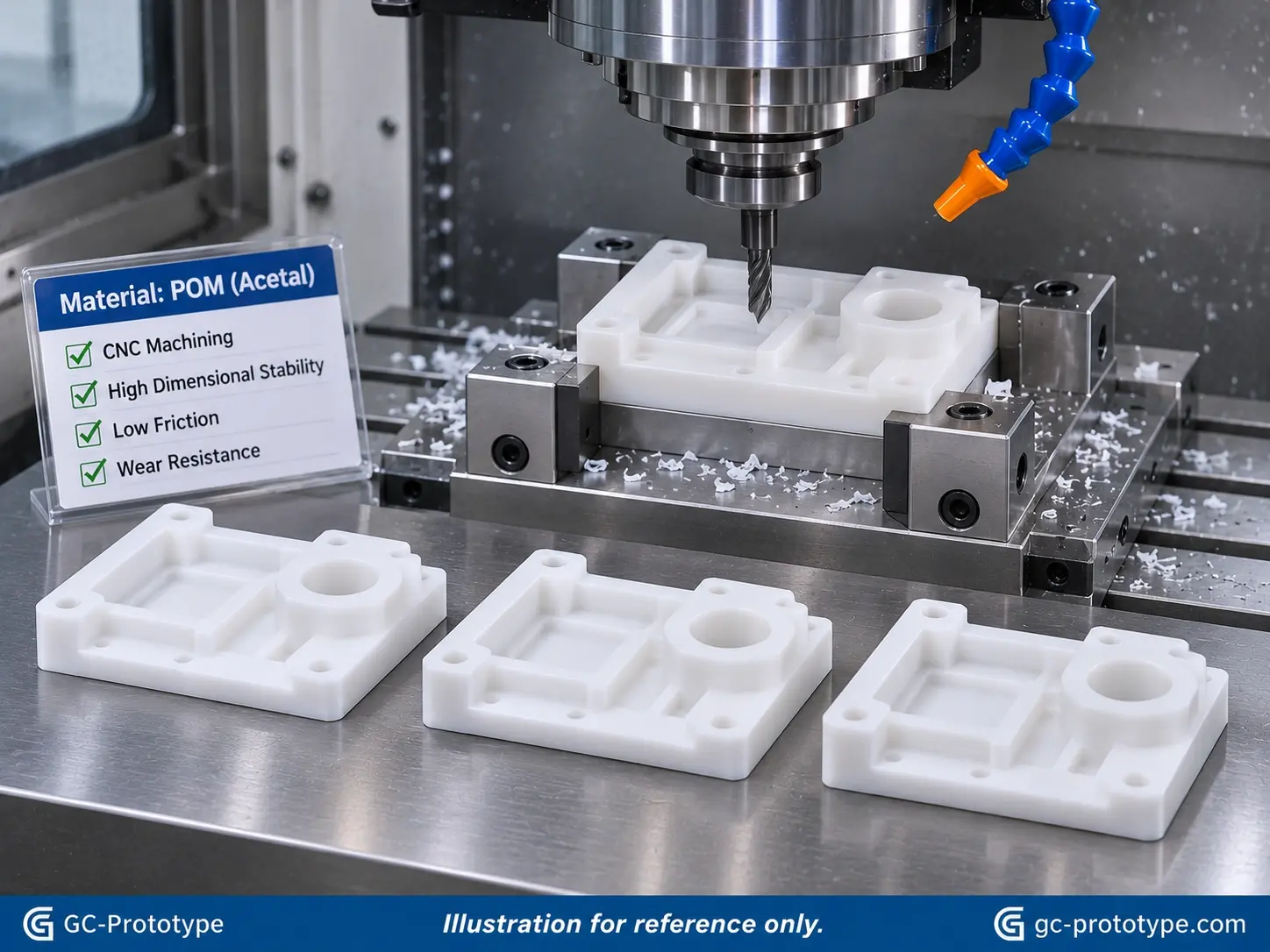
Quality inspection ensures that finished components meet engineering drawings and functional requirements.
For plastic parts, measurement methods should account for material flexibility, temperature sensitivity, and component geometry.
Manufacturers should confirm the specified polymer grade before machining.
Depending on project requirements, buyers may request material identification, certificates, or traceability documentation.
This is particularly important for applications involving chemicals, elevated temperatures, or electrical performance.
Critical dimensions should be identified according to their role in the final assembly.
Examples include:
Mounting-hole positions on equipment covers.
Internal diameters of bushings.
Sealing surfaces of PTFE components.
Critical thicknesses of insulating parts.
Mating features on plastic brackets.
Inspection should focus on the dimensions that directly affect functionality.
Coordinate Measuring Machines (CMM), gauges, calipers, and optical systems can be used for dimensional inspection.
However, measurement force, component support, material deformation, and temperature can affect results.
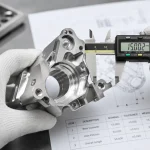
GC-Prototype uses Hexagon CMM equipment to support dimensional verification. Suitable inspection methods should be selected according to the actual material and geometry.
Industrial plastic components may also require visual inspection for scratches, burrs, discoloration, and surface defects.
Protective packaging is important for transparent covers, precision mating surfaces, and delicate components.
For recurring OEM projects, customers may require consistent material specifications, approved drawings, and dimensional inspection documentation.
Clear revision records and agreed inspection requirements help reduce differences between production batches.
| Part Type | Important Inspection Focus |
| Plastic Machine Cover | Mounting locations, fit, appearance |
| PTFE Seal | Dimensions, surface condition, material |
| POM Bushing | ID, OD, roundness, functional fit |
| Electrical Insulator | Critical geometry, material documentation |
| Plastic Bracket | Hole position, flatness, deformation |
For OEM customers, plastic component manufacturing often continues beyond the first prototype.
A coordinated workflow helps engineering teams manage design changes, validate part performance, and prepare for repeat production.
Customers provide 3D CAD models and engineering drawings.
The manufacturing team reviews material specifications, critical dimensions, component geometry, and production requirements.
Initial samples are produced using the selected manufacturing process.
Customers can evaluate assembly fit, surface condition, and functional performance.
For PTFE or other application-sensitive materials, testing should reflect relevant operating conditions.
After sample approval, small-batch manufacturing can support engineering validation, equipment production, or market introduction.
Process selection should consider the required quantity, material, and component design.
For repeat orders, the approved drawing revision, material grade, inspection requirements, and manufacturing instructions should be confirmed.
This helps support consistent production as the customer moves from prototypes toward ongoing supply.
The cost of CNC plastic manufacturing depends on material selection, raw stock requirements, geometry, machining time, inspection, and order quantity.
Specialty polymers such as PEEK can be significantly more expensive than common engineering plastics.
Oversized raw stock can also increase material waste.
Deep pockets, thin walls, complex surfaces, and difficult-to-access features can increase machining time.
Simplifying nonfunctional features may help reduce manufacturing costs.
Tight dimensional requirements, detailed inspection reports, polishing, and special packaging can add cost.
Buyers should distinguish functional requirements from optional cosmetic preferences.
Setup costs are distributed across fewer components in prototype orders.
Suitable repeat production may offer opportunities to improve manufacturing efficiency through consistent workholding and process planning.
| Cost Factor | Cost Impact | Optimization Method |
| Plastic Material | Specialty polymers cost more | Select based on function |
| Raw Stock | Oversized stock increases waste | Optimize stock dimensions |
| Thin Walls | Higher distortion risk | Review wall thickness |
| Tight Tolerances | Additional machining and inspection | Prioritize critical dimensions |
| Surface Requirements | Additional finishing | Define functional and cosmetic zones |
| Quantity | Setup affects unit price | Compare prototype and batch pricing |
A complete Request for Quotation (RFQ) helps manufacturers evaluate production feasibility and provide accurate pricing.
For industrial plastic components, operating conditions are particularly important because material behavior can vary under different temperatures, loads, and chemical environments.
Provide a 3D STEP or STP model and a 2D PDF engineering drawing with dimensions, tolerances, and technical notes.
Specify the required polymer grade or provide the functional requirements if material selection is still under review.
Useful information includes operating temperature, chemical exposure, friction requirements, and mechanical loading.
Clearly identify critical mounting features, sealing surfaces, dimensions, and any required inspection documentation.
Provide prototype quantities, expected production volumes, target delivery dates, and packaging requirements.
| RFQ Information | What to Provide |
| CAD Model | STEP / STP / IGES |
| 2D Drawing | PDF with dimensions and tolerances |
| Material | Polymer grade or functional requirements |
| Operating Conditions | Temperature, chemicals, load, friction |
| Quantity | Prototype and production quantities |
| Critical Features | Mounting holes, sealing surfaces, fits |
| Surface Requirements | Appearance, roughness, edge quality |
| Inspection | Required dimensional reports |
| Delivery | Destination and required schedule |
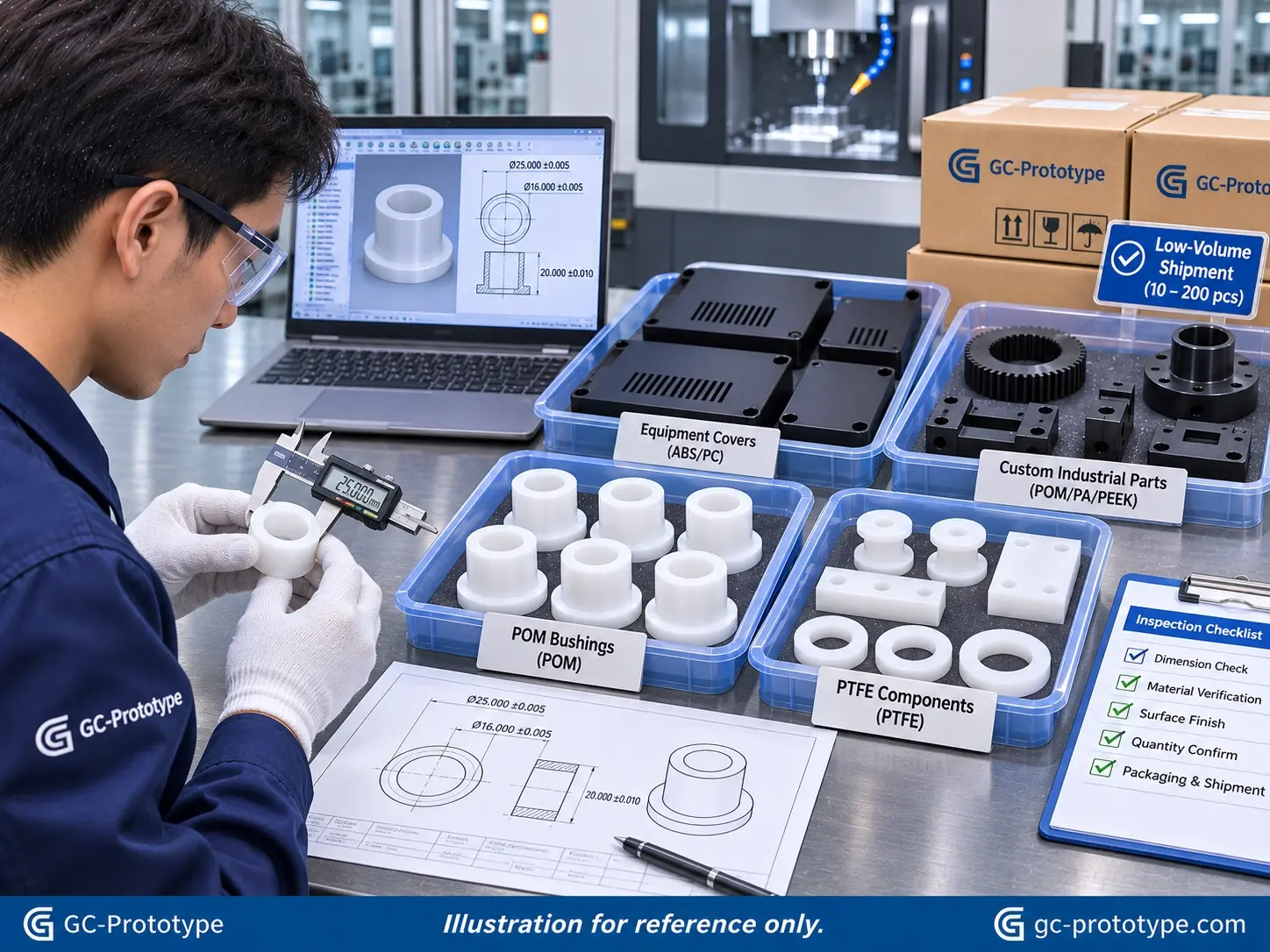
CNC plastic manufacturing is used to produce customized engineering plastic parts such as industrial covers, housings, bushings, insulators, brackets, seals, and mechanical components. It is particularly suitable for prototypes, specialized replacement parts, and selected low-volume production requirements.
Yes. CNC machining can manufacture suitable machine covers, particularly smaller components requiring precise mounting features and customized geometry. Large or thin-wall covers may be better suited to plastic sheet fabrication, thermoforming, or other processes.
Common PTFE components include bushings, washers, sleeves, valve seats, sealing rings, and electrical insulators. Material grade and design should be selected according to operating temperature, chemical exposure, loading, and functional requirements.
There is no single best material. POM is useful for many low-friction mechanical parts, nylon offers toughness and wear resistance, PTFE provides low friction and chemical resistance, and PEEK can be suitable for demanding operating environments.
Yes. CNC machining can support prototype development and suitable repeat manufacturing orders. Consistency depends on approved drawings, material specifications, suitable machining processes, and appropriate inspection controls.
A 3D CAD file and a 2D engineering drawing are recommended. Buyers should also provide material requirements, critical tolerances, quantities, surface finish specifications, operating conditions, and delivery expectations.
Looking for a reliable plastic manufacturing service for your next industrial equipment or OEM project?
GC-Prototype provides custom CNC machining and prototype manufacturing support for engineering plastic components, including suitable machine covers, precision housings, bushings, brackets, and specialized functional parts.
Whether your project involves a custom plastic machine cover, precision POM components, or ptfe custom parts, our team can review your engineering drawings, material requirements, critical dimensions, and production quantities to evaluate suitable manufacturing solutions.
Send us your 3D CAD/STEP files and 2D engineering drawings, including material specifications and operating conditions.
From CAD review and prototype samples to functional validation, low-volume pilot production, and mass production support, GC-Prototype helps international B2B customers move their manufacturing projects forward.