Address:
Shenzhen Bao'an District Xinqiao Subdistrict Huangpu Community Huangpu East Ring Road No. 504 Shenzhen Yuan Industrial City Building C
Work Hours:
Monday to Friday: 9AM - 21PM
Weekend: 9AM - 21PM

Address:
Shenzhen Bao'an District Xinqiao Subdistrict Huangpu Community Huangpu East Ring Road No. 504 Shenzhen Yuan Industrial City Building C
Work Hours:
Monday to Friday: 9AM - 21PM
Weekend: 9AM - 21PM

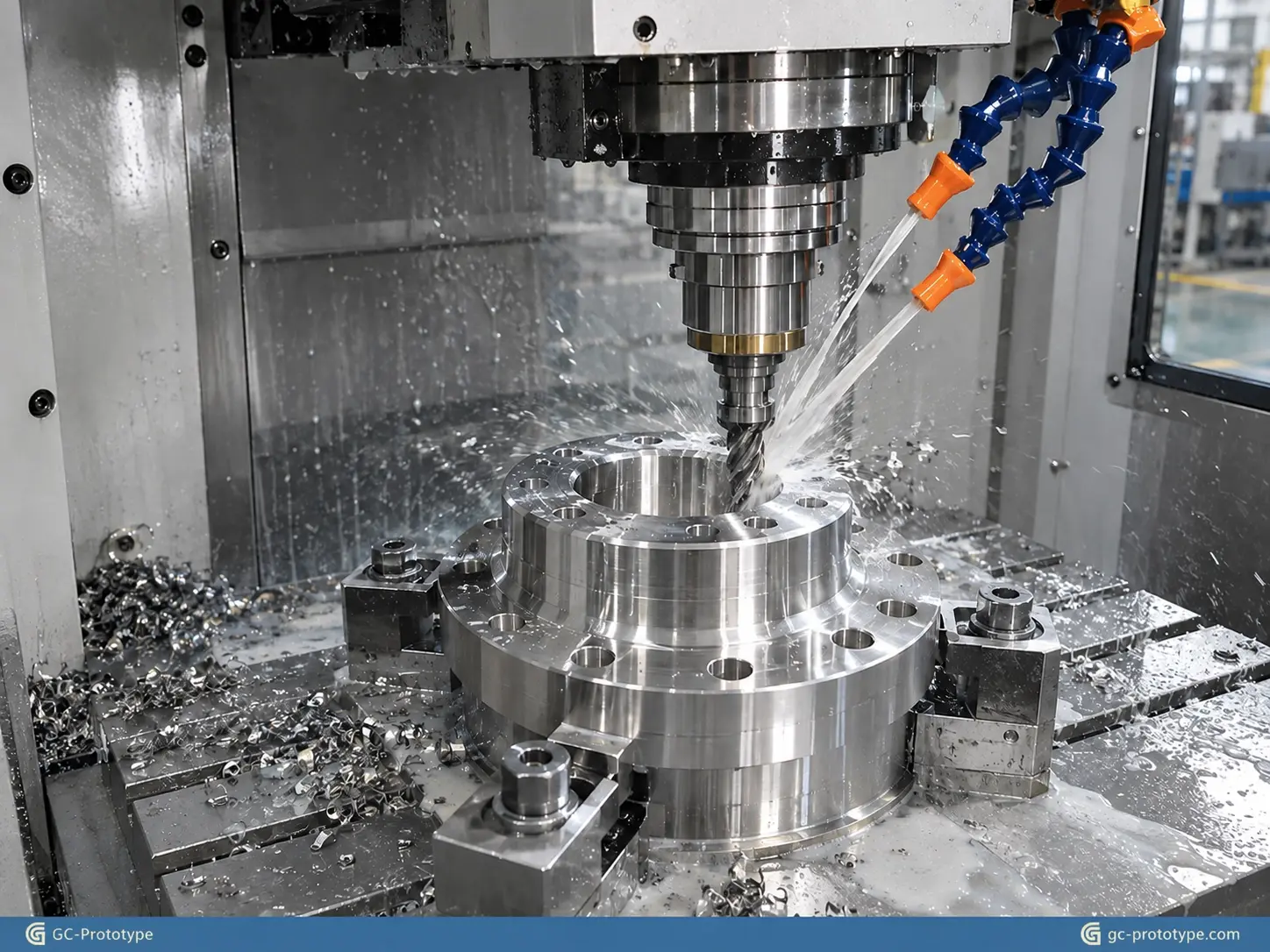
Stainless steel CNC machining parts are widely used in automotive, medical equipment, aerospace, industrial automation, and other demanding applications where strength, corrosion resistance, and dimensional accuracy are essential. Choosing the right stainless steel CNC machining parts supplier involves more than selecting a material and machining process. Engineers and procurement teams must also consider material grades, machining challenges, surface finishes, quality inspection, and manufacturing costs.
Whether you need custom shafts, precision connectors, stainless steel housings, or other stainless steel CNC parts, selecting an experienced manufacturing partner can help reduce development risks and improve component reliability.
At GC-Prototype, we support custom CNC machining projects from CAD design and prototype samples to functional validation, low-volume production, and mass production support. This guide explains how to select stainless steel grades, understand machining requirements, and source reliable custom components for your next engineering project.
Stainless steel CNC machining parts are components manufactured from stainless steel stock using computer-controlled machining processes. These processes remove material to create precise shapes, holes, slots, threads, and other functional features according to engineering drawings.
Stainless steel is particularly useful when components require a combination of mechanical strength, corrosion resistance, and long-term durability.
Unlike some conventional carbon steels, stainless steel contains sufficient chromium to form a protective passive surface layer. This layer helps resist corrosion under suitable environmental conditions.
Engineers select stainless steel for several reasons:
Corrosion resistance: Suitable grades perform well in many humid, chemical, and industrial environments.
Mechanical strength: Many stainless steel grades provide good strength and structural stability.
Temperature resistance: Selected grades maintain useful mechanical properties at elevated or reduced temperatures.
Durability: Stainless steel components can provide long service life under appropriate operating conditions.
Surface appearance: Stainless steel can achieve brushed, polished, or other specified finishes.
Material selection should always consider the actual operating environment rather than relying on general material descriptions.
Common cnc machined stainless steel parts include:
Precision shafts and pins
Bushings and spacers
Threaded connectors and fittings
Mechanical brackets and mounting components
Valve bodies and fluid-handling components
Equipment housings and enclosures
Custom fasteners and structural components
These parts are frequently used in equipment where dimensional consistency and material performance directly affect assembly and operation.
Selecting the correct stainless steel grade is one of the most important decisions in custom machining.
Different grades have different corrosion resistance, strength, machinability, and cost characteristics. Choosing an unsuitable material can increase manufacturing costs or cause performance problems during product operation.
303 stainless steel is a free-machining grade developed to improve machinability.
It is commonly used for components involving extensive turning, drilling, and threading.
Typical applications include:
Precision shafts
Threaded fittings
Fasteners
Bushings
Small mechanical connectors
Its improved machinability can help reduce machining time and tool wear compared with many other austenitic stainless steel grades.
However, 303 generally offers lower corrosion resistance than 304 and 316, particularly in certain chloride-containing environments.
It is therefore important to evaluate the operating environment before selecting this grade.
304 stainless steel is one of the most widely used stainless steel grades.
It offers a useful combination of corrosion resistance, strength, formability, and availability.
Common applications include:
Industrial equipment housings
Mounting brackets
Mechanical components
Equipment fittings
General-purpose precision parts
For many industrial applications, 304 provides a practical balance between material performance and cost.
However, it may not be the best choice for environments involving significant chloride exposure or more aggressive chemical conditions.
316 stainless steel contains molybdenum, which improves its resistance to certain forms of corrosion compared with 304.
316L is a low-carbon version of 316.
These materials are frequently considered for:
Marine equipment components
Chemical processing equipment
Fluid-handling fittings
Medical equipment components
Corrosion-sensitive mechanical assemblies
The choice between 316 and 316L depends on the application, fabrication requirements, and operating environment.
For example, 316L may be preferred when welding considerations and resistance to sensitization are important.
17-4 PH is a precipitation-hardening stainless steel known for its combination of strength, hardness, and corrosion resistance.
It is commonly considered for demanding mechanical applications such as:
High-strength shafts
Precision structural components
Industrial machinery parts
Aerospace-related mechanical components
High-load fittings
Its final properties depend on the selected heat-treatment condition.
Engineers should specify the required material condition and mechanical properties rather than simply requesting 17-4 PH without further details.
| Stainless Steel Grade | Main Characteristics | Typical Applications |
| 303 | Improved machinability | Shafts, fittings, fasteners |
| 304 | General corrosion resistance and versatility | Housings, brackets, industrial parts |
| 316 | Improved resistance in many chloride environments | Marine and chemical equipment |
| 316L | Low-carbon variant | Welded and corrosion-sensitive assemblies |
| 17-4 PH | High strength after suitable heat treatment | Structural and precision components |
There is no universally best stainless steel grade. The right choice depends on mechanical loading, corrosion exposure, manufacturing requirements, and budget.
Stainless steel and carbon steel are both widely used in precision manufacturing, but they serve different engineering requirements.
For buyers sourcing precision cnc machined carbon steel parts, the decision often involves balancing mechanical strength, corrosion protection, machining costs, and maintenance requirements.
Stainless steel generally provides better corrosion resistance because of its chromium-rich passive surface layer.
Carbon steel typically requires additional protection, such as painting, plating, or other suitable coatings, when corrosion is a concern.
However, carbon steel can offer excellent mechanical properties and may be more economical for components operating in controlled environments.
Machining cost depends on the specific material grade, stock availability, geometry, and required tolerances.
Some carbon steels are relatively straightforward to machine, while certain stainless steel grades create additional challenges because of work hardening, heat generation, and tool wear.
The total project cost should also include any necessary surface protection.
| Comparison | Stainless Steel | Carbon Steel |
| Corrosion Resistance | Generally better | Usually requires protection |
| Mechanical Strength | Grade-dependent | Grade-dependent |
| Machinability | Varies by grade | Varies by grade |
| Material Cost | Often higher | Often lower |
| Surface Protection | Application-dependent | Frequently requires coating |
| Common Applications | Fittings, housings, shafts | Structural and mechanical parts |
For components exposed to moisture, chemicals, or demanding operating environments, stainless steel may offer better long-term value.
For cost-sensitive mechanical parts operating in controlled conditions, carbon steel may be a practical alternative.
The final decision should be based on engineering requirements rather than material price alone.
Although stainless steel offers useful engineering properties, machining it requires appropriate tooling, cutting parameters, workholding, and process control.
Understanding these challenges helps buyers evaluate whether a supplier has the necessary manufacturing experience.
Some stainless steel grades, particularly austenitic grades such as 304 and 316, can experience work hardening during machining.
When the material is subjected to excessive deformation, the machined surface may become harder than the underlying material.
This can make subsequent cutting more difficult and accelerate tool wear.
Appropriate cutting parameters, tool geometry, and machining strategies help reduce this problem.
Stainless steel can retain heat around the cutting zone.
If machining conditions are unsuitable, elevated temperatures may accelerate tool wear and negatively affect surface quality.
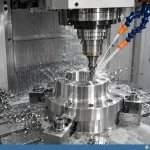
Effective coolant application, appropriate cutting speeds, and suitable cutting tools help manage heat during machining.
Long, continuous chips can create difficulties during CNC machining.
Poor chip evacuation may affect surface quality, cutting stability, and operator safety.
Manufacturers should select suitable chip-breaking strategies and machining parameters.
Deburring is also important because sharp edges and burrs can interfere with assembly or create safety concerns.
Thin walls, deep cavities, and complex geometries can increase the difficulty of maintaining dimensional accuracy.
Stainless steel components may also experience dimensional changes due to heat and machining stresses.
A suitable machining strategy should consider:
Workholding stability
Cutting sequence
Tool condition
Machining allowances
Temperature control
Inspection methods
For components with critical bearing interfaces, mounting features, or sealing surfaces, these factors are particularly important.
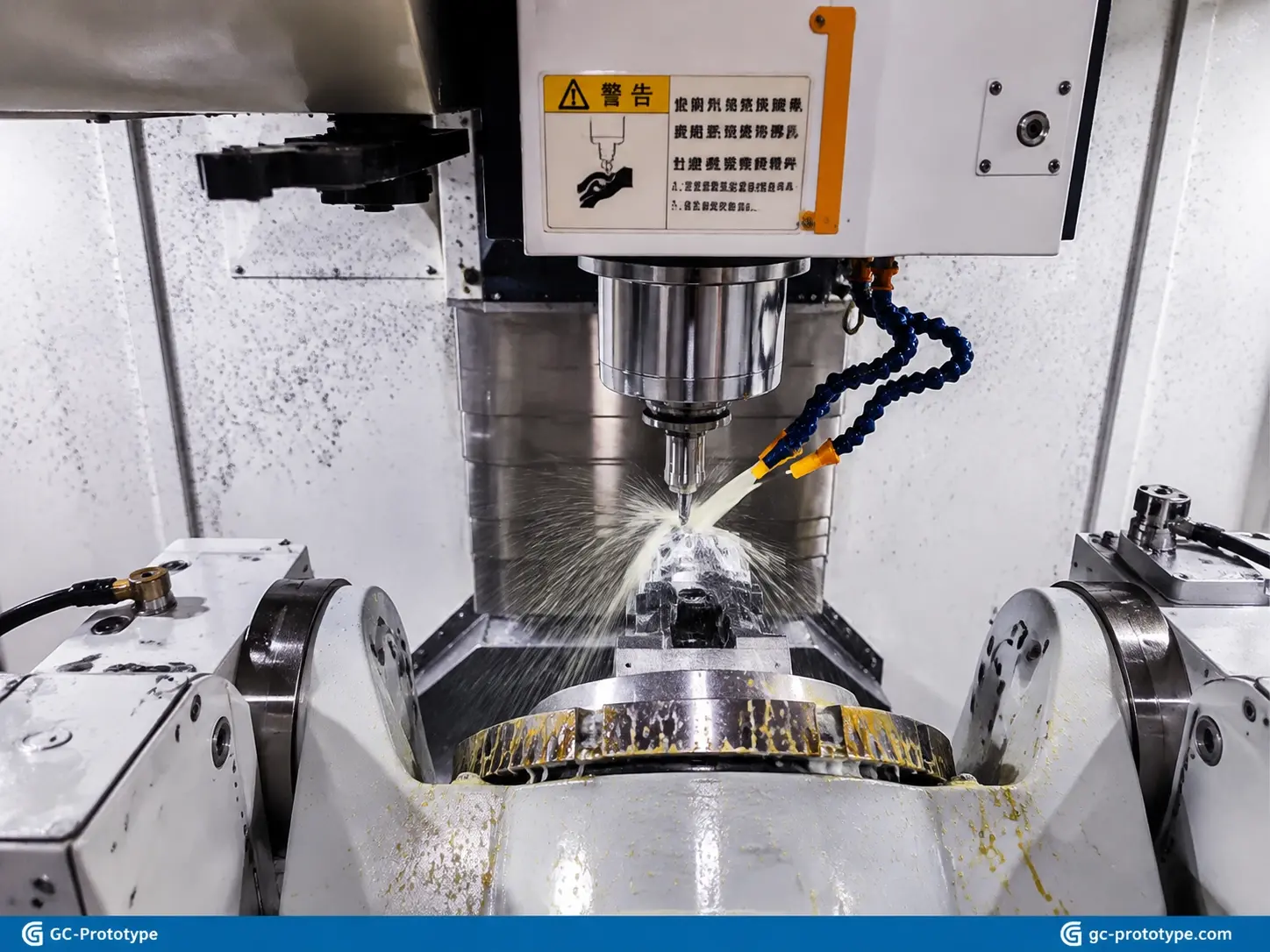
The manufacturing process should be selected according to component geometry, tolerances, production quantity, and functional requirements.
CNC milling is suitable for stainless steel components with flat surfaces, pockets, slots, holes, and complex contours.
Typical applications include:
Mounting brackets
Valve bodies
Mechanical housings
Equipment connectors
Structural components
For complex geometries, multi-axis machining can reduce repeated setups and improve access to different component surfaces.
CNC turning is suitable for producing cylindrical stainless steel components.
Common examples include:
Precision shafts
Threaded fittings
Bushings
Pins
Spacers
Cylindrical connectors
The process can produce accurate diameters, grooves, threads, and other rotational features.
For components with multiple angled surfaces or complex three-dimensional features, four-axis and five-axis machining may improve manufacturing efficiency.
The appropriate process depends on the geometry and required dimensional relationships.
Rather than automatically choosing the most advanced machine, manufacturers should evaluate the actual machining requirements and select a cost-effective approach.
Surface finishing is an important consideration when manufacturing stainless steel components.
The required finish may affect appearance, corrosion performance, cleanliness, friction, and assembly compatibility.
An as-machined finish retains the surface characteristics produced by the CNC cutting process.
It may be suitable for internal mechanical features, mounting surfaces, and components where appearance is not a primary requirement.
Brushed finishes create a directional surface appearance and are frequently used for visible equipment components.
Polishing can reduce surface roughness and improve appearance.
For applications involving sliding contact, sealing, or cleaning requirements, the specified surface roughness should be considered carefully.
Passivation is a chemical treatment used to improve the corrosion resistance of stainless steel by supporting the formation of its protective passive surface.
Electropolishing removes a small amount of surface material through an electrochemical process and can improve surface smoothness.
These treatments may be appropriate for certain medical, food-processing, and fluid-handling components.
However, the correct process depends on the stainless steel grade, application, and required surface condition.
Surface finish requirements should be defined according to function.
For example:
Bearing interfaces may require controlled surface roughness.
Sealing surfaces may require specific finish specifications.
Visible housings may require consistent cosmetic appearance.
Fluid-contact surfaces may require additional cleanliness considerations.
Specifying a finish that is more demanding than necessary can increase manufacturing costs without improving functional performance.
Quality inspection helps confirm that finished components meet engineering drawings and project requirements.
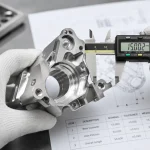
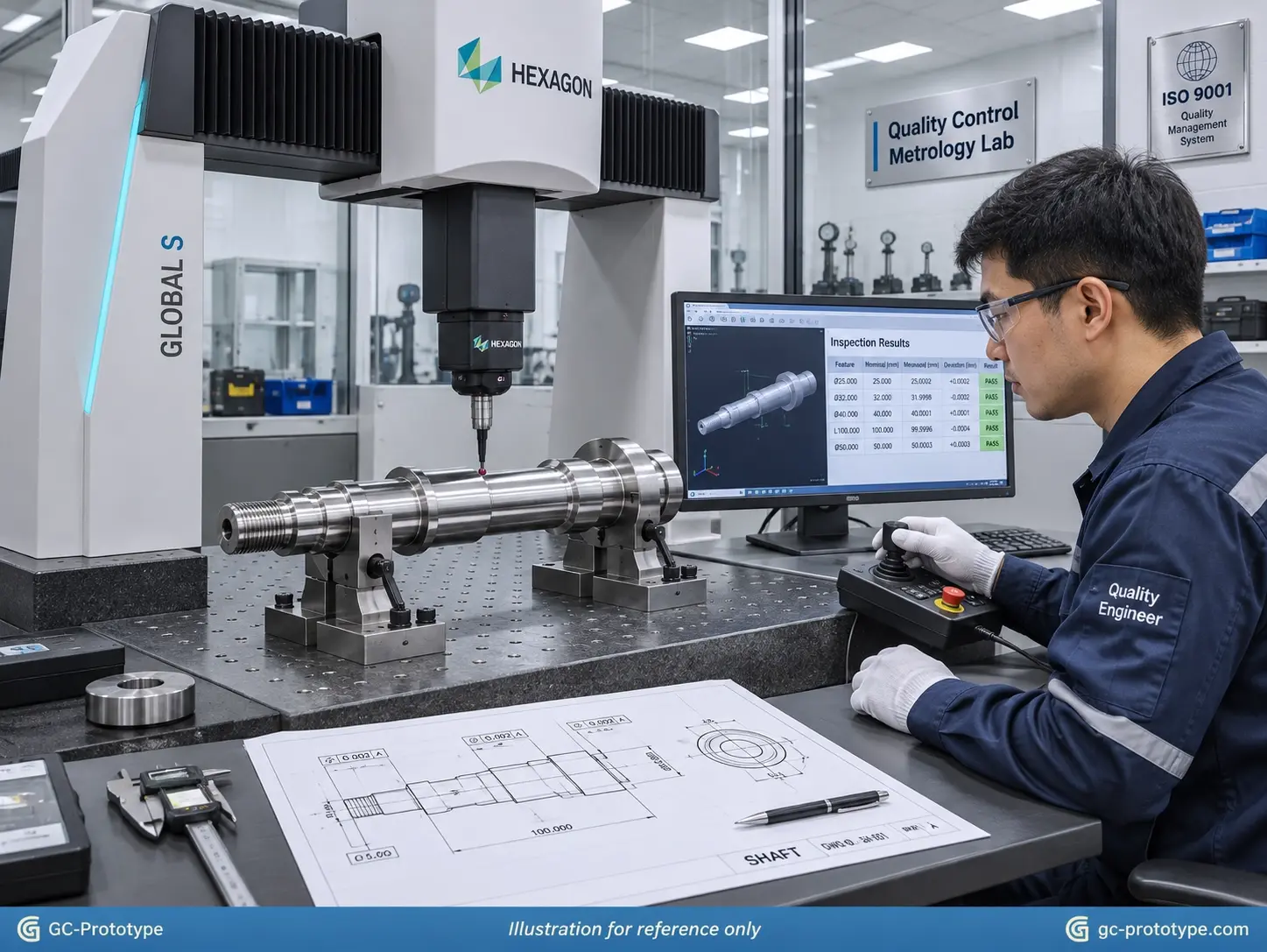
For buyers sourcing precision cnc machined stainless steel parts, inspection should focus on the features that directly affect assembly, functionality, and product reliability.
Coordinate Measuring Machines (CMM) are useful for measuring complex geometries and verifying dimensional relationships.
Depending on the component, inspection may cover:
Bore diameters
Hole positions
Flatness
Perpendicularity
Parallelism
Profile requirements
Critical mounting dimensions
GC-Prototype uses dimensional inspection equipment, including Hexagon CMM systems, to support precision measurement requirements.
The inspection plan should be based on the customer’s engineering drawings and critical features.
Material verification is particularly important when components have specified mechanical or corrosion-resistance requirements.
Depending on project needs, buyers may request:
Material certificates
Material grade confirmation
Batch identification
Chemical composition verification
Inspection documentation
GC-Prototype also uses Olympus XRF equipment for material analysis.
The appropriate verification method depends on the material and the information that must be confirmed. XRF results alone should not be treated as proof of every mechanical property or material specification.
Not every dimension requires the same level of precision.
Critical dimensions should be identified clearly on the engineering drawing.
For example, a stainless steel shaft may require close control of its bearing diameter, while nonfunctional external surfaces may have more flexible tolerances.
A clear inspection plan helps control quality without adding unnecessary manufacturing costs.
Stainless steel customized mechanical parts are used in industries where material durability, corrosion resistance, and mechanical performance are important.
Stainless steel components are used in selected medical equipment housings, instrument mechanisms, connectors, and precision mechanical assemblies.
Material selection depends on the intended use, applicable regulatory requirements, cleaning procedures, and corrosion exposure.
Automotive and automation applications may include:
Precision shafts
Mechanical connectors
Sensor mounting components
Fasteners
Equipment brackets
Actuator components
Dimensional accuracy is important when these parts interact with bearings, motors, sensors, or other mechanical assemblies.
Stainless steel is frequently used in fluid-handling and food-processing equipment because selected grades provide useful corrosion resistance and cleanability.
Typical components include fittings, valve parts, connectors, and mechanical interfaces.
Surface condition and material selection should follow the actual application requirements.
Stainless steel may be selected for aerospace-related mechanical components and electronic equipment parts requiring specific strength, durability, or corrosion properties.
The required material grade, documentation, inspection, and qualification procedures depend on the application.
The cost of stainless steel CNC machining depends on more than raw material prices.
Manufacturing complexity, machining time, finishing requirements, inspection, and order quantity all influence the final quotation.
Different stainless steel grades have different material costs and availability.
For example, 303 may offer machining advantages for certain turned components, while 316L may be selected for more demanding corrosion-related applications.
Specialized materials or nonstandard stock dimensions may increase procurement time and cost.
Complex geometries generally require more programming, machining operations, and inspection.
Deep cavities, thin walls, multiple setups, and difficult-to-access features can increase manufacturing time.
Simplifying nonfunctional features may help reduce cost.
Tighter tolerances may require additional machining operations and more detailed inspection.
Surface treatments such as passivation, polishing, or electropolishing can also add cost.
Buyers should specify only the tolerances and finishing requirements necessary for component performance.
Prototype orders often have higher unit costs because programming and setup expenses are distributed across fewer components.
As order quantities increase, suppliers may optimize workholding, tooling, and machining sequences to improve manufacturing efficiency.
| Cost Factor | Impact on Quotation | Optimization Method |
| Material Grade | Different material prices and availability | Select grade based on actual requirements |
| Geometry | Complex features increase machining time | Simplify nonfunctional features |
| Tolerances | Tight tolerances increase processing and inspection costs | Apply tight tolerances selectively |
| Surface Finish | Additional finishing increases cost | Specify functional finish requirements |
| Quantity | Setup costs affect unit price | Consolidate compatible orders |
| Inspection | Additional reports and measurements increase cost | Define critical inspection requirements |
To receive a meaningful quotation, provide complete drawings, material specifications, quantities, and surface-finish requirements.
Choosing a manufacturing partner that supports multiple development stages can simplify the transition from engineering design to production.
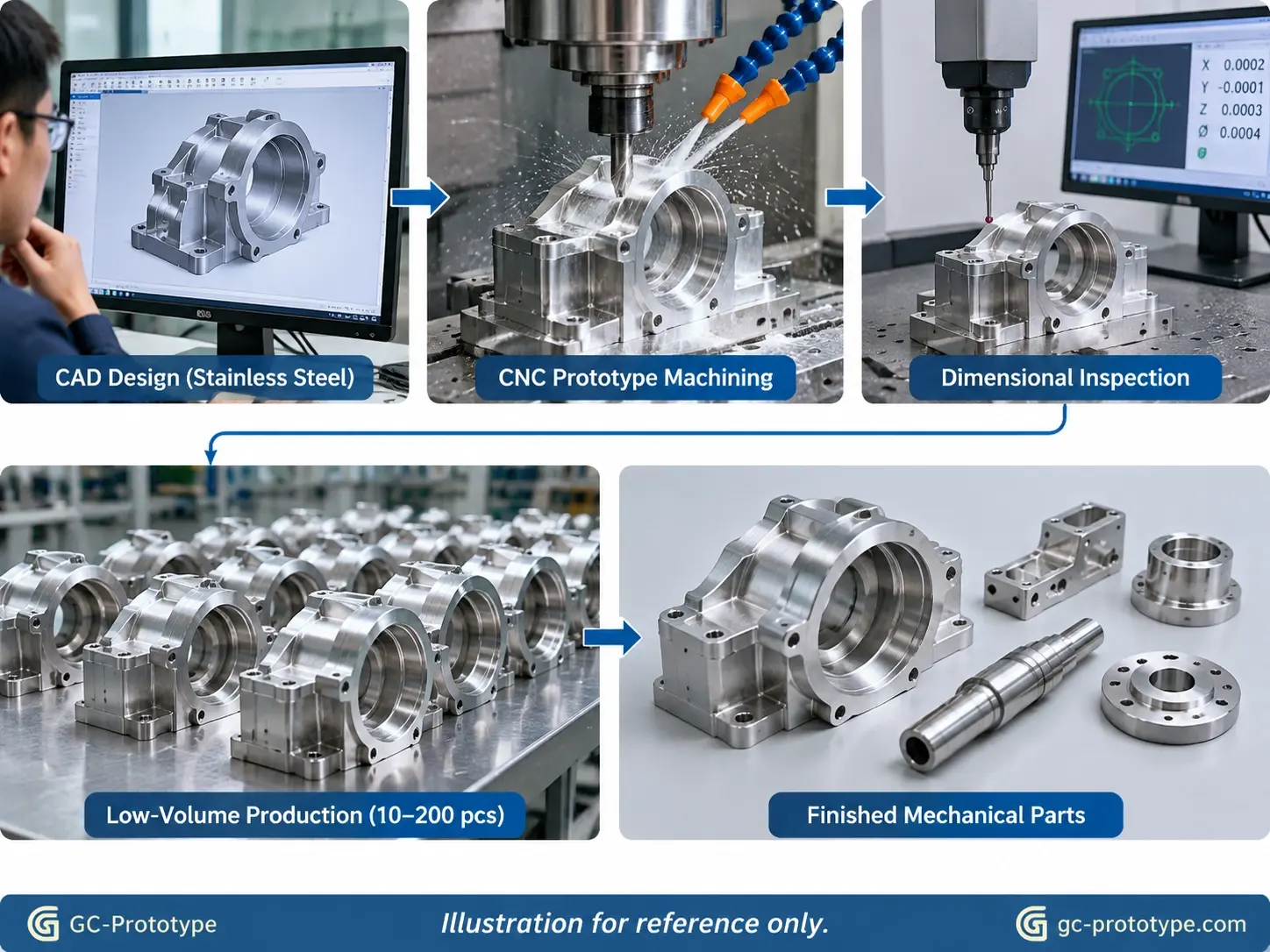
GC-Prototype supports customers through the following workflow:
Customers provide 3D CAD models and engineering drawings.
The manufacturing team reviews geometry, material selection, tolerances, and manufacturing feasibility.
Suitable machining processes are selected to manufacture stainless steel prototype components.
The samples can then be evaluated for dimensions, fit, and assembly requirements.
Engineering teams test prototype components according to the intended application.
Design revisions can be incorporated before proceeding to the next manufacturing stage.
After prototype validation, small batches can support further product evaluation and manufacturing planning.
Once the design is established, manufacturing processes can be reviewed for repeatability, production efficiency, and cost optimization.
Depending on the part geometry and order volume, CNC machining or other suitable manufacturing processes may be considered.
The best grade depends on the application. 303 is often selected for improved machinability, 304 for general industrial applications, 316 for improved corrosion resistance in many environments, and 17-4 PH for high-strength applications.
304 is suitable for many general-purpose applications. 316 provides improved resistance to certain corrosive environments, particularly those involving chlorides. The right choice depends on operating conditions and budget.
Stainless steel parts are often more expensive to machine than comparable aluminum parts because of differences in material cost, cutting conditions, and machining time. Actual costs depend on grade, geometry, quantity, and tolerances.
Yes. Stainless steel can be machined to tight dimensional requirements using appropriate tooling, machining strategies, and inspection methods. Achievable tolerances depend on component geometry, material condition, and manufacturing conditions.
Options may include as-machined, brushed, polished, passivated, and electropolished finishes. The appropriate finish depends on appearance, corrosion, cleanliness, and functional requirements.
Provide a 3D CAD file, preferably STEP or STP, together with a 2D engineering drawing. Include material grade, quantity, tolerances, surface finish, inspection requirements, and delivery expectations.
Finding the right manufacturing partner is essential for producing reliable stainless steel components.
GC-Prototype provides custom CNC milling, precision turning, engineering support, dimensional inspection, and multiple prototype manufacturing processes for international B2B customers.
Whether you need precision stainless steel shafts, custom connectors, mechanical housings, or complex functional components, our team can review your drawings and discuss suitable manufacturing solutions.
Looking for a reliable supplier of custom stainless steel CNC machining parts?
Send us your 3D CAD/STEP files and engineering drawings. Our team can review your material specifications, machining requirements, critical dimensions, and production quantities.
From initial CAD review and prototype samples to functional validation, low-volume pilot production, and mass production support, GC-Prototype helps you move your product development project forward.
Upload your CAD files today to request a technical DFM review and a customized CNC machining quotation.