Address:
Shenzhen Bao'an District Xinqiao Subdistrict Huangpu Community Huangpu East Ring Road No. 504 Shenzhen Yuan Industrial City Building C
Work Hours:
Monday to Friday: 9AM - 21PM
Weekend: 9AM - 21PM

Address:
Shenzhen Bao'an District Xinqiao Subdistrict Huangpu Community Huangpu East Ring Road No. 504 Shenzhen Yuan Industrial City Building C
Work Hours:
Monday to Friday: 9AM - 21PM
Weekend: 9AM - 21PM

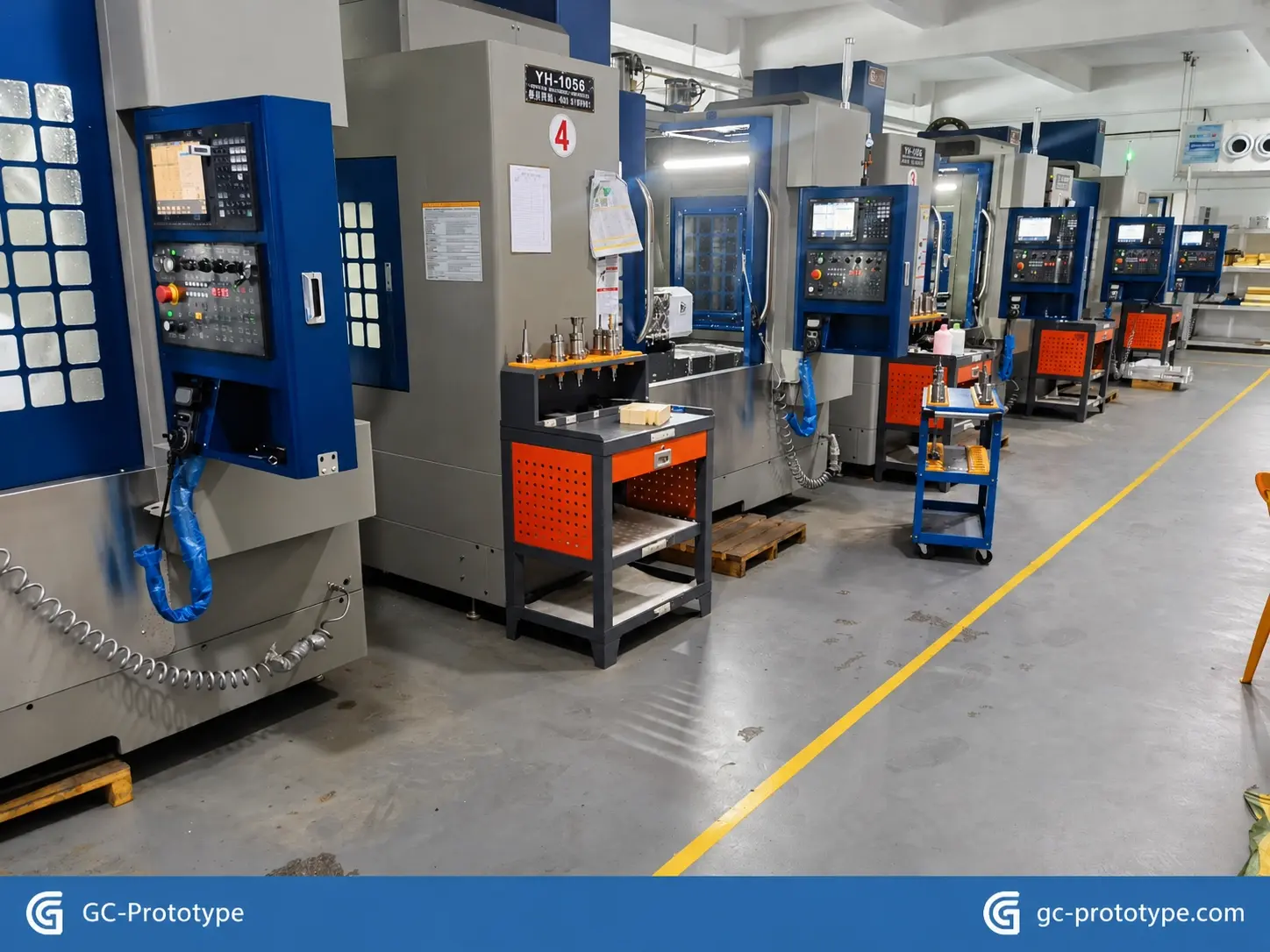
Choosing reliable cnc prototype manufacturers is essential for engineering teams that need precision components, functional testing, and dependable delivery before production. Whether you are sourcing cnc machining prototype manufacturers for custom aluminum housings, stainless steel components, or complex mechanical assemblies, selecting the right supplier can significantly affect product development costs, quality, and project timelines.
For overseas B2B buyers, finding a manufacturing partner involves more than comparing quotations. You need to evaluate CNC equipment, material expertise, dimensional inspection, engineering support, communication, and the ability to move from prototypes to production.
Some suppliers specialize in precision CNC machining, while others operate as a broader functional prototypes manufacturer, offering multiple manufacturing processes for different engineering requirements.
This guide explains seven important factors to evaluate before selecting a CNC prototype manufacturer, how to verify supplier quality, compare quotations, reduce overseas sourcing risks, and identify a suitable partner for your next engineering project.
A CNC prototype manufacturer transforms engineering drawings and 3D CAD models into physical components for design evaluation, functional testing, and product development.
Unlike conventional production machining, prototype manufacturing frequently involves small quantities, changing engineering requirements, and multiple design iterations.
A reliable supplier should understand both the manufacturing process and the intended application of the component.
Manufacturing experience should be evaluated based on the types of components a supplier has successfully produced.
For example, manufacturing a simple aluminum plate requires different capabilities from producing a five-axis robotic joint housing with multiple precision bearing interfaces.
When evaluating a supplier, consider:
CNC milling and turning capabilities
Three-axis, four-axis, and five-axis machining
Engineering metal and plastic materials
Complex geometries and precision features
Surface finishing and secondary operations
Dimensional inspection capabilities
Ask whether the supplier has experience with components similar to yours rather than relying exclusively on general equipment lists.
Prototype manufacturing requires flexibility.
Engineering teams may revise CAD models several times before approving a final design. A suitable supplier should be able to manage these changes without unnecessary delays or confusion.
Production machining, on the other hand, generally focuses on repeatability, process optimization, and manufacturing efficiency.
A supplier experienced in both areas can help bridge the gap between early engineering samples and subsequent production requirements.
Not every manufacturing supplier performs every process in-house.
Some companies operate their own CNC machining facilities while outsourcing anodizing, heat treatment, laser cutting, or specialized finishing.
This is not necessarily a disadvantage. What matters is whether the supplier clearly explains which processes are performed internally and which involve external partners.
Before ordering, clarify who is responsible for process coordination, inspection, and final delivery.
Selecting the right supplier requires a structured evaluation rather than relying on price or marketing claims.
The following seven factors can help engineering and procurement teams make better decisions.
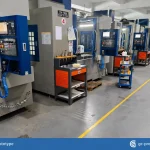
Start by checking whether the manufacturer’s equipment is appropriate for your component geometry.
Three-axis CNC milling is suitable for many conventional parts, including brackets, plates, and housings.
Four-axis and five-axis machining can be more efficient for components with multiple angled surfaces, complex contours, and features requiring machining from different directions.
CNC turning is particularly useful for cylindrical components such as shafts, bushings, pins, and threaded parts.
Ask the supplier to explain which machining method they recommend and why.
A supplier should have practical experience machining the materials specified in your engineering drawings.
Common prototype materials include:
Aluminum 6061 and 7075
Stainless steel 304 and 316
Titanium alloys
Brass and copper
ABS and polycarbonate
POM and nylon
PEEK
Material availability is also important.
A supplier may have extensive CNC equipment but still experience delays if a specialized material grade is difficult to source.
For demanding applications, request confirmation of the material grade and any required supporting documentation.
A manufacturer should have suitable measurement equipment and inspection procedures for the components being produced.
Depending on the project, inspection may involve:
Digital calipers and micrometers
Height gauges
Coordinate Measuring Machines (CMM)
Thread gauges
Surface roughness testers
Optical measuring equipment
Ask whether the supplier can inspect critical dimensions against your engineering drawings and provide a dimensional inspection report when required.
Design for Manufacturability (DFM) support can help identify potential manufacturing problems before machining begins.
Examples include:
Thin walls that may deform during machining
Small internal radii requiring specialized tools
Unnecessarily tight tolerances
Difficult tool-access locations
Material selection that does not match the application
A good manufacturing partner should explain these concerns and suggest practical alternatives without changing critical design requirements without approval.
Lead time depends on material availability, part complexity, machining operations, surface finishing, and inspection requirements.
When requesting a quotation, distinguish between:
Quotation response time.
Engineering review time.
Manufacturing lead time.
Inspection and finishing time.
International shipping time.
Ask for a realistic delivery schedule rather than relying on general promises such as extremely fast turnaround for every project.
Clear communication is particularly important when working with overseas suppliers.
A small misunderstanding involving a hole position, material grade, or drawing revision can result in unusable components.
A professional supplier should confirm important technical requirements before machining begins.
They should also maintain clear communication when engineering changes affect cost, delivery, or manufacturing methods.
Many product development projects require more than one prototype.
An engineering team may begin with two or three samples, revise the design, and then order 20, 50, or 100 components for further testing.
A suitable supplier should understand how to support these different stages.
The ability to coordinate prototype manufacturing, low-volume pilot production, and subsequent production planning can reduce the need to repeatedly qualify new suppliers.
| Evaluation Factor | What Buyers Should Check | Why It Matters |
| CNC Equipment | 3-axis, 4-axis, 5-axis capabilities | Determines machining suitability |
| Material Experience | Aluminum, steel, titanium, plastics | Ensures material compatibility |
| Inspection | CMM and dimensional reports | Verifies component requirements |
| DFM Support | Drawing review and engineering feedback | Reduces manufacturing risks |
| Lead Time | Manufacturing and delivery schedules | Supports project planning |
| Communication | Drawing revisions and technical responses | Prevents misunderstandings |
| Production Support | Prototype and pilot batch capabilities | Simplifies development transitions |
A supplier’s claims about precision and quality should be supported by verifiable manufacturing evidence.
Before placing an order, procurement teams should request relevant documentation and understand how the manufacturer controls component quality.
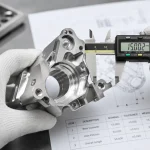
A dimensional inspection report helps buyers understand whether the supplier can measure and document important component features.
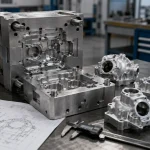
For example, a precision robotic actuator housing may contain several critical bearing bores and mounting holes.
A useful inspection report should identify the measured features, specified dimensions, actual results, and applicable tolerances.
Depending on project requirements, buyers may also request a First Article Inspection (FAI) report.
For applications involving aerospace, medical equipment, automotive systems, or demanding industrial environments, material documentation may be important.
Ask whether the supplier can provide relevant material certificates, such as mill test reports, when required.
Also clarify how material grades and production batches are identified and documented.
Do not assume every supplier automatically provides traceability documentation. Confirm this before ordering.
Engineering drawings frequently contain Geometric Dimensioning and Tolerancing (GD&T) requirements.
These specifications communicate how features must relate to one another, rather than simply defining individual dimensions.
For example, a bearing housing may require accurate bore diameter, position, and perpendicularity.
Ask the supplier how these features will be inspected and whether the proposed measurement method is suitable.
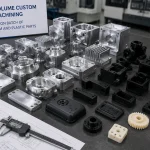
Real manufacturing photographs and sample components can provide useful evidence of a supplier’s experience.
When reviewing samples, look for:
Machining quality
Surface finish
Edge and corner conditions
Hole and thread quality
Dimensional inspection evidence
Consistency between components
For complex projects, a sample manufacturing review or an initial prototype order can help establish whether the supplier meets your expectations.
Price is important, but comparing quotations requires more than looking at the final number.
Two suppliers may quote different prices because they use different materials, machining strategies, finishing processes, or inspection requirements.
Material selection affects both raw material cost and machining time.
For example, aluminum 6061 is generally easier to machine than titanium alloys.
A complex titanium component may require specialized cutting tools, more conservative machining parameters, and additional process planning.
Part geometry also matters. Deep cavities, thin walls, and complex surfaces can increase machining time.
Some quotations include only machining, while others include deburring, anodizing, bead blasting, or dimensional inspection.
Always check what is included.
If your component requires a specific surface finish or inspection document, it should be clearly identified in the RFQ.
Use a standardized comparison to evaluate supplier quotations.
| Quotation Item | Supplier A | Supplier B |
| Material Grade | Confirmed | Confirmed |
| CNC Machining | Included | Included |
| Surface Finishing | Included / Extra | Included / Extra |
| Inspection Report | Included / Extra | Included / Extra |
| Packaging | Included / Extra | Included / Extra |
| Shipping | Included / Extra | Included / Extra |
| Total Project Cost | Compare | Compare |
The purpose of this table is to ensure that both suppliers are quoting the same manufacturing requirements.
A lower machining price may not represent better overall value if important finishing or inspection operations are excluded.
For international procurement, also clarify shipping terms, packaging requirements, and any additional charges.
Working with an overseas manufacturing partner can provide access to a broad range of machining capabilities and competitive manufacturing costs.
However, international projects require clear technical communication and well-defined responsibilities.
Before manufacturing begins, confirm that the supplier has the correct 3D model and 2D engineering drawing.
Critical information should include:
Material grade
Dimensional tolerances
GD&T requirements
Surface finish
Thread specifications
Special manufacturing notes
If information is missing or inconsistent, request clarification before approving production.
Engineering changes are common during product development.
For example, a revised CAD model may change a mounting hole position or modify the wall thickness of an enclosure.
Every revision should have a clear identifier.
The manufacturer should confirm which revision is approved for machining to avoid producing components based on outdated files.
Do not wait until the parts arrive to discuss inspection expectations.
Specify which dimensions are critical, whether a dimensional report is required, and what documentation must accompany the shipment.
This helps both parties understand the acceptance requirements before manufacturing begins.
International buyers should clarify:
Manufacturing location
Expected production completion date
Shipping method
Packaging requirements
Delivery terms
Main technical contact
Procedure for handling quality issues
For overseas projects, consistent English communication and timely engineering feedback are important parts of supplier reliability.
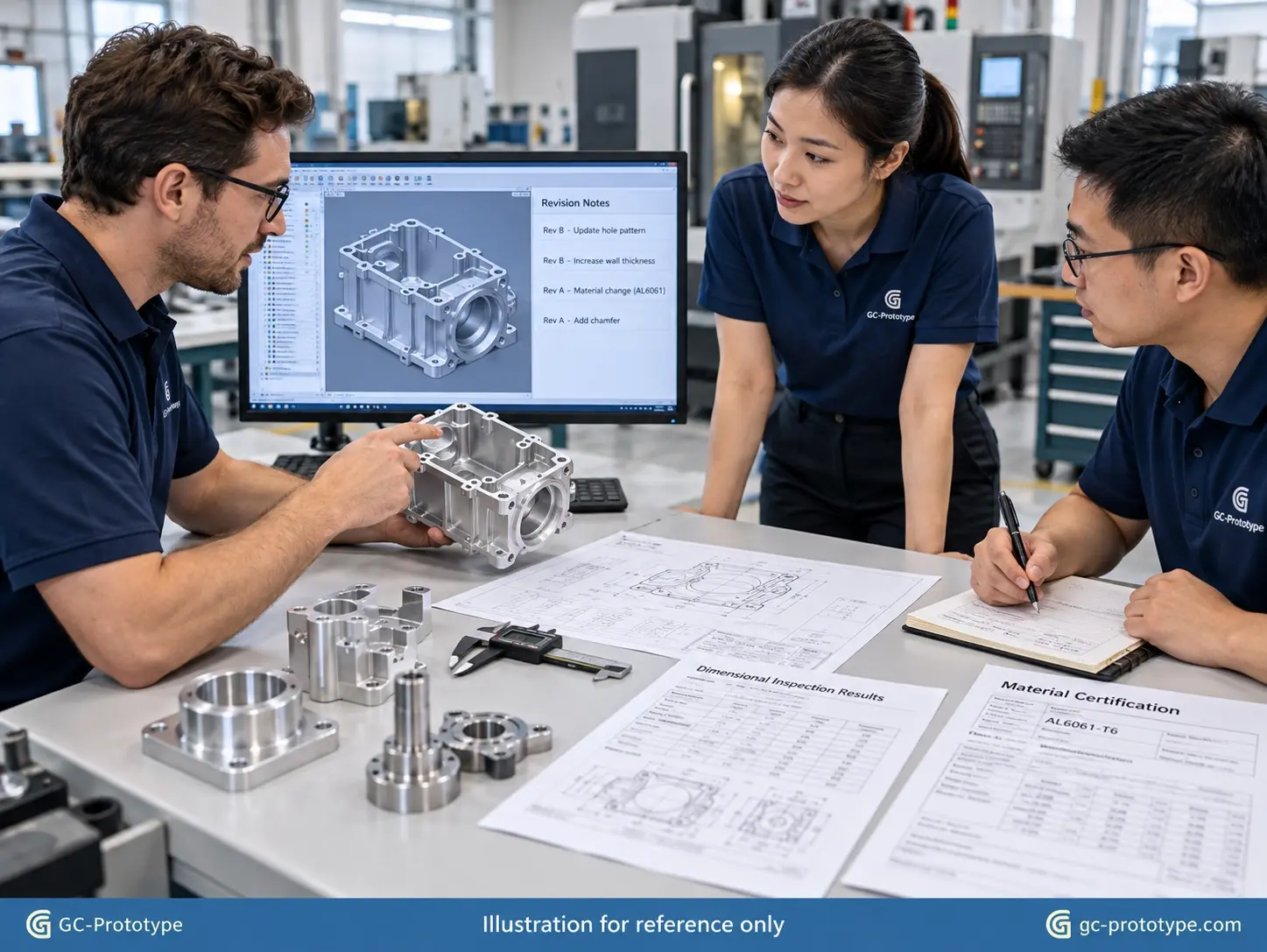
Some projects require more than a machined component.
They need a physical prototype that can be assembled, operated, and evaluated under representative conditions.
A suitable functional prototypes manufacturer should understand the relationship between material selection, manufacturing processes, and testing objectives.
Different products have different validation requirements.
A robotic joint housing may need accurate bearing interfaces and sufficient structural stiffness.
An automotive sensor enclosure may require dimensional accuracy, sealing features, and thermal evaluation.
A medical equipment component may require specific material characteristics and surface finishing.
The manufacturing process should be selected according to the features being evaluated.
The first prototype is not always the final design.
Engineering teams may need to modify dimensions, adjust mounting positions, or change material specifications after testing.
A supplier capable of managing repeated prototype iterations can help reduce development delays.
Not every component is best produced using CNC machining.
Depending on geometry and functional requirements, other suitable processes may include:
SLA and SLS 3D printing
MJF 3D printing
Sheet metal laser cutting and bending
Vacuum casting
Silicone molding
Rapid injection tooling
Pressure die casting
The objective is to select the most appropriate process for each component rather than forcing every project into one manufacturing method.
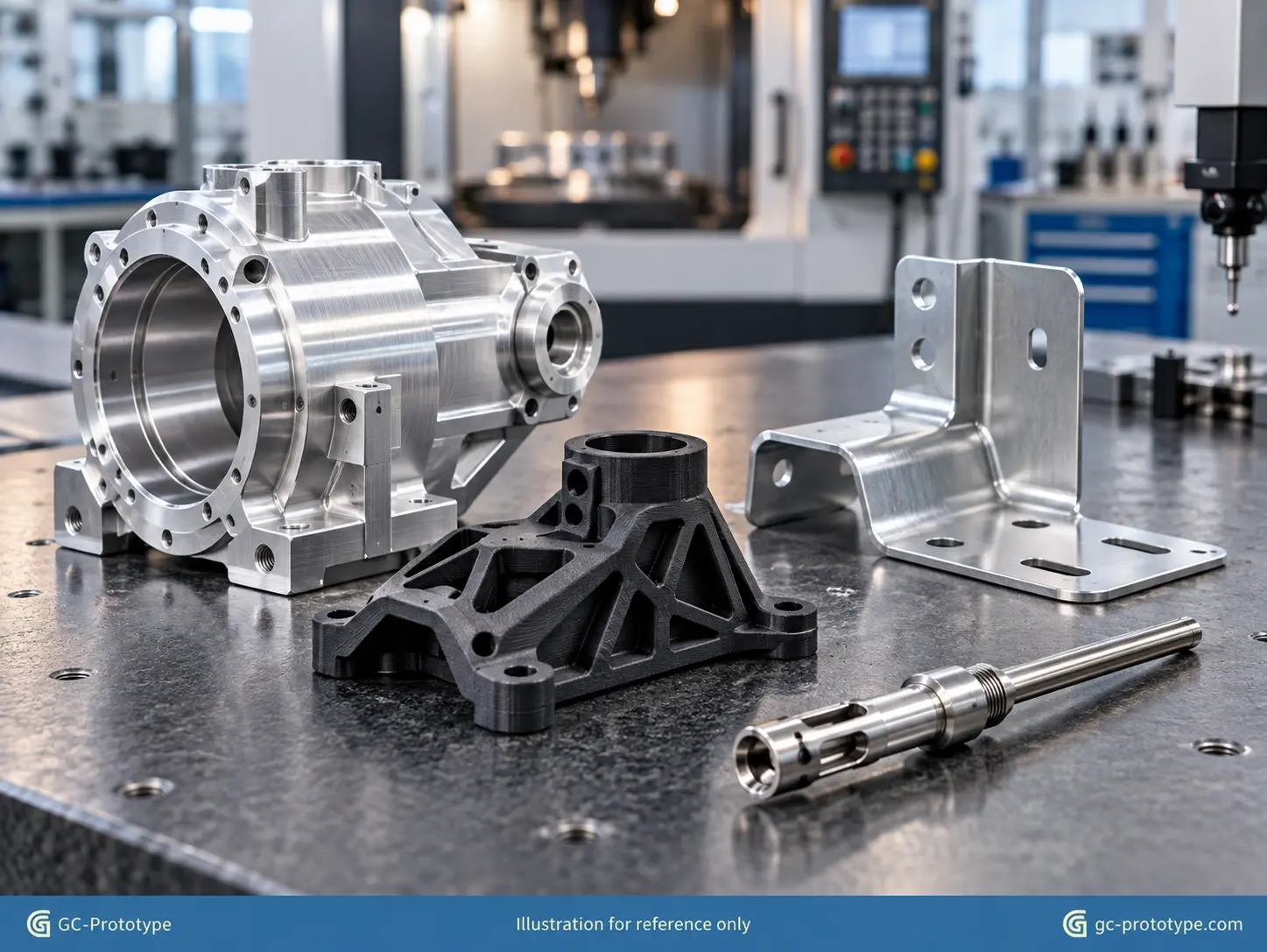
Choosing a prototype to manufacturing company can simplify the transition between product development and subsequent manufacturing stages.
Instead of managing multiple suppliers independently, engineering teams can coordinate different development requirements through a manufacturing partner.
The process begins with 3D CAD models and engineering drawings.
The manufacturer reviews the geometry, material requirements, tolerances, and manufacturing feasibility.
Potential DFM issues should be identified before production.
Physical samples are manufactured using appropriate processes.
Engineering teams then evaluate dimensional accuracy, assembly compatibility, and relevant functional requirements.
If problems are identified, the design can be revised and new samples manufactured.
After the design has been validated, low-volume pilot production can help assess manufacturing consistency and identify remaining process issues.
This stage is particularly useful before committing to larger production investments.
Once the design and manufacturing requirements are established, the supplier can support the transition toward mass production.
Depending on the component, this may involve continuing CNC machining or evaluating more scalable processes such as injection molding and die casting.
For buyers, this development path provides a clearer connection between engineering prototypes and future manufacturing requirements.
A complete RFQ helps manufacturers understand the project and prepare an accurate quotation.
Before contacting suppliers, prepare the following information.
Commonly accepted engineering file formats include STEP, STP, IGES, and 2D PDF drawings.
Provide both 3D models and engineering drawings whenever possible.
The 3D model communicates component geometry, while the drawing identifies dimensions, tolerances, material specifications, and special requirements.
Clearly specify:
Required material and grade
Prototype quantity
Surface finishing
Critical tolerances
Inspection requirements
Expected delivery date
Future production quantities, if known
If you have specific functional testing requirements, include those details as well.
Providing complete information reduces unnecessary quotation revisions and helps the supplier recommend the most appropriate manufacturing process.
Start by evaluating machining capabilities, material experience, inspection equipment, engineering support, and communication.
Request real manufacturing samples and relevant inspection documentation before committing to larger projects.
Look for suitable CNC equipment, experience with your material, reliable dimensional inspection, clear quotations, and the ability to manage engineering changes.
The supplier should understand your component’s functional requirements.
Request dimensional inspection reports, relevant material certificates, and examples of previous machining work.
For critical components, clarify the inspection method and acceptance criteria before production.
Yes. Many CNC machining suppliers handle individual prototypes as well as small batches.
Confirm the minimum order quantity, setup costs, and production scheduling with the supplier.
Some suppliers support the full development process, from CAD review and prototype manufacturing to functional validation, low-volume production, and mass production support.
Available processes depend on the supplier’s manufacturing capabilities and project requirements.
Most suppliers need a 3D CAD model, preferably in STEP or STP format, together with a 2D engineering drawing.
Material, quantity, tolerance, surface finish, and delivery requirements should also be provided.
Choosing the right CNC manufacturing partner can reduce development risks, improve prototype quality, and simplify the transition toward production.
GC-Prototype provides custom CNC machining, precision turning, 3D printing, sheet metal fabrication, vacuum casting, and other prototype manufacturing services for international B2B customers.
From initial CAD review and prototype samples to functional validation, low-volume pilot production, and mass production support, we help engineering and procurement teams coordinate their product development requirements.
Looking for reliable CNC prototype manufacturers for your next engineering project?
Send us your 3D CAD/STEP files and engineering drawings. Our team can review your manufacturing requirements, provide DFM feedback, recommend suitable processes, and prepare a customized quotation.
Whether you need a single precision prototype or a small batch of functional components, GC-Prototype is ready to discuss your project.