Address:
Shenzhen Bao'an District Xinqiao Subdistrict Huangpu Community Huangpu East Ring Road No. 504 Shenzhen Yuan Industrial City Building C
Work Hours:
Monday to Friday: 9AM - 21PM
Weekend: 9AM - 21PM

Address:
Shenzhen Bao'an District Xinqiao Subdistrict Huangpu Community Huangpu East Ring Road No. 504 Shenzhen Yuan Industrial City Building C
Work Hours:
Monday to Friday: 9AM - 21PM
Weekend: 9AM - 21PM

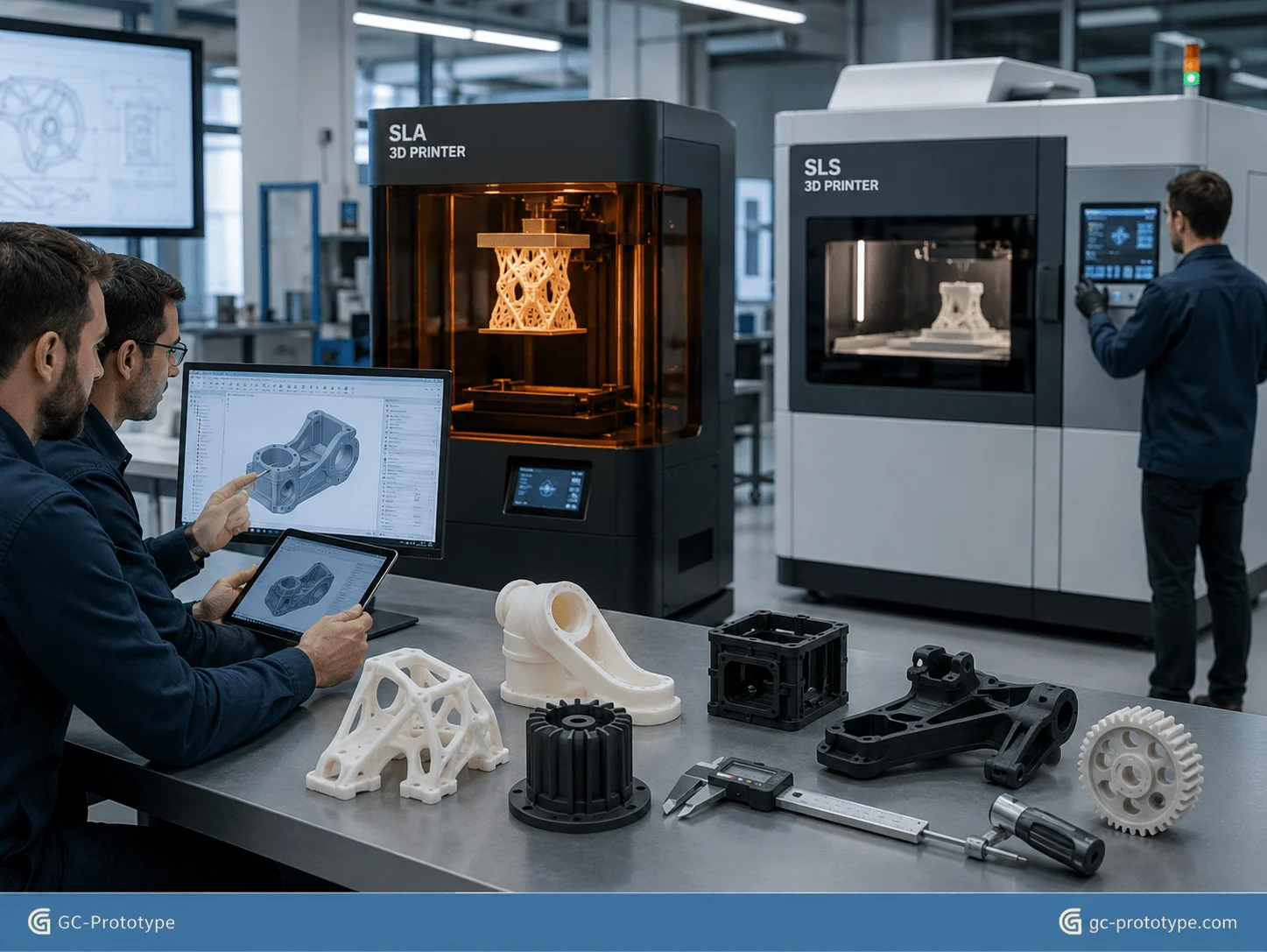
3D Printing has become one of the most valuable manufacturing technologies for New Product Introduction (NPI), functional prototyping, and low-volume production. When CNC machining is constrained by complex internal channels, difficult geometry, or excessive material removal—and injection molding requires expensive tooling before a design is validated—industrial additive manufacturing offers a faster, more flexible route from CAD to physical parts.
For Senior Mechanical Engineers, Product Designers, R&D Engineers, and Sourcing Managers, however, choosing 3D printing is not simply about speed. Process selection, engineering materials, surface roughness, dimensional accuracy, post-processing, production quantity, and total project cost all influence whether additive manufacturing is the right solution.
This guide explains how industrial 3D printing supports medical devices, aerospace development, consumer electronics, robotics, and other B2B hardware applications. It also compares SLA and SLS surface quality, evaluates 3D printing against injection molding, and provides practical DFM and procurement guidance for reducing prototype and low-volume manufacturing cost.
Why Industrial 3D Printing Matters During NPI
Traditional manufacturing usually becomes most efficient after product geometry and production volume are relatively stable. During early product development, however, both may change repeatedly.
A design team may need to:
Test several geometries.
Validate assembly fit.
Evaluate user ergonomics.
Confirm airflow or fluid flow.
Test mechanical performance.
Build customer demonstration units.
Produce a short pilot batch.
Modify the product after field feedback.
Industrial 3D printing supports these requirements because there is usually no dedicated production mold. A revised CAD model can move directly into the next manufacturing iteration.
Different additive manufacturing technologies provide different capabilities:
| Process | Typical Materials | Primary Strength | Common Applications |
|---|---|---|---|
| SLA | Photopolymer resins | Smooth surface and fine detail | Cosmetic prototypes, housings |
| SLS | PA12, PA11, TPU | Functional nylon parts, complex geometry | Snap fits, brackets, mechanisms |
| MJF | Engineering nylon | Batch efficiency and functional parts | Low-volume plastic production |
| FDM/FFF | Engineering thermoplastics | Large parts and broad material options | Fixtures, prototypes |
| SLM/DMLS | Titanium, aluminum, stainless steel, nickel alloys | High-strength complex metal parts | Aerospace, medical, industrial |
Unlike machining, additive manufacturing creates geometry layer by layer rather than removing material from a solid block. This enables internal channels, lightweight lattice structures, organic shapes, and part consolidation that may be difficult or impossible to machine conventionally.
Still, additive manufacturing should not automatically replace CNC machining. Precision bores, sealing surfaces, highly loaded threads, and very tight tolerance interfaces may still benefit from CNC finishing.
A practical strategy is therefore often hybrid:
3D Printing → Functional Validation → CNC Post-Machining Where Required → Low-Volume Production
This approach gives engineering teams design freedom without sacrificing critical dimensional accuracy.
Industry Applications & Material Compliance
Industrial additive manufacturing serves industries that value rapid iteration, customization, lightweight structures, and complex geometry.
Typical sectors include:
Medical equipment
Aerospace and defense
Automotive development
Consumer electronics
Robotics
Industrial automation
Scientific instrumentation
Smart hardware
The process selected should match the end-use requirement rather than simply the appearance of the CAD model.
A transparent medical housing may favor SLA. A nylon robotic bracket may be better suited to SLS or MJF. A high-strength aerospace manifold may require metal powder-bed fusion.
Material selection is equally important.
Engineers should evaluate:
Tensile strength
Impact resistance
Temperature exposure
Chemical compatibility
Fatigue behavior
Moisture absorption
Sterilization conditions
Surface requirements
Regulatory or documentation needs
For B2B manufacturing projects, material traceability and supplier documentation can be as important as mechanical properties.
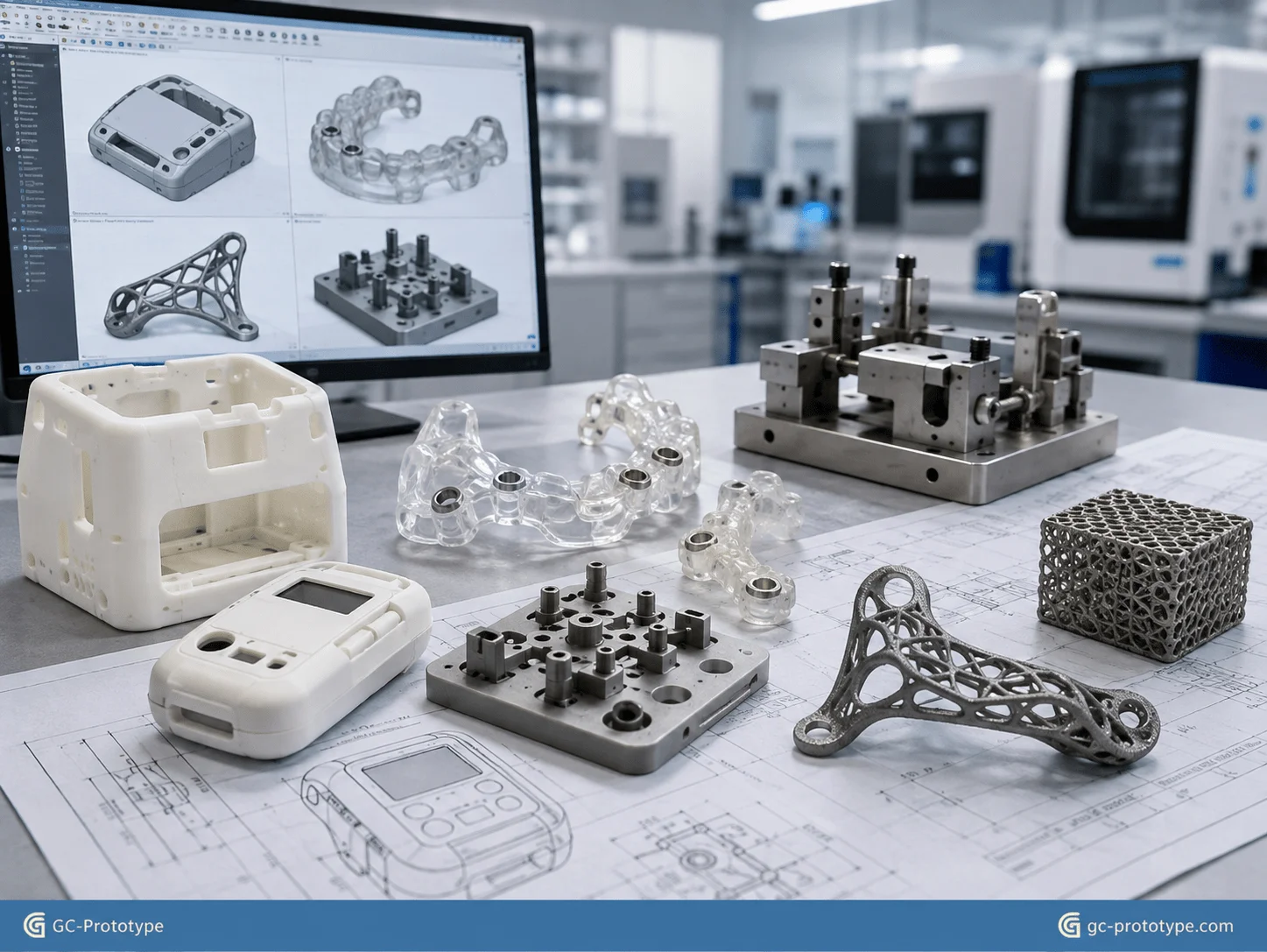
Medical Innovation: Following 3d printing design guidelines for medical devices
Following 3d printing design guidelines for medical devices helps Medical R&D and Design Engineers take advantage of additive manufacturing without confusing prototype capability with final device qualification.
Medical 3D printing applications may include:
Diagnostic equipment housings
Surgical guides
Anatomical models
Customized fixtures
Instrument prototypes
Patient-specific planning models
Robotic surgery components
Laboratory equipment accessories
Different applications require different materials.
Medical-oriented resin systems can support highly detailed models and surgical-planning components. High-performance polymers such as PEEK may be used in specialized additive manufacturing applications, while titanium alloys are important for selected high-performance medical components.
However, a material being available for additive manufacturing does not automatically mean that every printed part is suitable for patient contact.
Engineering teams should evaluate the exact material grade, printing process, post-processing, cleaning procedure, sterilization method, and intended use against the relevant product requirements.
Designing Lightweight Lattice Structures
One major advantage of 3D printing is the ability to create lattice structures.
Instead of manufacturing a completely solid component, engineers can create internal cellular geometry that reduces weight while maintaining stiffness in selected directions.
Lattice structures may help:
Reduce material consumption.
Improve stiffness-to-weight ratio.
Control energy absorption.
Create porous structures.
Improve thermal behavior.
Reduce overall part mass.
For medical tooling or customized fixtures, this can make large components easier to handle.
But lattice structures should not be added only because they look advanced. Engineers should evaluate load direction, cleaning requirements, trapped material, support removal, and inspection accessibility.
Enclosed cavities may trap uncured resin or powder, so suitable drainage or powder-removal access should be incorporated during DFM.
Designing for Sterilization and Cleanability
Medical components may be exposed to cleaning chemicals, heat, radiation, or other sterilization environments.
The selected polymer should therefore be tested under actual expected conditions. Some prototype resins can discolor, become brittle, soften, or change dimensionally after repeated exposure.
For medical-device development, additive manufacturing is especially valuable for accelerating:
Concept → Functional Prototype → User Evaluation → Design Revision
but production qualification should remain device- and material-specific.
Aerospace & High-Performance Metal Applications
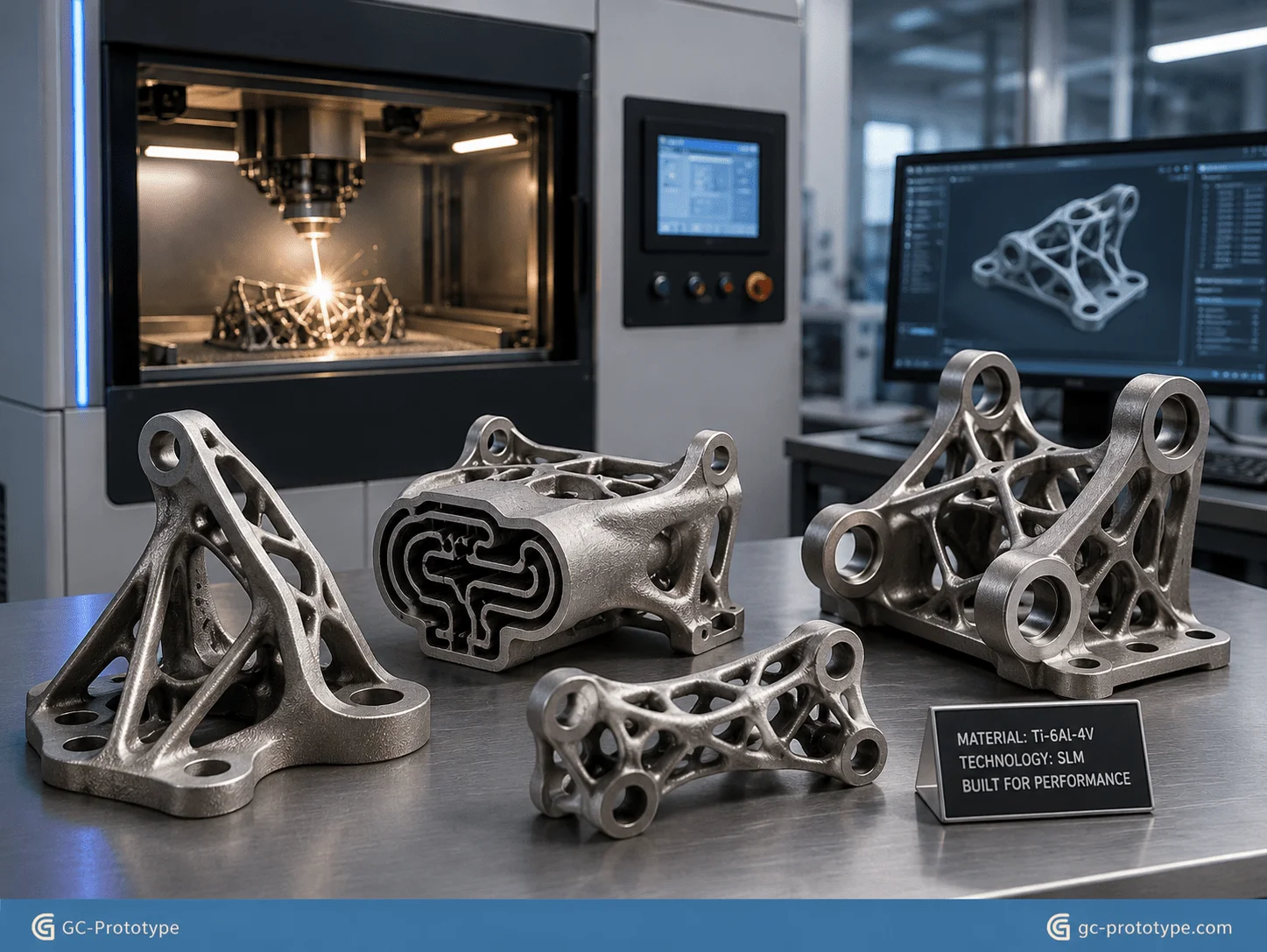
Aerospace Prototyping: Leveraging metal 3d printing for aerospace prototyping
Using metal 3d printing for aerospace prototyping allows aerospace engineers to manufacture complex structures that would otherwise require multiple machined components, welds, or assemblies.
Metal additive manufacturing processes such as SLM and DMLS use controlled energy to fuse metal powder layer by layer.
Common material families include:
Titanium alloys
Aluminum alloys
Stainless steels
Nickel-based alloys
Aerospace applications may include:
Lightweight brackets
Fluid manifolds
Heat exchangers
UAV components
Satellite structures
Engine-development parts
Complex valve bodies
Thermal-management components
The greatest advantage is often geometric freedom.
A conventional aerospace manifold may require several machined blocks, drilled passages, fittings, seals, and assembly operations.
Metal 3D printing can potentially consolidate many of these features into one component containing integrated channels.
This can reduce:
Part count
Assembly labor
Fasteners
Leak paths
Inventory complexity
Strength-to-Weight Optimization
Weight reduction is especially valuable in aerospace systems.
Topology optimization can remove material from low-stress areas while preserving load paths. Additive manufacturing can then produce the resulting organic geometry more easily than traditional machining.
However, engineers should consider:
Build orientation
Support structures
Residual stress
Surface condition
Heat treatment
Inspection
Post-machining
A metal printed component may leave the machine with supports and relatively rough surfaces. Critical holes, bearing seats, sealing faces, or datum surfaces may still require CNC machining.
Post-processing may also include stress relief, support removal, heat treatment, blasting, polishing, or other application-specific steps.
When Metal 3D Printing Is Not the Best Choice
Metal additive manufacturing is not automatically economical for every metal part.
A simple rectangular aluminum bracket may be much cheaper to machine.
Metal 3D printing becomes more attractive when geometry creates real engineering value, such as:
Internal channels
Part consolidation
Lightweight structures
Complex curved passages
Very low production quantity
Difficult-to-machine geometry
The manufacturing decision should therefore be based on total functional value rather than technological novelty.
Process Trade-Offs & Prototyping Cost
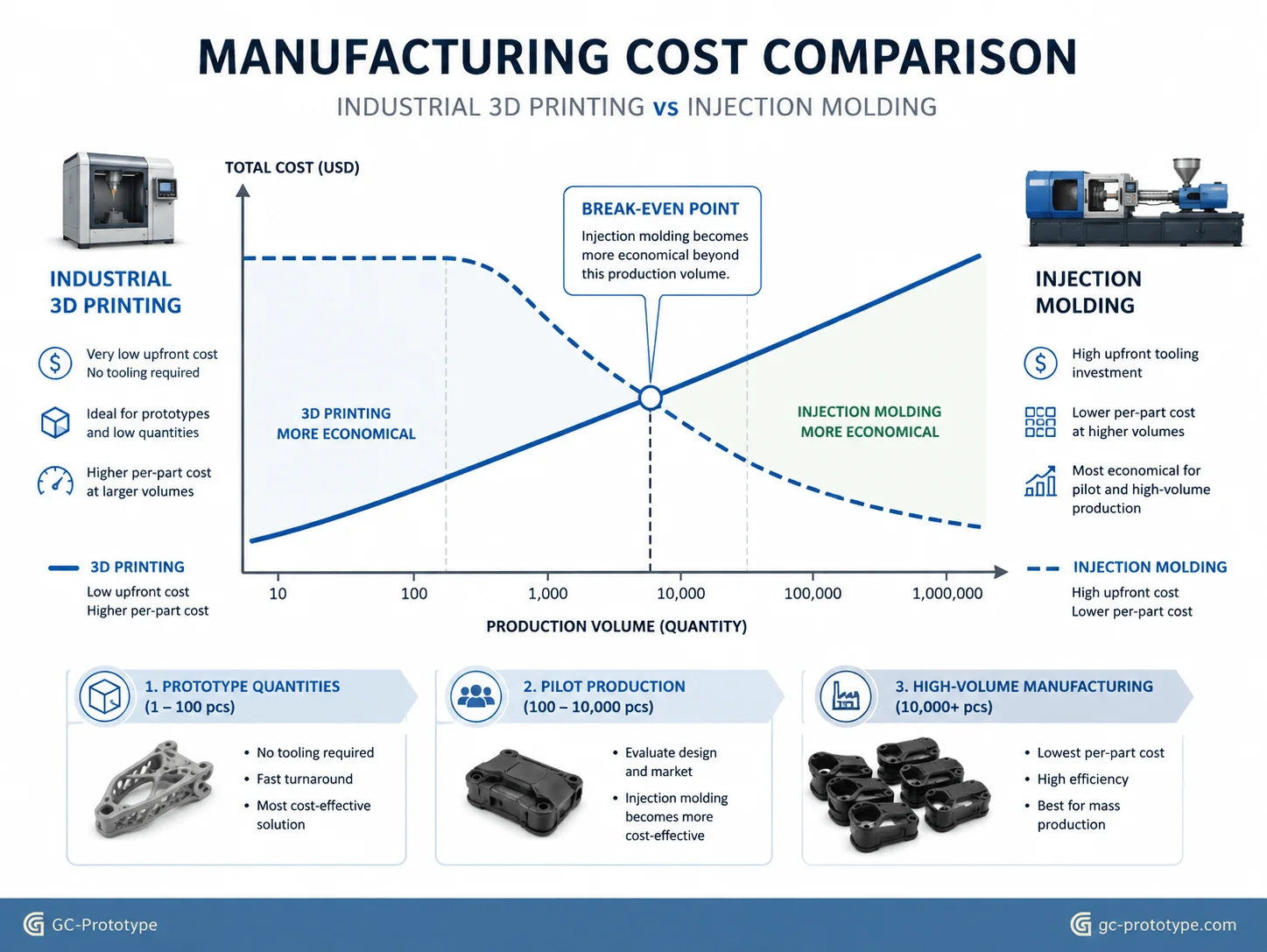
Cost Breakdown: industrial 3d printing vs injection molding cost
A practical industrial 3d printing vs injection molding cost comparison begins with one question:
How many identical parts are actually required?
Additive manufacturing generally has very low tooling cost. Injection molding requires a mold, but once the mold is produced, the recurring cost per part can become extremely low.
This creates a volume-dependent cost relationship.
| Production Volume | Industrial 3D Printing | Injection Molding | Typical Preferred Route |
|---|---|---|---|
| 1–5 parts | Excellent | Poor economics | 3D printing |
| 5–50 parts | Very competitive | Tooling often difficult to justify | 3D printing |
| 50–500 parts | Application-dependent | Rapid tooling may become attractive | Compare both |
| 500–1,000 parts | Depends on geometry/material | Increasingly attractive | Project-specific |
| 1,000+ parts | Unit cost may remain higher | Strong unit-cost advantage | Often injection molding |
These quantity bands are directional rather than universal. Part size, material, build density, finish, tolerance, tool complexity, and lifecycle volume all influence the break-even point.
Why 3D Printing Wins at Prototype Quantities
For prototype quantities, additive manufacturing eliminates most tooling investment.
Suppose an engineering team needs 15 functional housings for verification testing.
With 3D printing, the primary costs may include:
Material
Machine time
Build setup
Support removal
Finishing
Inspection
Injection molding would add:
Mold design
Mold manufacture
Tool sampling
Tool modification
Molding setup
If the design changes after testing, the 3D printing file can simply be updated. An injection mold may require modification.
This ability to change geometry quickly dramatically reduces NPI financial risk.
Why Injection Molding Wins at Scale
Once a design is frozen and quantities rise, injection molding becomes increasingly powerful.
A mold can repeatedly produce identical parts with:
Short cycle times
Production thermoplastics
High repeatability
Low marginal unit cost
This is why 3D printing should often be viewed as a bridge rather than a universal replacement for molding.
A practical roadmap may be:
3D Printing → Engineering Validation → Low-Volume Market Testing → Rapid Tooling → Injection Molding
This allows capital investment to increase gradually as both design confidence and market demand improve.
Total Cost of Ownership Matters More Than Piece Price
Procurement teams should also calculate:
Engineering-change cost
Tooling risk
Lead time
Inventory
Obsolescence
Finishing
Inspection
Supply-chain responsiveness
A part that costs slightly more per piece but allows a product to launch weeks earlier may provide significantly greater business value.
Surface Quality: SLA vs SLS
Aesthetic Excellence: Comparing sls vs sla 3d printing surface roughness
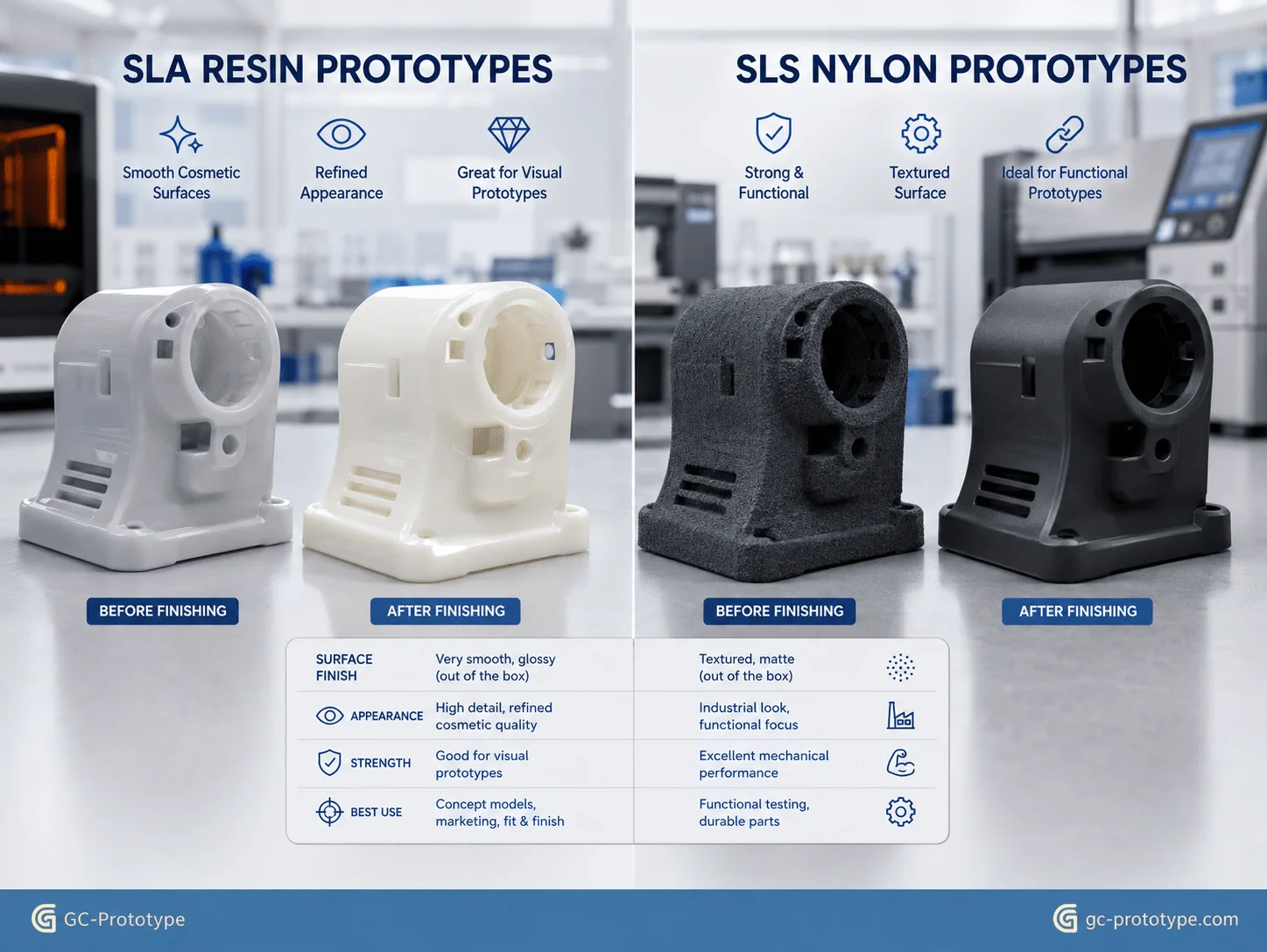
Comparing sls vs sla 3d printing surface roughness is important when Product Designers and Industrialization Engineers need to balance appearance and functional performance.
SLA and SLS produce fundamentally different surfaces because they use different materials and build mechanisms.
SLA Surface Characteristics
SLA cures liquid resin using light.
The process is known for:
Fine details
Smooth surfaces
Sharp cosmetic geometry
High visual quality
It is often selected for:
Consumer electronics prototypes
Medical housings
Presentation models
Transparent components
Industrial design verification
The as-printed surface usually contains fine layer lines, but these can often be reduced through sanding, polishing, coating, or painting.
SLS Surface Characteristics
SLS uses a laser to fuse polymer powder, commonly engineering nylons.
The surrounding powder supports the part during printing, reducing the need for conventional support structures.
SLS components generally have a more granular or slightly textured surface compared with SLA.
However, SLS offers strong advantages for functional engineering parts:
Durable nylon materials
Snap-fit components
Hinges and mechanisms
Complex assemblies
Low-volume batches
Surface texture can be improved through:
Bead blasting
Tumbling
Dyeing
Vapor smoothing where suitable
Coating
| Feature | SLA | SLS |
|---|---|---|
| Typical Surface | Smooth | Slightly granular |
| Fine Cosmetic Detail | Excellent | Good |
| Functional Nylon Parts | Limited | Excellent |
| Support Structures | Usually required | Powder supports geometry |
| Snap Fits | Material-dependent | Very suitable |
| Transparent Parts | Possible | Generally not |
| Dyeing | Less common | Common |
| Best Fit | Appearance models | Functional engineering parts |
Exact Ra values depend heavily on equipment, layer settings, material, orientation, and post-processing, so suppliers should provide actual process data when roughness is a critical specification.
Selecting the Right Process
Choose SLA when the priority is:
Cosmetic appearance
Fine details
Smooth prototypes
Transparent visual parts
Choose SLS when the priority is:
Durability
Functional testing
Complex geometry
Low-volume nylon parts
For appearance-critical B2B prototypes, process choice should also consider what happens after printing. A professionally painted SLA part may look extremely close to a production molded housing, while dyed and smoothed SLS parts can provide durable functional prototypes.
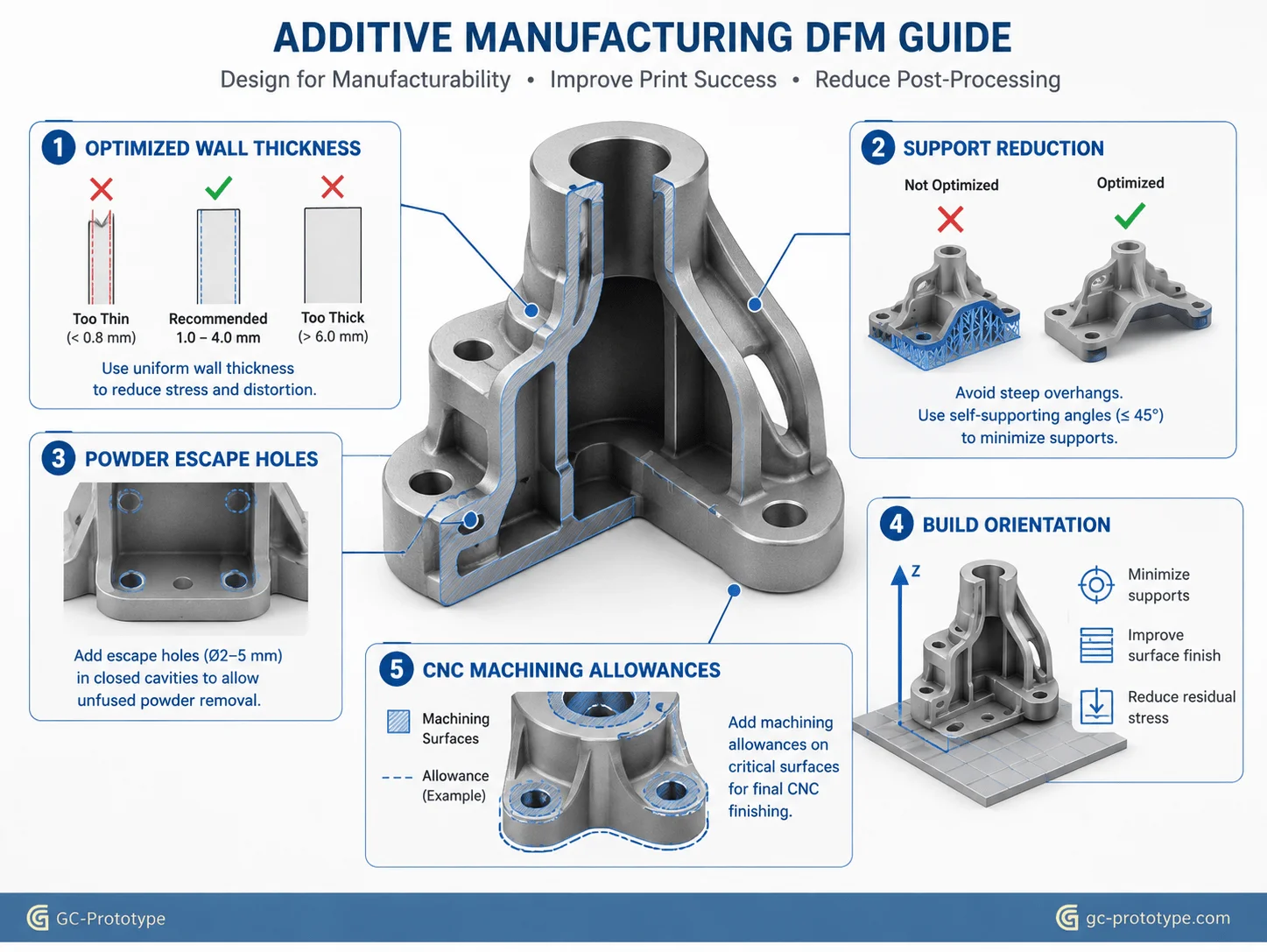
Essential DFM Guidelines for Industrial 3D Printing
Good additive manufacturing design can reduce material, build time, post-processing, and failure risk.
Optimize Wall Thickness
Very thin walls may warp or break, while unnecessarily thick walls increase material use and build time.
Minimum practical wall thickness depends on:
Process
Material
Part size
Orientation
Structural loading
Engineers should use supplier-specific DFM recommendations rather than applying one universal value.
Reduce Unnecessary Supports
Support structures increase:
Material use
Printing time
Removal labor
Surface marks
Part orientation can sometimes reduce support volume substantially.
For metal additive manufacturing, orientation also affects heat flow and residual stress, so support reduction should not be the only consideration.
Provide Drainage and Powder-Removal Access
Hollow components may trap:
Liquid resin
SLS powder
Metal powder
Design suitable openings so uncured or unsintered material can be removed safely and completely.
Design Critical Features for Secondary Machining
If a bearing bore requires a very tight tolerance, designing machining allowance may be more reliable than demanding that the printing process achieve the final dimension directly.
Hybrid manufacturing can combine:
Complex additive geometry + CNC precision
for the best overall result.
Consolidate Parts Carefully
One of additive manufacturing’s most powerful capabilities is combining multiple components into a single printed part.
Part consolidation can reduce:
Fasteners
Welds
Assembly
Inventory
Failure points
But excessive consolidation can make maintenance difficult. Engineers should consider whether components need future replacement or access.
Consider Build Orientation
Orientation influences:
Surface quality
Accuracy
Support volume
Anisotropy
Build time
Critical cosmetic surfaces should ideally be oriented to minimize support marks and visible layer artifacts.
Avoid Over-Specifying Tolerances
Like all manufacturing processes, tighter requirements generally increase cost.
The drawing should distinguish:
Critical interfaces
General dimensions
Cosmetic zones
Post-machined surfaces
This prevents unnecessary inspection and post-processing.
Procurement Strategy & Scaling
Financial Edge: Rapid Prototyping Without Tooling Overhead
For Procurement Managers and Strategic Buyers, industrial 3D printing offers one of the lowest-risk ways to purchase physical hardware during early product development.
There is no need to commit immediately to an expensive production mold.
Instead, companies can manufacture:
1 concept model
10 engineering prototypes
30 validation units
100 market-test parts
and modify the design between batches.
For suitable parts and available production capacity, rapid additive manufacturing can also support very short turnaround times—sometimes within approximately 24–48 hours for straightforward prototype jobs—helping engineering teams keep NPI programs moving.
The business advantage is not only faster manufacturing.
It is avoiding sunk tooling cost when a product is still evolving.
Reducing Inventory Risk
Traditional manufacturing often rewards large order quantities.
A supplier may quote a substantially lower unit price at 5,000 pieces than at 500 pieces. However, buying unnecessary inventory introduces financial risk.
If the design changes, the company may be left with obsolete stock.
3D printing supports on-demand manufacturing, allowing procurement teams to order closer to actual demand.
This is valuable for:
Spare parts
Custom equipment
Multiple product variants
Pilot production
Short lifecycle products
When to Transition Away from 3D Printing
Procurement teams should reassess the production method as quantity rises.
Ask:
Is the design frozen?
Is annual demand predictable?
Is the final production resin available through injection molding?
Can tooling be amortized?
Does part geometry still justify additive manufacturing?
If the answer favors high-volume conventional production, then moving to molding, casting, or CNC machining may reduce lifecycle cost.
Application Scenarios
Medical Device Housing
A medical equipment company needs 25 ergonomic housings for design validation. SLA produces smooth presentation-quality prototypes quickly, allowing engineers to evaluate assembly and user handling before committing to molding.
Surgical Guide or Customized Fixture
A Medical R&D team needs patient- or procedure-specific geometry. Additive manufacturing supports customization without dedicated tooling.
Aerospace Manifold Prototype
An aerospace engineering team needs a lightweight metal component containing internal passages that would require several conventional parts. Metal additive manufacturing integrates the geometry into a single prototype for functional evaluation.
Robotics Bracket
A robotics company uses SLS nylon to produce 50 functional brackets for pilot machines. The brackets require snap features and mechanical durability but do not yet justify injection tooling.
Consumer Electronics Housing
A Product Designer needs several premium cosmetic prototypes for customer presentations. SLA provides fine surface detail, followed by sanding, painting, and final cosmetic finishing.
Industrial Automation Spare Part
An automation company needs a discontinued plastic cover in very low annual quantities. Instead of rebuilding old tooling, digital inventory and additive manufacturing provide an on-demand replacement strategy.
Choosing an Industrial 3D Printing Supplier
The best supplier is not necessarily the company with the most printers. Engineering capability, process selection, finishing, inspection, and material control are equally important.
Evaluate capabilities such as:
SLA
SLS
MJF
FDM
Metal SLM/DMLS
CNC post-machining
Surface finishing
CMM inspection
Material documentation
DFM support
A professional RFQ should include:
3D CAD model
Required quantity
Material
Critical dimensions
Surface finish
Color
Intended application
Assembly requirements
Inspection expectations
Delivery target
If a drawing contains tight dimensions, identify which are genuinely critical.
This helps suppliers decide whether the dimension can be printed directly or should be CNC machined afterward.
For aerospace or medical projects, documentation requirements should be discussed before production—not after the parts have already been manufactured.
Frequently Asked Questions
What Is Industrial 3D Printing?
Industrial 3D printing is an additive manufacturing process that creates physical components layer by layer from digital CAD data using polymer, resin, or metal materials.
When Is 3D Printing Better Than CNC Machining?
3D printing is particularly valuable for complex internal geometry, lightweight structures, highly customized components, and rapid design iteration. CNC machining may be superior for simple geometry, tight tolerances, and many production-grade materials.
Is 3D Printing Suitable for Low-Volume Production?
Yes. It can be highly effective for tens or hundreds of parts when tooling cannot be justified, although economics depend on part size, process, material, and finishing.
When Does Injection Molding Become Cheaper Than 3D Printing?
There is no universal break-even quantity. Injection molding generally becomes increasingly economical as production volume rises because tooling cost is spread across more parts.
What Is the Difference Between SLA and SLS?
SLA uses liquid photopolymer resin and generally offers smoother surfaces and fine details. SLS fuses polymer powder and is widely used for durable functional nylon components.
Which Process Is Better for Cosmetic Prototypes?
SLA is often preferred when surface smoothness and visual detail are priorities.
Which Process Is Better for Functional Nylon Parts?
SLS or MJF are commonly selected for durable engineering nylon components.
Can 3D Printed Metal Parts Be CNC Machined?
Yes. Critical bores, threads, sealing surfaces, and datum features can be finish-machined after metal printing.
How Can 3D Printing Cost Be Reduced?
Reduce unnecessary material, optimize build orientation, minimize support structures, avoid excessive tolerances, batch compatible components, and select the process based on function rather than appearance alone.
What Files Are Required for a 3D Printing Quote?
A STEP or other suitable 3D CAD file is typically recommended, together with quantity, material, surface finish, color, tolerance, and inspection requirements.
Industrial 3D printing has become an essential manufacturing tool for moving hardware products from concept validation to functional testing and low-volume production.
Its strongest advantage is agility.
Without dedicated production tooling, engineering teams can change geometry quickly, manufacture complex internal structures, test multiple design variants, and produce market-test quantities without locking large amounts of capital into a mold too early.
Medical R&D teams can create customized guides, fixtures, and device housings. Aerospace engineers can use metal additive manufacturing for lightweight integrated structures. Product Designers can choose SLA for high-quality visual prototypes, while Mechanical Engineers can use SLS or MJF for functional nylon components.
At the procurement level, the correct strategy is to treat additive manufacturing as part of a broader product-lifecycle plan.
Use 3D printing where flexibility, complexity, and speed create real value. Transition to CNC machining, injection molding, or another process when design stability and production quantity justify the change.
Accelerating your hardware engineering cycle from concept validation to small-batch market testing shouldn’t compromise your R&D budget. Whether you are a Senior Mechanical Engineer developing healthcare devices or a Sourcing Manager evaluating 3D printing vs injection molding costs, GC Prototype delivers.