Address:
Shenzhen Bao'an District Xinqiao Subdistrict Huangpu Community Huangpu East Ring Road No. 504 Shenzhen Yuan Industrial City Building C
Work Hours:
Monday to Friday: 9AM - 21PM
Weekend: 9AM - 21PM

Address:
Shenzhen Bao'an District Xinqiao Subdistrict Huangpu Community Huangpu East Ring Road No. 504 Shenzhen Yuan Industrial City Building C
Work Hours:
Monday to Friday: 9AM - 21PM
Weekend: 9AM - 21PM

Sheet Metal Fabrication is one of the most flexible manufacturing solutions for producing lightweight, strong, and cost-effective structural components during New Product Introduction (NPI). When CNC machining becomes expensive because of excessive material removal and injection molding or stamping requires costly tooling investment, flexible sheet metal fabrication provides an ideal balance between strength, speed, design freedom, and low-volume production efficiency.
For Senior Mechanical Engineers, Product Designers, R&D Engineers, Manufacturing Engineers, and Sourcing Managers, the challenge is not simply choosing a sheet metal supplier. The key is understanding how material selection, laser cutting, bending parameters, welding methods, surface finishing, tolerance requirements, and production quantity influence the final cost and product performance.
This Sheet Metal Guide explains how low-volume sheet metal manufacturing supports rapid prototyping, equipment enclosures, brackets, industrial automation systems, medical hardware, and production scaling while avoiding unnecessary tooling costs.
During early product development, companies often face a manufacturing gap. CNC milling can produce accurate parts but may waste large amounts of material when creating large enclosures or panels. Traditional stamping can achieve extremely low unit costs but requires expensive hard tooling that may not be justified before the design is validated.
Flexible sheet metal fabrication solves this challenge by combining:
Laser cutting
CNC punching
Precision bending
Welding
Hardware insertion
Surface finishing
Assembly
This approach allows engineers to move quickly from CAD designs to functional prototypes and low-volume production parts.
Why Sheet Metal Fabrication Is Ideal for Low-Volume Manufacturing
Sheet metal fabrication transforms flat metal sheets into functional three-dimensional structures through cutting, forming, joining, and finishing processes.
Unlike injection molding or stamping, sheet metal manufacturing usually does not require expensive production molds. A digital CAD file can be converted into machine programs, allowing manufacturers to produce customized parts quickly.
Common sheet metal components include:
Equipment enclosures
Electrical cabinets
Machine covers
Control panels
Mounting brackets
Structural frames
Chassis components
Battery housings
Protective guards
Industrial automation supports
For product development teams, this flexibility is especially valuable when designs are still evolving.
A typical development process may include:
1.CAD design and DFM review
2.Sheet material selection
3.Laser cutting or punching
4.CNC bending
5.Welding or fastening
6.Surface treatment
7.Inspection and assembly
8.Pilot production
Compared with machined blocks, sheet metal parts often achieve significant weight reduction because material is placed only where structural strength is required.
For example, an electronic equipment enclosure manufactured from a solid aluminum block would require extensive machining and generate large amounts of scrap. A sheet metal enclosure can achieve similar protection using thin aluminum or stainless-steel panels formed into a rigid structure.
| Manufacturing Process | Tooling Investment | Material Efficiency | Best Quantity |
|---|---|---|---|
| CNC Machining | Low | Lower for large parts | 1–1,000 |
| Sheet Metal Fabrication | Very Low | Excellent | 1–10,000 |
| Injection Molding | High | Excellent at volume | 10,000+ |
| Stamping | High | Excellent at mass production | 5,000+ |
| Die Casting | High | Good | Medium/high volume |
Sheet metal fabrication provides several advantages:
Fast Design Iteration
When engineers modify hole locations, mounting features, or enclosure dimensions, only the CAD file and cutting program need adjustment.
Reduced Upfront Investment
Without expensive molds, companies can validate designs before committing to mass-production tooling.
Strong Mechanical Performance
Properly designed bends, ribs, folds, and welded joints can create lightweight structures with excellent stiffness.
Production Scalability
The same fabrication methods can support prototypes, pilot builds, and low-volume commercial production.
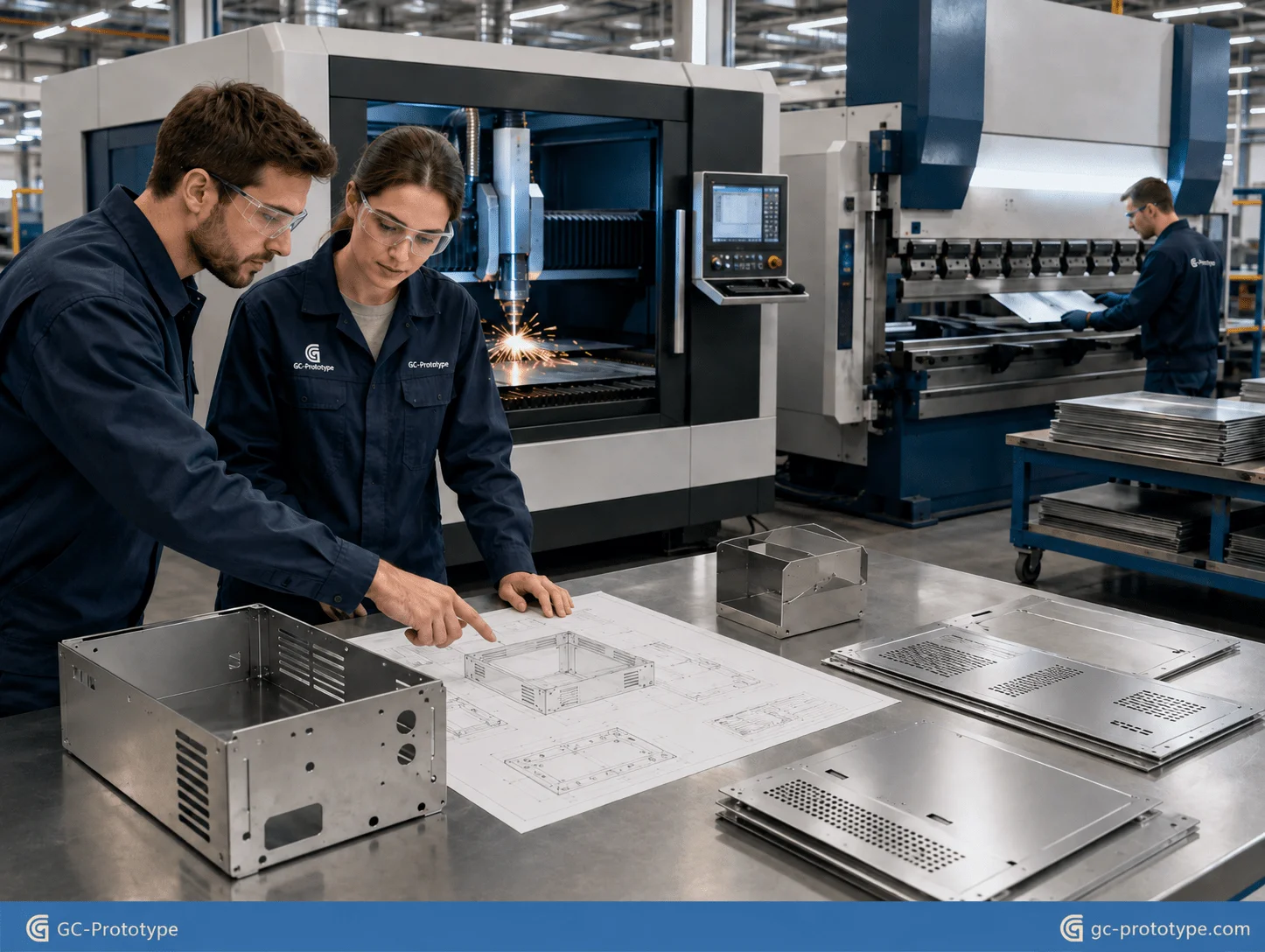
Industry Applications & Material Compliance
Sheet metal fabrication supports many industries where lightweight structures, durability, and customization are important.
Major application areas include:
Medical equipment
Industrial automation
Robotics
Automotive systems
Aerospace equipment
Consumer electronics
Laboratory instruments
Electrical systems
Material selection directly affects:
Strength
Weight
Corrosion resistance
Appearance
Manufacturability
Cost
Common sheet metal materials include:
| Material | Advantages | Applications |
|---|---|---|
| Aluminum 5052 | Lightweight, corrosion resistant, easy forming | Enclosures and panels |
| Aluminum 6061 | Strong and machinable | Structural components |
| Stainless Steel 304 | Corrosion resistance | Medical and industrial equipment |
| Stainless Steel 316L | Chemical resistance | Harsh environments |
| Mild Steel | Low cost and strong | Machine frames |
| Galvanized Steel | Corrosion protection | Industrial cabinets |
Material selection should consider the final operating environment.
For example:
A laboratory enclosure may require stainless steel because of chemical exposure and cleaning requirements.
An outdoor electrical cabinet may require aluminum or coated steel to resist corrosion.
A robotic base structure may prioritize stiffness and load-bearing capability.
Medical Innovation: Following sheet metal design guidelines for medical enclosures
Following sheet metal design guidelines for medical enclosures helps Medical R&D Engineers and Laboratory Managers create equipment housings that meet requirements for durability, cleanability, protection, and manufacturing efficiency.
Medical equipment enclosures often require:
Dust protection
Easy cleaning
Corrosion resistance
Structural rigidity
Cable management
Precise mounting features
Smooth external surfaces
Examples include:
Diagnostic equipment housings
Mobile medical carts
Laboratory equipment cabinets
Imaging-system structures
Medical instrument frames
Stainless steel 304 and 316L are commonly considered for medical environments because they provide excellent corrosion resistance and can support demanding cleaning procedures.
Aluminum panels are also widely used when weight reduction is important.
A medical enclosure design should consider:
IP Protection Requirements
Many medical devices require protection against dust and liquid exposure.
Design factors include:
Panel gaps
Door seals
Fastener placement
Weld quality
Surface finishing
Cleanability
Medical equipment surfaces should avoid unnecessary:
Sharp corners
Deep recesses
Difficult-to-clean joints
Rounded corners and smooth welded seams improve cleaning performance.
Structural Design
Thin sheet metal can achieve excellent rigidity when properly designed.
Engineers can improve strength through:
Folded edges
Internal brackets
Embossments
Reinforcement ribs
Strategic bends
Instead of increasing sheet thickness, optimized geometry often provides better cost efficiency.
Surface Finishing
Medical applications may require:
Powder coating
Brushed stainless finish
Electropolishing
Protective coatings
The selected finish should balance appearance, durability, cleaning requirements, and cost.
A common mistake is designing medical enclosures like simple boxes without considering manufacturing sequence.
A better approach considers:
Flat pattern development
Bend sequence
Welding access
Hardware installation
Inspection requirements
Early DFM collaboration reduces manufacturing risk and avoids expensive redesigns.
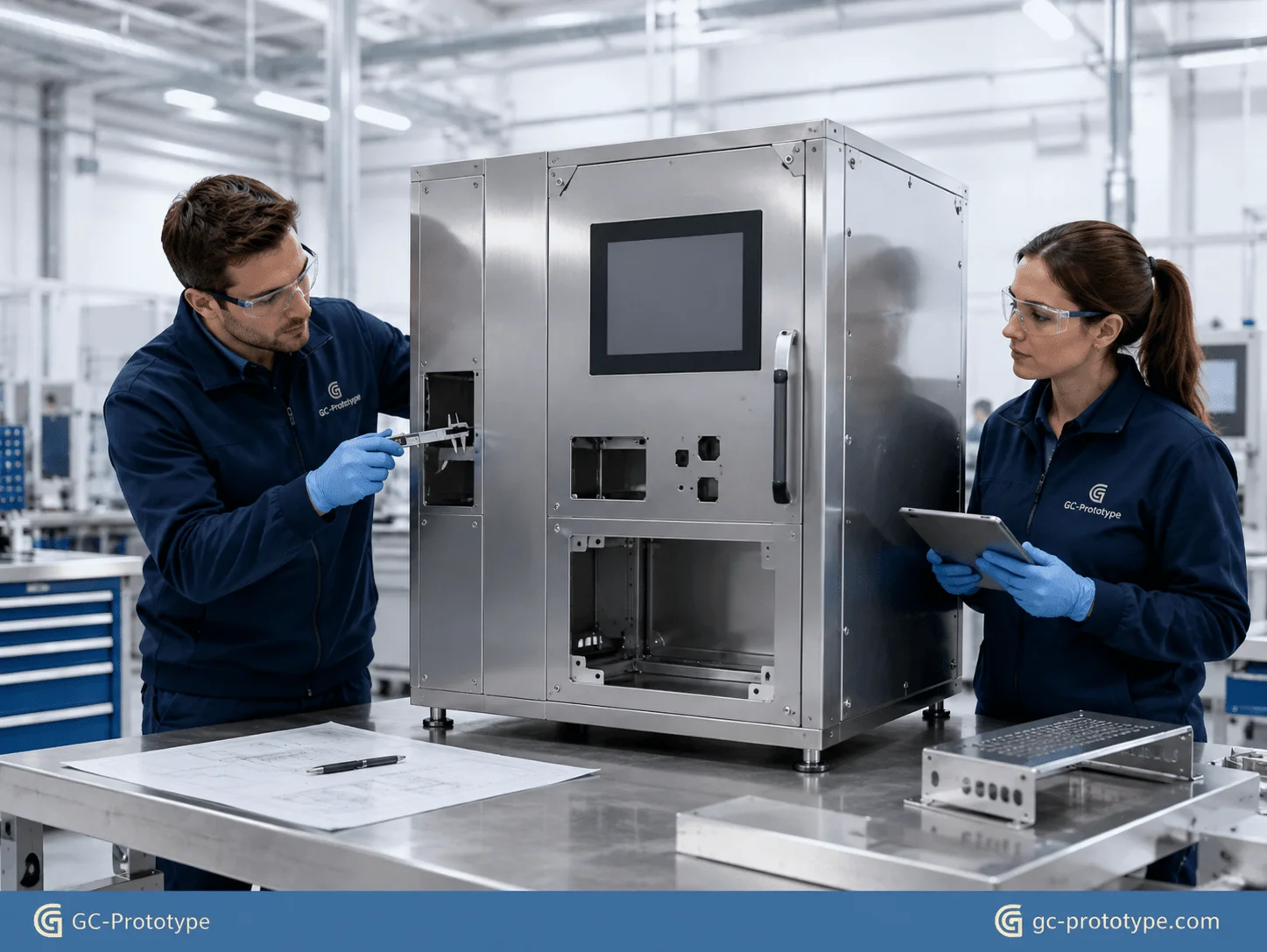
Industrial Applications & Structural Optimization
Supporting custom sheet metal fabrication for industrial automation
Supporting custom sheet metal fabrication for industrial automation allows Robotics Engineers, Manufacturing Engineers, and Sourcing Managers to develop strong, lightweight, and highly customized structures without committing to expensive tooling.
Industrial automation systems commonly require:
Electrical control cabinets
Robot safety covers
Machine frames
Sensor mounting brackets
Conveyor structures
Operator panels
Protective guards
Equipment housings
Unlike mass-produced consumer products, automation equipment is often customized for specific production lines. Each project may require different:
Dimensions
Mounting locations
Cable routing
Sensor positions
Access panels
Protection requirements
This makes flexible sheet metal fabrication an ideal manufacturing solution.
A common challenge in industrial equipment design is achieving sufficient rigidity without increasing material thickness.
Simply increasing sheet thickness can improve strength, but it also increases:
Material cost
Weight
Shipping expense
Manufacturing difficulty
A better approach is using structural design techniques such as:
Reinforcement Ribs
Ribs improve stiffness by increasing the structural moment of inertia without adding excessive weight.
Embossments
Embossed features can strengthen large flat panels and reduce vibration.
Folded Edges
Bent edges create stronger structures compared with flat sheets.
Internal Brackets
Additional supports can distribute loads and improve assembly stability.
For robotic equipment, precision mounting is especially important.
Robot bases, actuator brackets, and automation frames often require:
Accurate mounting-hole locations
Controlled flatness
Weld distortion management
Machined reference surfaces
A poorly designed sheet metal structure may create alignment problems during final assembly.
Therefore, engineers should consider:
Weld sequence
Bend sequence
Datum references
Post-weld machining
Inspection requirements
during the initial design stage.
Process Trade-Offs & Surface Quality
Sheet metal manufacturing includes several different processes, and selecting the correct process has a major impact on cost.
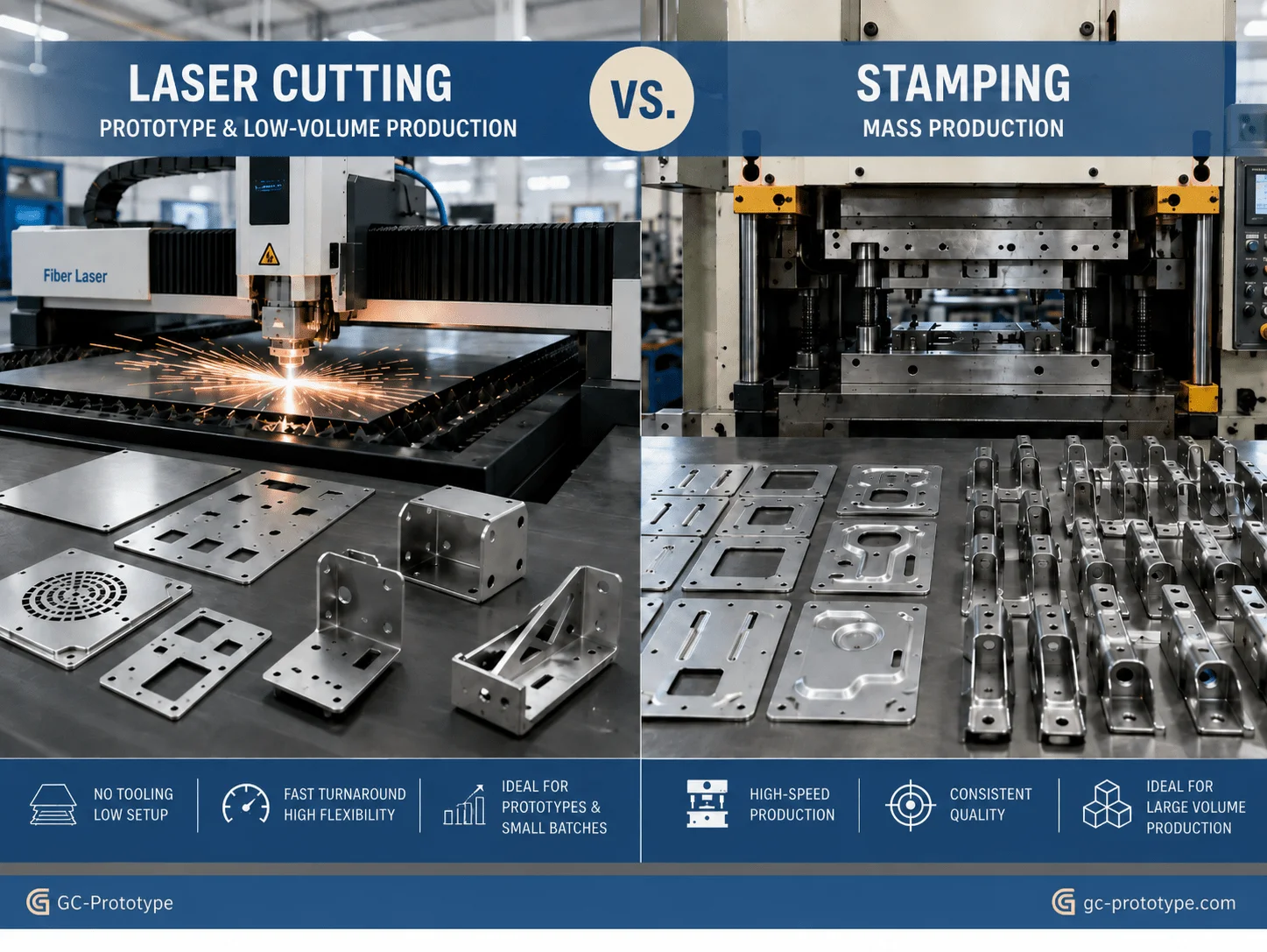
The most common comparison for low-volume and mass production is laser cutting versus stamping.
Cost Breakdown: laser cutting vs stamping sheet metal cost
A realistic laser cutting vs stamping sheet metal cost comparison depends heavily on production quantity.
Laser cutting requires little setup investment. A CAD file can be converted directly into a cutting program, making it ideal for prototypes and small batches.
Stamping requires dedicated dies. These tools can be expensive and require engineering time, but once production volume becomes high enough, stamping provides extremely low unit costs.
| Cost Factor | Laser Cutting + CNC Bending | Stamping |
|---|---|---|
| Initial Tooling | Very Low | High |
| Setup Time | Short | Long |
| Prototype Production | Excellent | Poor |
| Low Volume (1–500 pcs) | Cost Effective | Usually Expensive |
| Medium Volume | Competitive | Improving |
| High Volume (5,000+) | Higher Unit Cost | Excellent |
| Design Changes | Easy | Expensive |
| Part Consistency | High | Excellent |
For product development teams, the financial decision usually follows production volume.
1–500 Units: Flexible Fabrication Advantage
During NPI and prototype validation, laser cutting and CNC bending are usually the most economical choices.
Advantages include:
No stamping die investment
Fast design changes
Short lead times
Low financial risk
For example, a startup developing an industrial controller enclosure may need:
20 engineering prototypes
100 customer evaluation units
Several design revisions
Creating stamping dies at this stage creates unnecessary cost exposure.
5,000+ Units: Stamping Advantage
When annual demand becomes predictable, stamping can significantly reduce unit cost.
A stamping tool can produce:
Thousands of identical panels
High-speed production
Minimal labor per part
The initial die investment becomes distributed across many units.
However, stamping becomes less flexible after tooling is created.
A design change may require:
Die modification
Tool revalidation
Production delays
Therefore, stamping is usually selected after:
Geometry is finalized
Demand is confirmed
Product lifecycle is predictable
Total Cost Consideration
The correct calculation should include:
Total manufacturing cost = tooling investment + production cost + engineering-change risk + inventory cost
A low unit price does not always mean lower project cost.
For uncertain products, flexible sheet metal fabrication often provides better financial control.
For mature products with stable demand, stamping usually provides superior long-term economics.
Engineering Precision: Understanding the sheet metal bending radius standard chart
Understanding the sheet metal bending radius standard chart helps Mechanical Engineers and Industrialization Engineers design parts that can be manufactured consistently without cracking, deformation, or unexpected dimensional variation.
Sheet metal bending is affected by:
Material type
Sheet thickness
Bend radius
Grain direction
Tooling selection
Bend angle
Springback behavior
The minimum recommended bend radius is generally related to material thickness.
A common design rule is:
Bend radius should be proportional to material thickness (T).
For example:
| Material | Thickness | Typical Minimum Bend Radius |
|---|---|---|
| Aluminum | 1 mm | Approximately 1T |
| Aluminum | 2 mm | Approximately 1–2T |
| Stainless Steel | 1 mm | Approximately 1T–2T |
| Stainless Steel | 3 mm | Approximately 2T–3T |
| Mild Steel | 2 mm | Approximately 1T |
(The exact value depends on alloy condition, tooling, and supplier capability.)
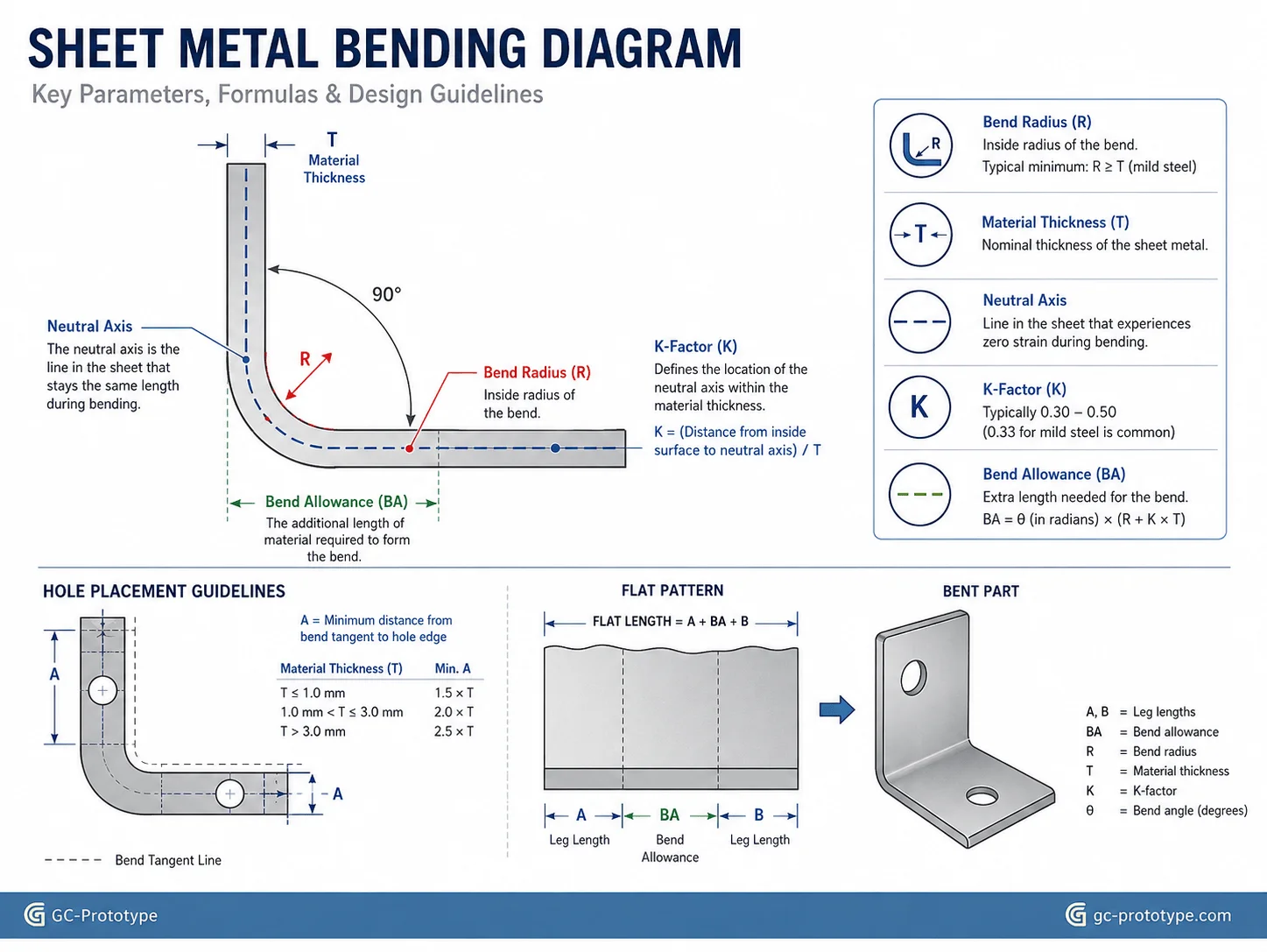
Understanding K-Factor
The K-factor represents the neutral axis location during bending.
When sheet metal bends:
The outside surface stretches
The inside surface compresses
A neutral zone remains relatively unchanged
The K-factor helps manufacturers calculate accurate flat patterns.
Incorrect K-factor assumptions can cause:
Incorrect unfolded dimensions
Hole-position errors
Assembly interference
Dimensional mismatch
Bend Radius and Hole Placement
One of the most common sheet metal design mistakes is placing holes too close to bend lines.
During bending, material deformation can distort nearby holes.
A practical guideline is:
Hole distance from bend line ≥ material thickness + bend allowance.
For example:
A mounting hole positioned too close to a 90-degree bend may become oval or shift position after forming.
This creates problems during:
Assembly
Fastener installation
Component alignment
Bend Allowance and Flat Pattern Accuracy
Before bending, manufacturers must calculate the flat pattern size.
Important variables include:
Material thickness
Bend angle
Bend radius
K-factor
Tooling method
Accurate flat patterns reduce:
Material waste
Trial-and-error adjustments
Production delays
A strong sheet metal supplier should review these factors during DFM.
Surface Finishing Options for Sheet Metal Parts
Surface finishing plays an important role in both appearance and performance.
Common sheet metal finishing methods include:
Powder Coating
Powder coating is widely used for industrial equipment because it provides:
Durable protection
Wide color selection
Good corrosion resistance
Attractive appearance
Typical applications:
Electrical cabinets
Machine covers
Industrial frames
Anodizing
Anodizing is commonly applied to aluminum sheet metal parts.
Benefits include:
Improved corrosion resistance
Decorative appearance
Increased surface hardness
Common applications:
Electronics housings
Lightweight structures
Premium hardware products
Brushed Finish
Brushing creates a directional surface texture.
Used for:
Consumer electronics
Medical equipment
Architectural components
Stainless Steel Polishing
Polishing improves:
Appearance
Cleanability
Corrosion resistance
Common applications:
Laboratory equipment
Medical hardware
Food-processing equipment
Surface Finish Selection Strategy
The finish should match the actual requirement.
For example:
A medical cart may prioritize:
Easy cleaning
Chemical resistance
Smooth surfaces
An industrial machine cover may prioritize:
Durability
Cost
Scratch resistance
A consumer electronics enclosure may prioritize:
Premium appearance
Texture consistency
Over-specifying finishes increases cost without improving product value.
Procurement Strategy & Scaling Sheet Metal Production
For Procurement Managers and Strategic Buyers, one of the biggest advantages of sheet metal fabrication is the ability to produce functional parts without committing to expensive tooling too early.
During product development, demand is often uncertain. A company may know the product concept but not yet know:
Final market demand
Customer feedback
Production volume
Design stability
Long-term manufacturing strategy
In this situation, flexible sheet metal fabrication reduces financial risk.
Compared with stamping or injection molding, low-volume sheet metal manufacturing allows companies to produce:
5 prototype units
50 validation units
500 pilot-production units
Several thousand low-volume commercial parts
without major tooling investment.
Reducing Product Development Risk
Many engineering teams experience multiple design changes before reaching production.
Typical changes include:
Connector relocation
Mounting-hole adjustment
Ventilation improvement
Structural reinforcement
Weight reduction
Cosmetic modification
With sheet metal fabrication, these changes usually require only:
Updated CAD files
Revised flat patterns
Updated cutting programs
This significantly reduces engineering-change costs.
For example:
A robotics company developing an automated inspection machine may initially require ten protective covers.
After testing, engineers discover that cable routing needs modification.
With flexible sheet metal fabrication:
The CAD design is updated
The laser-cut program changes
A revised batch is produced quickly
No stamping die modification is required.
Low-Volume Production Cost Optimization
The cost of sheet metal parts depends on several factors:
| Cost Factor | Influence on Final Cost |
|---|---|
| Material Thickness | Higher thickness increases material cost |
| Part Size | Larger sheets increase handling and cutting time |
| Number of Bends | More bends increase forming time |
| Welding Requirements | Additional labor and inspection |
| Surface Finish | Coating and finishing increase cost |
| Quantity | Larger batches reduce setup cost per part |
| Hardware Installation | Adds assembly operations |
A common mistake is focusing only on material price.
For example:
A stainless-steel enclosure may use inexpensive sheet material, but excessive welding, complex bends, and cosmetic finishing can become the main cost drivers.
A better approach is optimizing the complete manufacturing process.
Design Changes and Supply Chain Flexibility
Flexible sheet metal fabrication provides advantages for companies with:
Rapid product cycles
Customized equipment
Multiple product variants
Short market windows
Uncertain demand
This is especially important in industries such as:
Industrial automation
Robotics
Medical equipment
Laboratory systems
Electronics hardware
These industries often require customized products rather than millions of identical parts.
Sheet metal manufacturing supports this business model because production remains flexible.
Sheet Metal Manufacturing Workflow
A professional sheet metal fabrication process typically follows several controlled stages.
Step 1 — Engineering Review and DFM Analysis
Before production begins, engineers review:
3D CAD model
Material selection
Sheet thickness
Bend requirements
Welding locations
Surface finish
Assembly method
The purpose of DFM is to identify problems before manufacturing.
Common issues include:
Impossible bends
Incorrect bend radius
Hole interference
Excessive welding
Difficult assembly sequence
Early review prevents expensive redesigns.
Step 2 — Laser Cutting or Punching
Laser cutting is widely used for prototype and low-volume sheet metal production because it provides:
High accuracy
Flexible geometry
Fast programming
Low setup cost
Typical cut features include:
Holes
Slots
Mounting patterns
Ventilation openings
Complex outlines
For higher production volumes, CNC punching may become attractive because it can provide faster cycle times for repeated patterns.
Step 3 — CNC Press Brake Bending
After cutting, flat sheets are formed into three-dimensional parts.
Precision bending controls:
Angle accuracy
Part dimensions
Assembly fit
Structural performance
Important factors include:
Tool selection
Bend sequence
Springback compensation
Material direction
Poor bending control can cause:
Misalignment
Uneven gaps
Assembly problems
Step 4 — Welding and Assembly
Common joining methods include:
TIG welding
MIG welding
Spot welding
Riveting
Fasteners
Hardware insertion
The joining method depends on:
Strength requirements
Appearance requirements
Production quantity
Material type
For visible medical or consumer products, welding quality is especially important because poor weld finishing can affect appearance and cleaning performance.
Step 5 — Surface Treatment and Inspection
The final stages include:
Deburring
Cleaning
Surface finishing
Dimensional inspection
Functional testing
Inspection may include:
Dimensional measurement
Flatness checks
Hole-location verification
Assembly testing
A complete quality process ensures the fabricated component performs as intended.
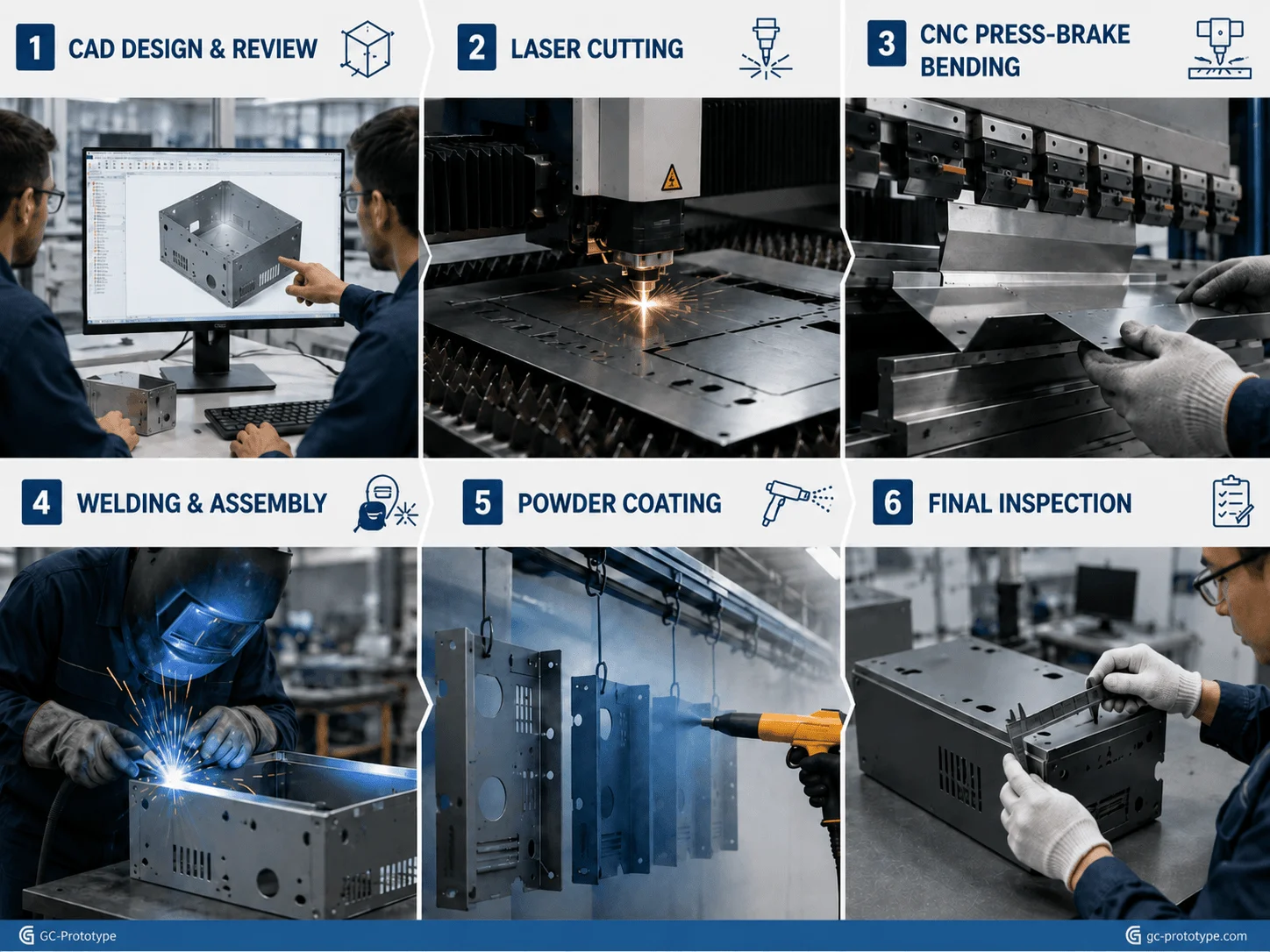
Application Scenarios of Sheet Metal Fabrication
Medical Equipment Enclosures
Medical equipment manufacturers use sheet metal fabrication for:
Diagnostic machine covers
Mobile medical carts
Laboratory cabinets
Instrument housings
Key requirements include:
Cleanability
Durability
Corrosion resistance
Precise assembly
Stainless steel fabrication is often preferred when equipment requires frequent cleaning or exposure to chemicals.
Industrial Automation Systems
Automation companies frequently require custom fabricated structures.
Examples include:
Robot safety enclosures
Control cabinets
Machine covers
Sensor brackets
Equipment frames
Because automation projects are often customized, sheet metal provides the required flexibility.
Robotics Applications
Robotics manufacturers use sheet metal components for:
Protective covers
Electrical cabinets
Structural supports
Mounting brackets
Lightweight aluminum structures can reduce robot weight while maintaining sufficient rigidity.
Electronics and Smart Hardware
Sheet metal fabrication supports:
Server chassis
Control boxes
Communication equipment
Power-system enclosures
Designers can combine:
Laser-cut panels
Bent structures
Insert hardware
Surface finishing
to create professional-looking products.
Aerospace Ground Equipment
Aerospace companies use sheet metal parts for:
Testing equipment
Support frames
Covers
Instrument structures
The ability to create lightweight but strong structures makes sheet metal attractive for aerospace support applications.
How to Select a Sheet Metal Fabrication Supplier
Choosing the right supplier directly affects quality, cost, and delivery performance.
A capable sheet metal supplier should provide:
Engineering support
Laser cutting capability
CNC bending
Welding expertise
Surface finishing
Inspection capability
Low-volume production experience
Evaluate Manufacturing Capability
Ask suppliers about:
Maximum sheet size
Material capability
Thickness range
Bending capacity
Welding capability
Finishing options
A supplier experienced with prototypes may provide better support during early development.
A supplier focused only on mass production may not be flexible enough for engineering changes.
Review Quality Control Process
Important quality systems include:
Incoming material inspection
First article inspection
Dimensional verification
Weld inspection
Final assembly checks
For critical applications, request:
Inspection reports
Material certificates
Traceability documents
Provide Complete RFQ Information
For accurate quotation, provide:
3D CAD files
2D drawings
Material specification
Thickness
Quantity
Surface finish
Welding requirements
Hardware requirements
Inspection expectations
A complete RFQ helps suppliers avoid assumptions and provides more accurate pricing.
Frequently Asked Questions About Sheet Metal Fabrication
What Is Sheet Metal Fabrication?
Sheet metal fabrication is a manufacturing process that transforms flat metal sheets into functional components through cutting, bending, joining, and finishing.
It is commonly used for enclosures, brackets, frames, cabinets, and structural parts.
Is Sheet Metal Fabrication Suitable for Prototypes?
Yes.
Sheet metal fabrication is one of the best options for functional prototypes because it provides:
Real production materials
Low tooling requirements
Fast design changes
Short lead times
What Materials Can Be Used for Sheet Metal Parts?
Common materials include:
Aluminum
Stainless steel
Mild steel
Galvanized steel
Copper alloys
The best choice depends on strength, weight, corrosion resistance, and cost requirements.
Is Laser Cutting Better Than Stamping?
Neither process is universally better.
Laser cutting is better for:
Prototypes
Low volume
Design changes
Stamping is better for:
Large production quantities
Stable designs
Lowest possible unit cost
How Does Sheet Thickness Affect Cost?
Thicker materials usually increase:
Material cost
Cutting time
Bending force requirements
Shipping weight
However, increasing thickness is not always the best way to improve strength. Structural design improvements can often achieve better results.
What Is the Recommended Bend Radius?
The recommended bend radius depends on:
Material
Thickness
Tooling
Mechanical requirements
Engineers should avoid extremely tight bends unless required because they may increase manufacturing difficulty.
Can Sheet Metal Parts Be Painted or Powder Coated?
Yes.
Common finishes include:
Powder coating
Painting
Anodizing
Brushing
Polishing
The correct finish depends on appearance, environment, and durability requirements.
How Can Sheet Metal Fabrication Costs Be Reduced?
Costs can be reduced by:
Simplifying bends
Using standard thicknesses
Reducing unnecessary welding
Optimizing material usage
Applying realistic tolerances
Choosing the right production process
Sheet metal fabrication remains one of the most practical manufacturing solutions for companies developing new products, customized equipment, and low-volume production parts. Its biggest advantage is the combination of design flexibility, low tooling investment, fast production turnaround, and excellent scalability.
Compared with traditional manufacturing methods such as stamping or injection molding, flexible sheet metal fabrication allows engineering teams to validate designs earlier while reducing financial risk.
For early-stage product development, the ability to quickly manufacture:
Prototype enclosures
Structural brackets
Machine covers
Medical equipment housings
Industrial automation components
provides valuable advantages during testing and customer validation.
A successful sheet metal manufacturing strategy depends on several key decisions:
Selecting the correct material
Designing practical bend features
Controlling tolerances
Optimizing welding locations
Choosing appropriate surface finishes
Matching production methods with expected volume
For prototypes and low-volume production, laser cutting combined with CNC bending often provides the best balance between speed, cost, and flexibility.
For mature products with predictable demand, stamping may become more economical because tooling investment can be distributed across thousands of parts.
The most effective approach is not choosing the cheapest manufacturing process at the beginning. It is selecting the process that supports the entire product lifecycle.
A professional sheet metal partner should help engineers optimize:
Manufacturing design
Material selection
Production cost
Quality requirements
Assembly efficiency
By applying DFM principles early, companies can avoid unnecessary manufacturing costs and accelerate product launches.
Whether you are developing medical equipment, industrial automation systems, robotic platforms, or customized electronic hardware, flexible sheet metal fabrication provides a reliable path from prototype to production.
Turn your sheet metal design into production-ready parts without expensive tooling investment. Whether you are a Mechanical Engineer validating a new enclosure design or a Sourcing Manager searching for a reliable fabrication partner, GC Prototype provides professional sheet metal manufacturing solutions.