Address:
Shenzhen Bao'an District Xinqiao Subdistrict Huangpu Community Huangpu East Ring Road No. 504 Shenzhen Yuan Industrial City Building C
Work Hours:
Monday to Friday: 9AM - 21PM
Weekend: 9AM - 21PM

Address:
Shenzhen Bao'an District Xinqiao Subdistrict Huangpu Community Huangpu East Ring Road No. 504 Shenzhen Yuan Industrial City Building C
Work Hours:
Monday to Friday: 9AM - 21PM
Weekend: 9AM - 21PM

EDM Surface Treatment is a critical manufacturing solution when conventional CNC cutting tools cannot efficiently machine hardened materials, narrow deep ribs, sharp internal features, or complex mold cavities. During New Product Introduction (NPI), engineers often need more than dimensional accuracy—they also need predictable mold textures, controlled surface integrity, and a cost-effective method for finishing difficult geometry. Electrical Discharge Machining (EDM) uses controlled electrical sparks rather than direct tool contact, enabling precision surface generation on electrically conductive materials that may be difficult to machine mechanically.
For Senior Mechanical Engineers, Product Designers, Manufacturing Engineers, and Sourcing Managers, the real challenge is balancing surface roughness, white-layer control, dimensional accuracy, machining time, manual polishing, and total manufacturing cost. This guide covers medical applications, EDM texture standards, Wire EDM roughness, cost optimization, quality control, procurement strategy, and industrial use cases.
What Is EDM Surface Treatment?
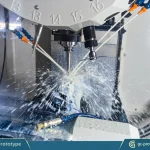
EDM removes material through a sequence of controlled electrical discharges between an electrode and an electrically conductive workpiece. The electrode and workpiece do not need conventional cutting contact. Instead, sparks generated across a small dielectric gap locally melt and vaporize microscopic areas of material.
Because cutting forces are extremely low compared with milling or grinding, EDM is especially valuable for hardened tool steels, carbide-related applications, high-strength alloys, delicate features, and mold geometries that are difficult to reach with conventional cutting tools.
Three EDM approaches are particularly relevant to precision manufacturing:
1.Sinker EDM for cavities, ribs, mold details, and electrode-replicated geometry
2.Wire EDM for precision profiles, slots, inserts, punches, and through-features
3.Small-hole EDM for starter holes and deep precision openings
Surface quality depends strongly on discharge energy. Aggressive roughing parameters remove material quickly but generally produce a rougher surface. Fine finishing passes use lower-energy pulses to reduce crater size and improve surface roughness.
This makes EDM more than simply a material-removal process. By carefully controlling the finishing parameters, manufacturers can create specific surface appearances and functional textures directly on molds and precision components.
Typical applications include:
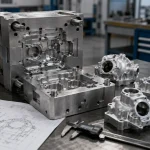
Injection mold cavities
Die-casting tooling
Medical instrument components
Aerospace tooling
Precision inserts
Punches and dies
Electronics molds
Automotive tooling
Robotic and automation components
EDM is particularly useful when a design contains narrow ribs or deep recesses that would otherwise require extremely small milling cutters. Such tools can deflect, wear quickly, or become impossible to use at extreme depth-to-width ratios.
For this reason, many mold manufacturers combine CNC machining and EDM. CNC removes accessible material efficiently, while EDM completes hardened, deep, narrow, or highly detailed areas.
EDM Surface Treatment vs Conventional Machining
| Factor | EDM Surface Treatment | CNC Milling / Grinding |
|---|---|---|
| Cutting Contact | Non-contact spark erosion | Physical cutting contact |
| Material Hardness | Handles hardened conductive materials well | Tool wear increases with hardness |
| Deep Narrow Features | Excellent | Tool accessibility can be difficult |
| Internal Sharp Details | Strong capability | Limited by cutter radius |
| Material Removal Rate | Generally slower | Usually faster for accessible geometry |
| Surface Control | Adjustable through discharge parameters | Controlled by tool and cutting conditions |
| Tool Force | Very low | Mechanical cutting force present |
| Typical Role | Precision finishing and difficult geometry | Primary material removal |
An efficient manufacturing plan therefore does not necessarily choose one process over the other. It allocates each feature to the most economical process.
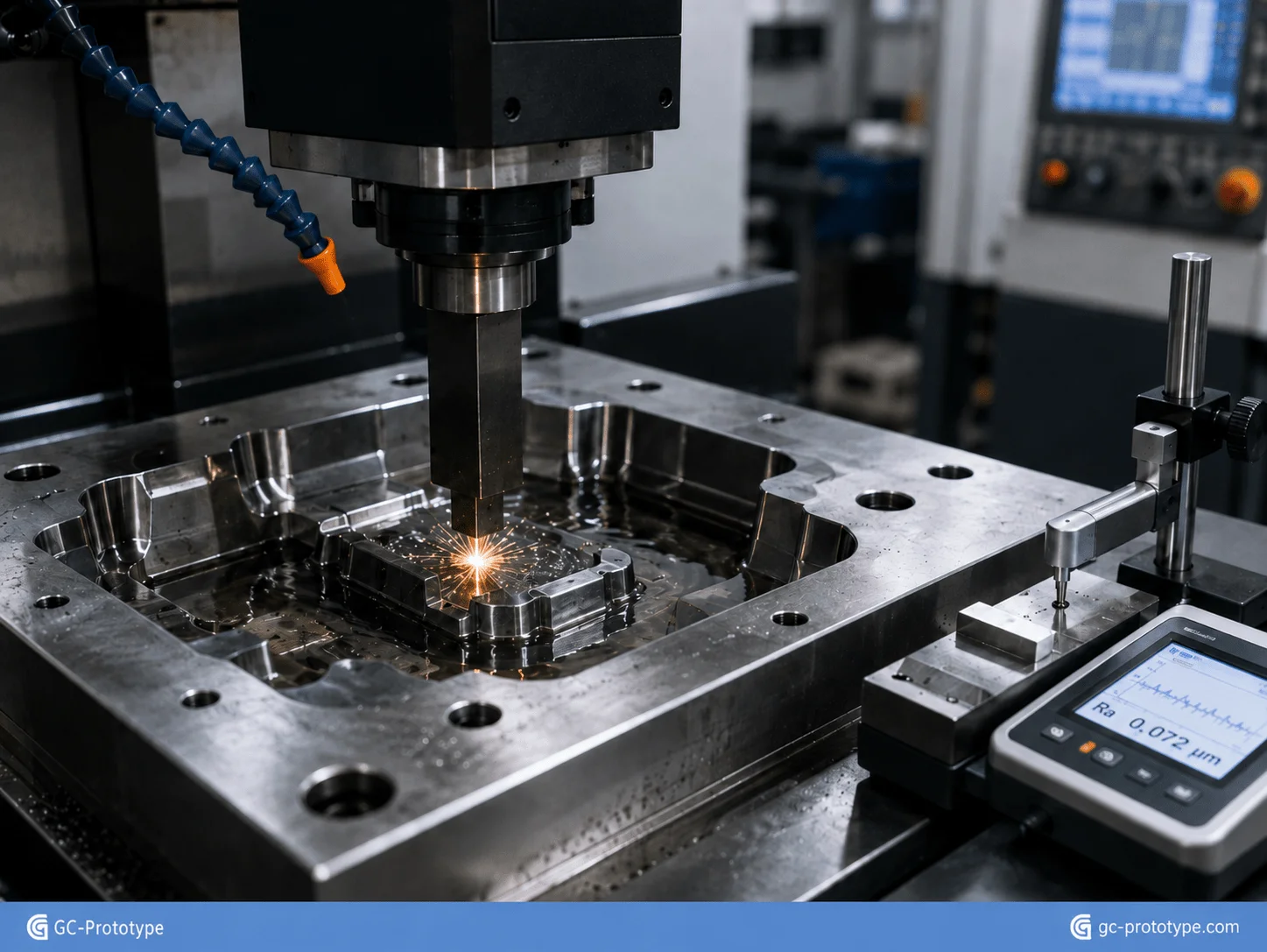
Industry Applications & Material Compliance
EDM is widely used wherever electrically conductive materials require complex geometry or precision after hardening. The technology is particularly important in mold manufacturing because the final EDM surface may be transferred directly to thousands of molded production components.
Consumer electronics companies use EDM for narrow mold ribs, speaker openings, connector details, battery housings, and textured enclosure cavities. Automotive manufacturers use the process for dies, precision tooling, connector molds, and hardened inserts. Aerospace and industrial-equipment companies use EDM to process difficult alloys and geometries that challenge conventional machining.
Medical manufacturing introduces additional surface-integrity considerations.
Medical Innovation: Applying biocompatible surface finish for medical edm parts
Applying a biocompatible surface finish for medical edm parts requires much more than achieving a low Ra value. Medical R&D teams must consider material chemistry, corrosion behavior, recast material, microcracks, contamination, cleaning, passivation or other post-processing, and the intended biological interaction of the finished component.
Possible applications include:
Minimally invasive surgical instrument features
Precision gripping ends
Orthopedic tooling
Surgical cutting-tool components
Medical mold inserts
Microstructured conductive components
Prototype implant-related manufacturing tools
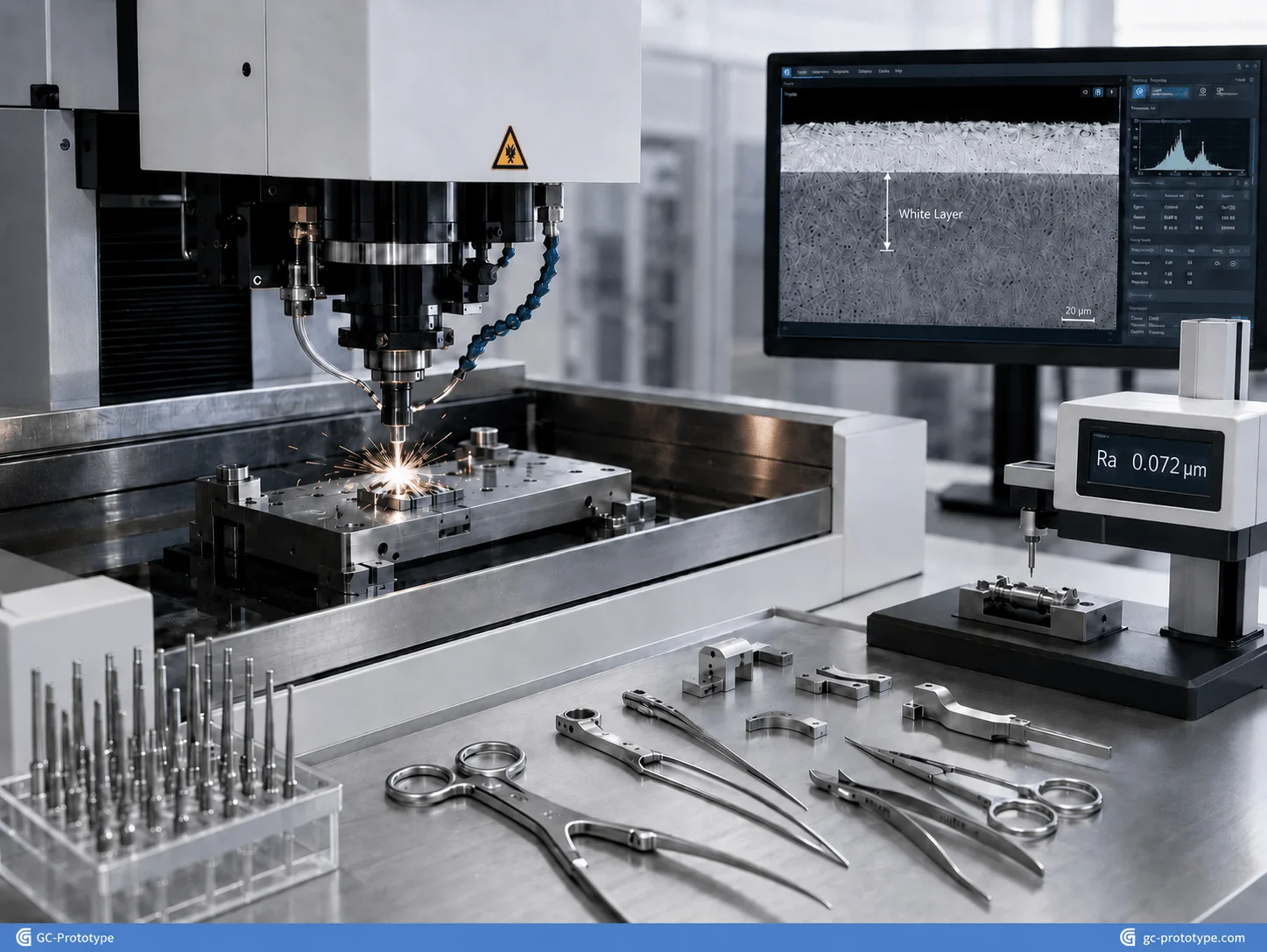
During EDM, localized melting and rapid resolidification can form a recast or altered surface region commonly referred to as a white layer. Its thickness and properties depend on discharge energy, pulse parameters, electrode or wire conditions, dielectric performance, flushing, and finishing strategy.
A heavy roughing pass may leave a thicker affected layer than a controlled finishing sequence. When surface integrity is critical, manufacturers may therefore use multiple finishing passes, followed by appropriate cleaning, polishing, grinding, passivation, or another validated secondary process.
For medical applications, this is important because surface integrity can affect corrosion resistance, fatigue behavior, cleanliness, and subsequent coating or finishing.
However, EDM itself should not be treated as proof of medical biocompatibility. Biocompatibility depends on the complete material and finished-device system, including the base alloy, processing history, contaminants, cleaning method, surface treatment, sterilization, and intended contact conditions.
Medical engineering teams should therefore define:
Base material specification
Final Ra requirement
White-layer acceptance criteria where relevant
Burr and microcrack requirements
Cleaning requirements
Corrosion requirements
Inspection method
Post-EDM finishing
Intended functional or biological contact
Quality requirements should be documented at the drawing and process-planning stage rather than added after manufacturing.
Process Trade-Offs & Surface Quality
EDM surface quality is closely tied to processing time. High-energy roughing removes material efficiently but creates larger discharge craters. Fine finishing reduces crater depth and surface roughness but requires additional machine time.
This relationship creates an important engineering and purchasing question: how smooth does the surface actually need to be?
Specifying the lowest achievable Ra on every feature can significantly increase cost without improving product performance.
Cost Breakdown: edm surface treatment vs manual polishing cost
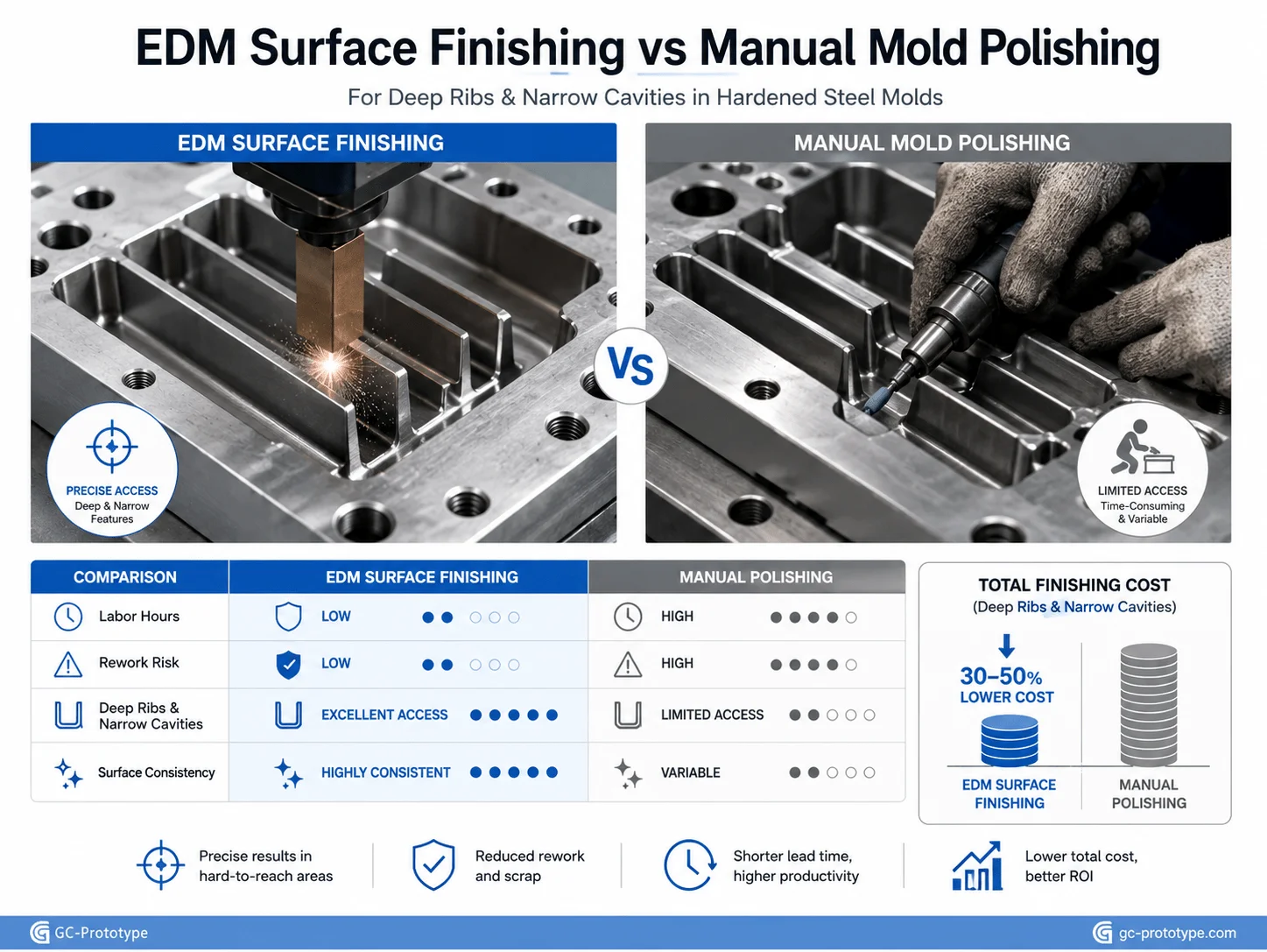
A practical edm surface treatment vs manual polishing cost comparison should consider total labor rather than only EDM machine-hour rates.
Manual polishing remains valuable for mirrors, cosmetic surfaces, blending, and final localized corrections. However, polishing narrow slots, deep ribs, complex cavities, and inaccessible internal geometry can require many skilled labor hours.
Human polishing also introduces variation. Two technicians may remove slightly different amounts of material, particularly around edges, radii, parting surfaces, or precision mold details.
EDM finishing can reduce this dependency by producing a controlled spark texture directly from the machine.
| Cost Factor | EDM Surface Finishing | Manual Polishing |
|---|---|---|
| Machine / Labor Rate | Higher machine cost | Skilled labor intensive |
| Deep Narrow Cavities | Excellent accessibility | Difficult |
| Repeatability | High with stable parameters | Operator-dependent |
| Complex Ribs | Strong capability | Time-consuming |
| Edge Geometry | Controlled without hand pressure | Risk of edge rounding |
| Mirror Finishing | May require secondary polishing | Very effective |
| Batch Tool Consistency | Strong | Depends on technician |
| Rework Risk | Lower with validated process | Higher on complex details |
Consider a mold insert containing twenty narrow ribs. CNC machining can rough the geometry, while Sinker EDM creates the final depth and texture. Attempting to hand-polish each rib may require extensive skilled labor and may round critical edges.
In such a situation, even if the EDM finishing cycle has a higher hourly machine rate, total project cost may be lower because manual work is reduced.
The opposite can also be true. If only one large, accessible flat surface requires a cosmetic polish, manual finishing may remain the more economical option.
The correct comparison should include:
Total finishing cost = EDM machining + electrode/wire + setup + inspection + manual finishing + rework risk
rather than simply comparing an EDM hourly rate against a technician’s hourly wage.
Where EDM Provides the Strongest Cost Advantage
EDM finishing becomes particularly valuable when:
Cavities are deep
Ribs are narrow
Hardened steel is already heat treated
Geometry is difficult to reach manually
Edges must remain dimensionally controlled
Multiple identical mold inserts need consistent texture
Manual polishing would require excessive time
Procurement teams should request quotations based on the functional surface requirement rather than simply demanding “best possible EDM finish.”
Mold Texture Standards & Aesthetic Control
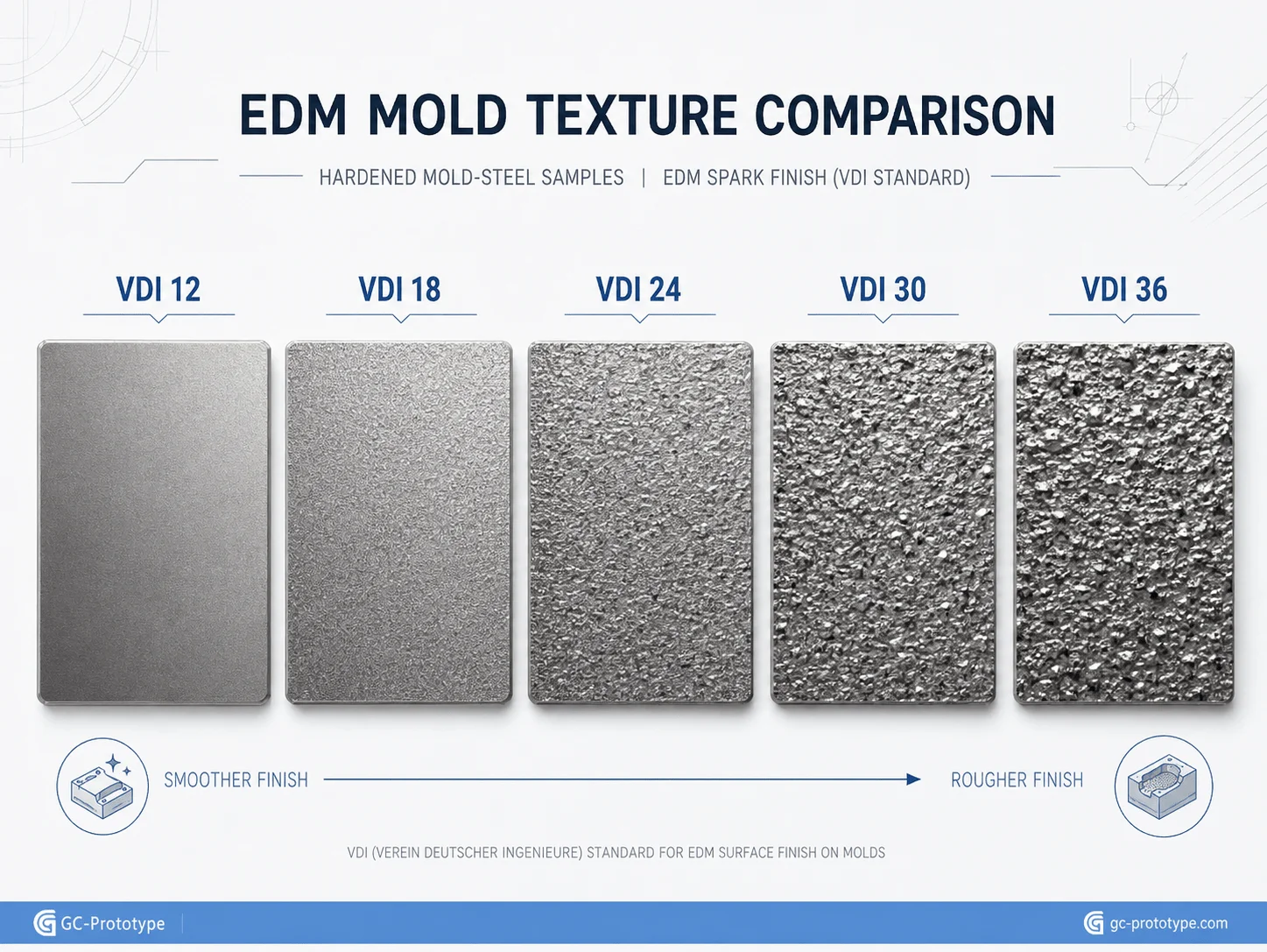
Aesthetic Excellence: Standardizing with edm surface finish vdi 3400 standard
Using an edm surface finish vdi 3400 standard reference gives Product Designers, Mold Engineers, and Industrialization Engineers a practical language for discussing spark-eroded surface textures.
VDI 3400 texture references are widely associated with EDM-style surface roughness and visual appearance. Different levels correspond to progressively different surface textures, allowing engineering and design teams to specify a target appearance rather than relying on vague terms such as “slightly matte.”
The exact surface achieved depends on machine technology, material, electrode condition, discharge settings, and subsequent processing, so sample comparison remains important for cosmetic products.
Typical references may include lower VDI values for relatively fine spark finishes and higher levels for increasingly coarse matte textures.
| VDI Reference | General Surface Character | Typical Application |
|---|---|---|
| VDI 12 | Fine EDM texture | Precision mold details |
| VDI 18 | Fine matte | Consumer electronics |
| VDI 24 | Medium matte | Industrial housings |
| VDI 30 | Coarser texture | Functional grips |
| VDI 36 | Rough matte | Heavy industrial texture |
These descriptions should be treated as practical visual guidance rather than a substitute for an approved physical sample.
One major advantage of direct EDM texturing is process consolidation. A mold cavity may already require EDM because of its depth or geometry. Instead of machining the cavity and then sending the tool through a separate chemical texturing step, the EDM finishing process may create the required spark texture directly.
This can reduce:
Additional supplier handling
Transportation between processes
Masking requirements
Chemical texturing lead time
Risk of texture entering unwanted areas
Localized EDM textures are particularly useful when only specific areas need controlled matte surfaces.
For example, an electronics enclosure mold might require a fine spark texture on the visible shell while maintaining polished sealing features and precision shutoff surfaces elsewhere.
Designing Mold Textures for Consumer Electronics
Consumer electronics and smart hardware frequently use matte finishes to reduce fingerprint visibility and create a premium appearance.
Surface quality must still be coordinated with mold release. A deeper texture can increase friction during ejection and may require greater draft.
Product Designers should therefore define texture requirements during DFM rather than after tool completion.
Important design inputs include:
Cosmetic surface zones
VDI reference
Draft angle
Parting-line location
Gate position
Resin
Color
Gloss requirement
Texture transition areas
A physical texture plaque can be useful before production tooling begins. It allows industrial designers, engineering teams, and suppliers to approve the actual appearance under realistic lighting instead of relying solely on a numerical specification.
Procurement Strategy & Surface Roughness Control
Financial Edge: Controlling wire edm surface roughness ra values
Controlling wire edm surface roughness ra values is one of the clearest examples of how engineering specifications directly affect procurement cost.
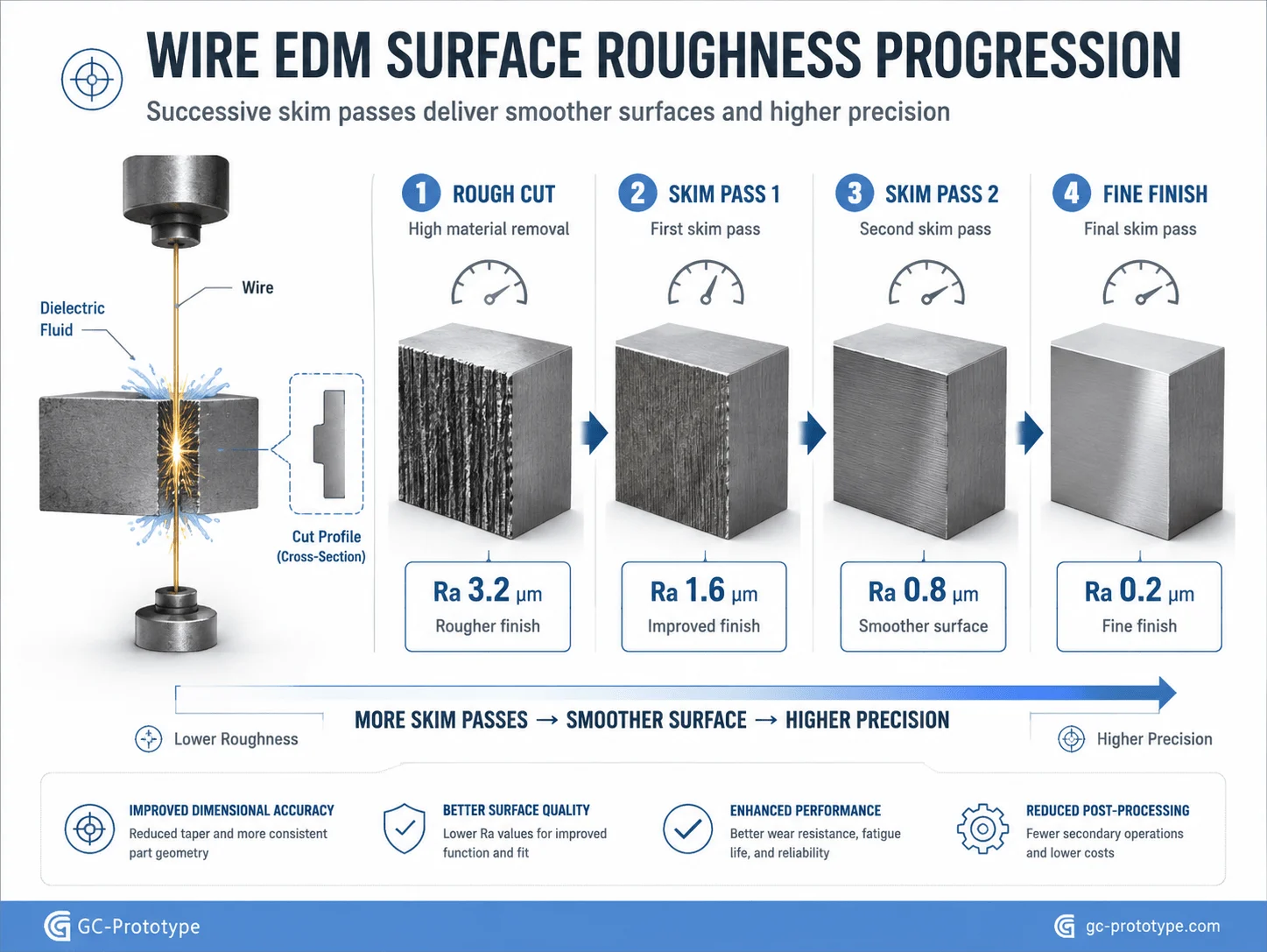
Wire EDM normally uses a continuously moving wire electrode to cut electrically conductive material. Rough cutting removes material efficiently, while subsequent skim or trim passes improve geometry and surface quality.
The outline target of approximately Ra 0.2–0.8 µm represents a fine-finish range that may require multiple controlled passes depending on the machine, material, height, wire, flushing conditions, and accuracy requirement.
Each additional skim pass adds machine time.
Therefore, a drawing that specifies an unnecessarily fine Ra across an entire component can increase cost substantially.
For example, a stamping insert might contain:
One precision sliding surface
Two mating edges
Several clearance walls
Nonfunctional external surfaces
Only the sliding and critical mating surfaces may need the finest finish. Applying the same Ra requirement to every cut surface wastes capacity without improving function.
Rough Cut vs Multiple Skim Passes
A typical Wire EDM strategy may progress from:
Rough cut → first skim → second skim → fine finishing pass
Each stage reduces surface irregularity and can improve dimensional performance.
However, surface roughness and tolerance are related but not identical. A smoother surface does not automatically guarantee perfect geometry, and a dimensionally accurate feature does not necessarily require the finest achievable finish.
The drawing should therefore separate:
Dimensional tolerance
Geometric tolerance
Surface roughness
Edge requirements
Functional mating zones
Procurement Cost Implications
| Requirement | Processing Effect | Cost Impact |
|---|---|---|
| Standard rough EDM cut | Fewer passes | Lowest |
| Improved finish | Additional skim pass | Moderate |
| Fine Ra requirement | Multiple skim passes | Higher |
| Very tight dimensional tolerance | Additional process control | Higher |
| Fine finish + tight tolerance | Maximum machine time | Highest |
A Strategic Buyer should therefore ask the engineering team three questions before approving a high-cost Wire EDM specification:
1.Is the Ra requirement functionally necessary?
2.Which surfaces actually need it?
3.Can noncritical areas use a more economical EDM finish?
This type of tolerance optimization can reduce unit cost without changing the design.
Other Factors Affecting Wire EDM Cost
Machine time is also influenced by:
Material thickness
Cut length
Material type
Number of internal profiles
Threading frequency
Required corner accuracy
Taper angles
Surface finish
Number of skim cuts
A thick hardened-steel insert with multiple precision openings naturally requires more machine time than a thin plate with one simple profile.
Procurement teams should compare quotations using identical technical requirements. Otherwise, a lower price may simply reflect fewer finishing passes or a looser interpretation of surface quality.
EDM DFM Guidelines for Better Surface Quality
EDM is flexible, but design decisions still influence machine time, electrode complexity, surface integrity, and total cost.
Avoid Unnecessarily Deep Narrow Features
Deep ribs are a major reason engineers select EDM, but extreme depth-to-width ratios increase flushing difficulty and machining time.
If a rib can be slightly widened without affecting product function, manufacturing may become more stable and economical.
Separate Roughing and Finishing Requirements
Not every feature requires the same EDM parameters.
Engineering drawings should distinguish rough cavity surfaces from cosmetic, sealing, mating, or precision surfaces.
Consider Electrode Access
Sinker EDM requires an electrode capable of reaching the target geometry. Complex cavities may need several graphite or copper electrodes for roughing, semi-finishing, and finishing.
Each electrode adds:
Electrode material
CNC electrode machining
Measurement
Setup
Alignment
Machine time
Reducing unnecessary complexity can lower tooling cost.
Specify Corner Requirements Realistically
EDM can achieve tight internal details, but electrodes and Wire EDM still have practical corner-radius limitations.
Very sharp corner requirements can increase machining time and may require specialized strategies.
Plan Surface Finishing Before Heat Treatment
The most efficient process sequence should be established before manufacturing begins.
A typical mold insert workflow might include:
1.CNC rough machining
2.Heat treatment
3.Precision grinding
4.Sinker or Wire EDM
5.Fine EDM finishing
6.Local polishing if required
7.Inspection
Changing surface requirements after EDM can create unnecessary rework.
Quality Inspection for EDM Surface Treatment
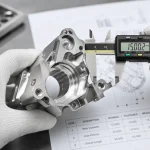
A professional EDM quality plan should verify both dimensional geometry and surface integrity.
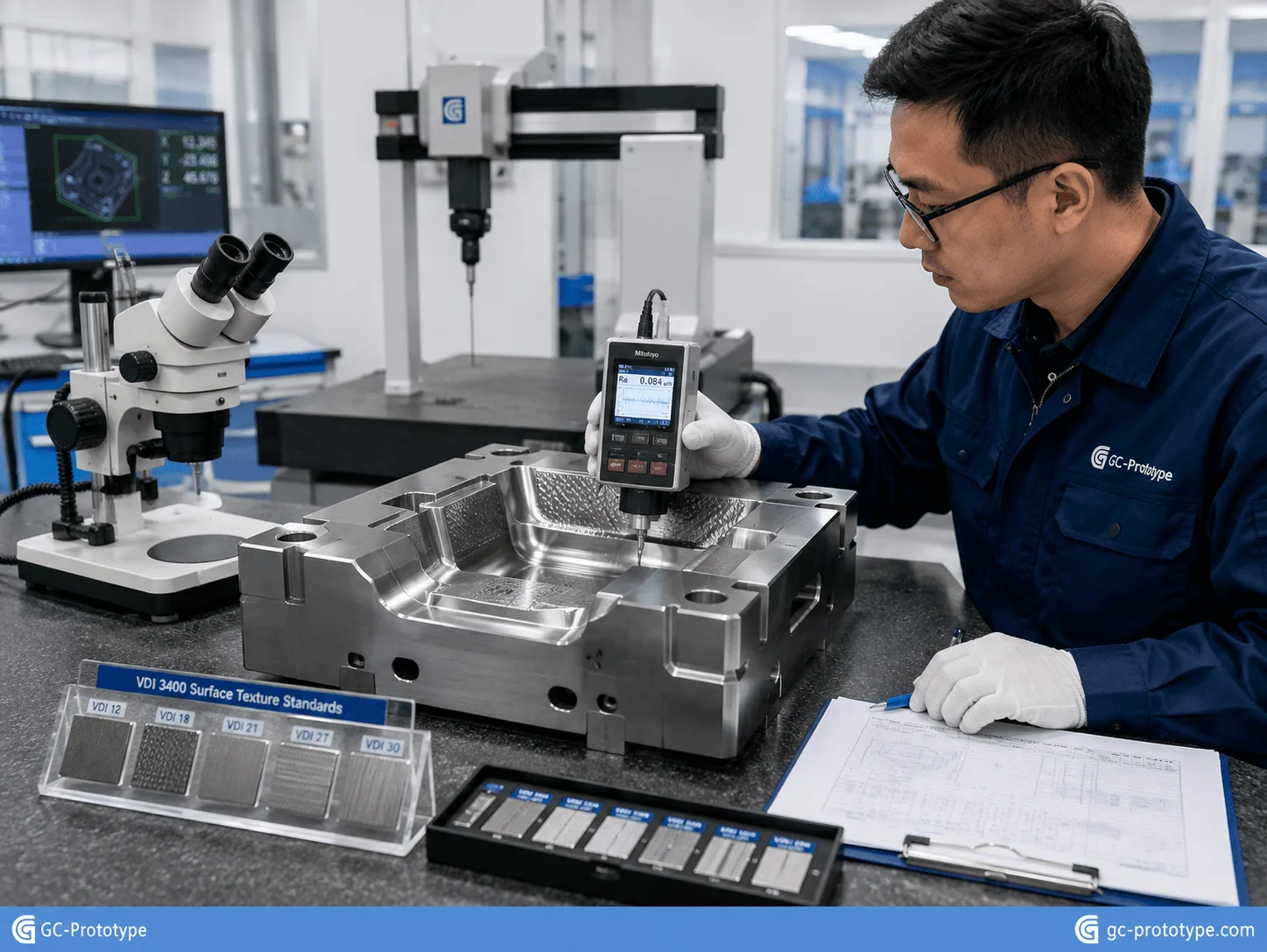
Common inspection methods include:
Surface roughness measurement
Optical microscopy
CMM measurement
Toolmaker microscope inspection
Profile measurement
Visual texture comparison
Edge inspection
Surface roughness instruments can measure Ra and other parameters depending on the drawing requirement.
For mold textures, visual uniformity is also important. Two surfaces may have similar measured roughness while appearing different because of directional marks, crater distribution, or polishing.
For critical medical or high-performance components, inspection may also evaluate recast-layer condition, microcracks, contamination, corrosion performance, or other application-specific requirements.
A well-defined quality specification prevents suppliers from over-processing unimportant areas while protecting the surfaces that directly affect component performance.
Application Scenarios for EDM Surface Treatment
Medical Instrument Tooling
A medical R&D team develops a hardened stainless or tooling component with narrow gripping details that are difficult to finish mechanically. EDM creates the geometry, followed by controlled finishing and inspection to manage the altered surface layer.
Consumer Electronics Mold
A Product Designer needs a uniform matte appearance on a smart-device enclosure. Sinker EDM creates the deep cavity geometry while controlled finishing establishes a repeatable VDI-style spark texture.
Automotive Connector Mold
An automotive supplier requires hardened mold inserts containing narrow ribs and detailed connector features. EDM completes geometry that would be difficult for long, small-diameter milling cutters.
Aerospace Precision Tooling
An aerospace tooling supplier uses Wire EDM to cut hardened inserts and precision profiles. Surface requirements are assigned only to critical functional areas to control machine time.
Robotics and Industrial Automation
A robotics manufacturer requires precision hardened components, dies, fixtures, or tooling with narrow slots and accurate profiles. Wire EDM provides a stable non-contact manufacturing method without introducing conventional cutting forces.
How to Select an EDM Manufacturing Supplier
An experienced EDM supplier should provide more than machine capacity. Engineering support is essential because electrode design, pulse strategy, flushing, roughness specifications, and post-processing directly influence both surface quality and cost.
Important capabilities include:
Sinker EDM
Wire EDM
Small-hole EDM
CNC electrode machining
Graphite and copper electrode expertise
Hardened tool-steel machining
Surface roughness measurement
CMM inspection
Mold finishing
Manual polishing
DFM engineering
When requesting a quotation, provide:
3D CAD files
2D technical drawings
Material specification
Heat-treatment condition
Critical dimensions
Required Ra
VDI texture requirement
White-layer requirement where applicable
Cosmetic zones
Quantity
Inspection requirements
Avoid requesting “best possible surface finish” without specifying function. This can encourage unnecessary finishing passes and increase cost.
A better RFQ identifies exactly which surfaces require fine EDM, which need texture, and which can remain at a standard machine finish.
Frequently Asked Questions
What Is EDM Surface Treatment?
EDM surface treatment uses controlled electrical discharges to remove material and generate precision surfaces on electrically conductive components. It is widely used for hardened mold steel, precision tooling, narrow cavities, and complex profiles.
What Is the VDI 3400 Standard Used For?
VDI 3400 references are commonly used to communicate spark-eroded mold textures and different levels of surface roughness. Physical reference samples are recommended for appearance-critical projects.
What Surface Roughness Can Wire EDM Achieve?
The achievable roughness depends on the machine, wire, material, workpiece height, discharge settings, flushing, and number of skim passes. The article outline highlights fine Wire EDM requirements around Ra 0.2–0.8 µm, which may require multiple finishing passes.
Does Better Wire EDM Surface Finish Increase Cost?
Yes. Finer surfaces generally require additional skim passes and longer machine time. Engineers should specify the finest finish only where it provides functional value.
Is EDM Better Than Manual Polishing?
It depends on the geometry and required finish. EDM can be highly economical for deep ribs, narrow cavities, and repeatable textures, while manual polishing remains valuable for selected mirror finishes and accessible cosmetic surfaces.
Can EDM Be Used for Hardened Steel?
Yes. EDM is particularly useful for electrically conductive materials after heat treatment because the process does not rely on conventional cutting hardness relationships.
What Is the White Layer in EDM?
The white layer is a recast or thermally altered surface region created by localized melting and rapid resolidification during EDM. Its condition depends on processing parameters and may need control for critical applications.
Is an EDM Surface Automatically Biocompatible?
No. Medical biocompatibility depends on the complete material, manufacturing, cleaning, surface-finishing, sterilization, and device-use conditions. EDM is only one part of the manufacturing process.
How Can EDM Surface Treatment Costs Be Reduced?
Use CNC machining for accessible bulk material removal, reserve EDM for difficult geometry, avoid unnecessary ultra-low Ra requirements, limit fine finishing to functional surfaces, and define surface requirements clearly before production.
What Information Is Required for an EDM Quote?
Provide CAD models, drawings, material, hardness, quantity, tolerances, surface roughness, VDI texture requirements, critical surfaces, post-processing requirements, and inspection expectations.
EDM Surface Treatment provides a unique combination of precision geometry, hardened-material capability, and controlled surface generation for molds and high-value engineering components. Its greatest advantage appears where conventional machining, chemical texturing, or manual polishing becomes difficult, inconsistent, or labor-intensive.
For medical tooling, consumer-electronics molds, automotive inserts, aerospace components, and industrial machinery, the most economical EDM strategy is not necessarily the smoothest possible surface. It is the surface specification that satisfies the actual functional requirement with the fewest unnecessary machine passes.
Engineers should therefore coordinate EDM texture, Wire EDM Ra, altered-layer control, dimensional tolerances, post-processing, and inspection during the DFM stage. Procurement teams should evaluate total finishing cost rather than machine-hour price alone.
Achieving production-grade surface textures on hardened alloys shouldn’t inflate your prototyping budget. Whether you are a Senior Mechanical Engineer designing intricate medical tooling or a Sourcing Manager evaluating EDM vs manual polishing costs, GC Prototype delivers.